Two quakes minutes apart jolt Venezuela, topple buildings in Caracas
Two strong earthquakes struck Venezuela within minutes of each other on Wednesday, collapsing buildings in Caracas and prompting an emergency response from a country already deep in political and economic crisis.
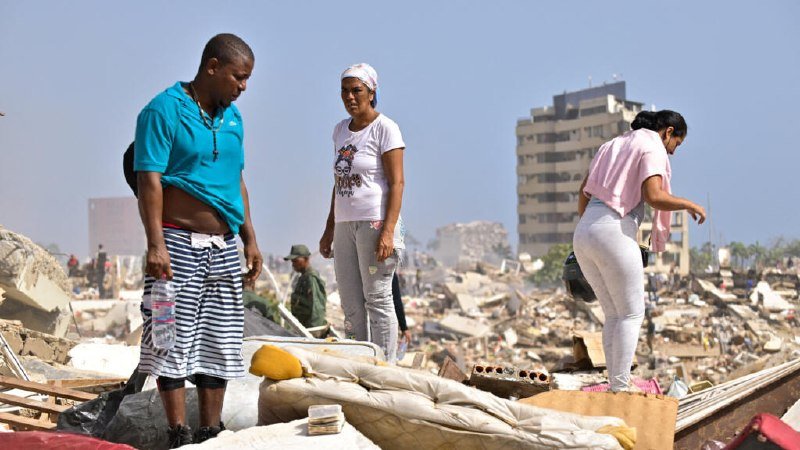
Two powerful earthquakes struck Venezuela within minutes of each other on Wednesday, 25 June 2026, toppling buildings in the capital Caracas and jolting a country whose public infrastructure is already hollowed out by years of economic and political crisis. The United States Geological Survey measured the principal shock at magnitude 7.1, located roughly 21 kilometres from the city of Morón, in Carabobo state, at a depth of about 13 kilometres — parameters that place it firmly in the category of quakes capable of serious structural damage (USGS, via France 24, 25 June 2026; CubaDebate, 25 June 2026 01:14 UTC).
For Caracas, more than 100 kilometres from the epicentre, the ground motion was enough to bring down buildings and send residents into the streets, according to France 24's reporting on the event (France 24, 25 June 2026 00:13 UTC). The seismic sequence — two strong shocks in quick succession — is the kind of pattern that typically multiplies damage, because structures weakened by the first wave collapse when the second arrives.
What is known so far
The initial USGS bulletin places the main shock near Morón, in north-central Venezuela, with the first reports of building collapses concentrated in Caracas. France 24's wire account, published at 00:13 UTC on 25 June, describes the events as "back-to-back" earthquakes and reports damage to structures in the capital. The Cuban outlet CubaDebate, citing the USGS directly, confirmed the 7.1 magnitude and the 21-kilometre distance from Morón, and noted the shallowness of the event at roughly 13 kilometres deep — a depth range that tends to amplify shaking at the surface (CubaDebate, 25 June 2026 00:35 UTC and 01:14 UTC; France 24, 25 June 2026 00:36 UTC).
As of the first bulletins reviewed by Monexus, casualty figures, building inventories, and the exact count of collapsed structures had not been disclosed in the source material. The available reporting establishes the seismic parameters and the visible damage in Caracas; the human toll is still being compiled.
Why the depth and the doublet matter
A magnitude 7.1 event is, by itself, a major earthquake. Two factors make this sequence especially concerning. First, the USGS-measured depth of around 13 kilometres is shallow by global standards — shallow ruptures transmit more energy to the surface and tend to produce stronger shaking at greater distance, which is consistent with reports of building collapses in Caracas, well over 100 kilometres from the epicentre. Second, the doublet pattern — two strong shocks in rapid succession — is the worst-case input for already-stressed structures. A building that survives the first wave with hidden damage is, in many cases, a building that does not survive the second.
This is also a country whose housing stock includes large numbers of informally constructed buildings, often without engineering oversight. In a Caracas still marked by years of recession, hyperinflation, and emigration, the assumption that any given block of flats meets modern seismic code is not a safe one. The combination of shallow depth, doublet sequencing, and a vulnerable building stock is what turns a regional hazard into a national emergency.
Caracas as the operating environment
The earthquake arrives on top of a humanitarian and political baseline that is already stretched. Venezuela's public services, housing maintenance, and disaster-response capacity have been diminished by a protracted economic contraction and by the departure of millions of citizens over the past decade. Hospitals in Caracas operate under chronic shortages; the national electrical grid has shown repeated instability; and the state's ability to mount a coordinated urban search-and-rescue operation is constrained in ways that do not apply to most of its regional peers.
That matters for two reasons. First, the immediate rescue and triage phase is the period in which outcomes for trapped survivors are decided, and the speed and reach of the state response will shape the final casualty count. Second, the post-event phase — temporary shelter, food and water distribution, electricity restoration, damage assessment — depends on administrative capacity that has been visibly eroded. A 7.1 earthquake in Chile would be a major national event; a 7.1 earthquake in Venezuela lands on an institutional floor that is much closer to the ground.
Regional neighbours and partners will almost certainly be drawn in. The Caribbean basin has well-rehearsed mutual-aid protocols, and the Cuban civil defence system in particular has experience mobilising quickly for cross-border emergencies — relevant context given that CubaDebate, a Cuban state outlet, was among the first to carry the USGS parameters in Spanish-language wire form on 25 June (CubaDebate, 25 June 2026 00:35 UTC).
What remains uncertain
The source material reviewed for this article does not yet contain an official casualty toll, a damage inventory, or a formal national emergency declaration from the Venezuelan government. The USGS-measured parameters — 7.1 magnitude, 21 kilometres from Morón, depth around 13 kilometres — are the most solid numbers available. The reporting on collapsed buildings in Caracas comes from France 24's wire account and from CubaDebate's USGS-cited bulletin; the structural inventory of what exactly fell, and where, is still being assembled.
What this event will be remembered as depends on the figures that emerge in the next 24 to 72 hours: how many buildings, how many lives, and how quickly the state and its regional partners can convert the initial response into sustained relief. For now, the wire picture is clear on the seismology and clear on the visible damage in Caracas, and unclear on everything that follows.
Desk note: Monexus treated the USGS parameters and the France 24 wire account as the load-bearing facts in this story, with CubaDebate's Spanish-language bulletins serving as cross-references on the seismic measurements. Coverage will be updated as official casualty and damage figures become available.
Wire provenance
This editorial synthesis draws on the following public wire/social posts:
- https://t.me/CubaDebate/133514
- https://t.me/CubaDebate/133517
- https://t.me/france24_en/41128
- https://earthquake.usgs.gov/earthquakes/eventpage/us7000m9x2/executive