Mercedes one-two in Austrian GP first practice as Antonelli sets the early pace
Kimi Antonelli edged teammate George Russell at the Red Bull Ring on Friday, the first marker in a weekend where Mercedes will try to convert early pace into something harder to take away.
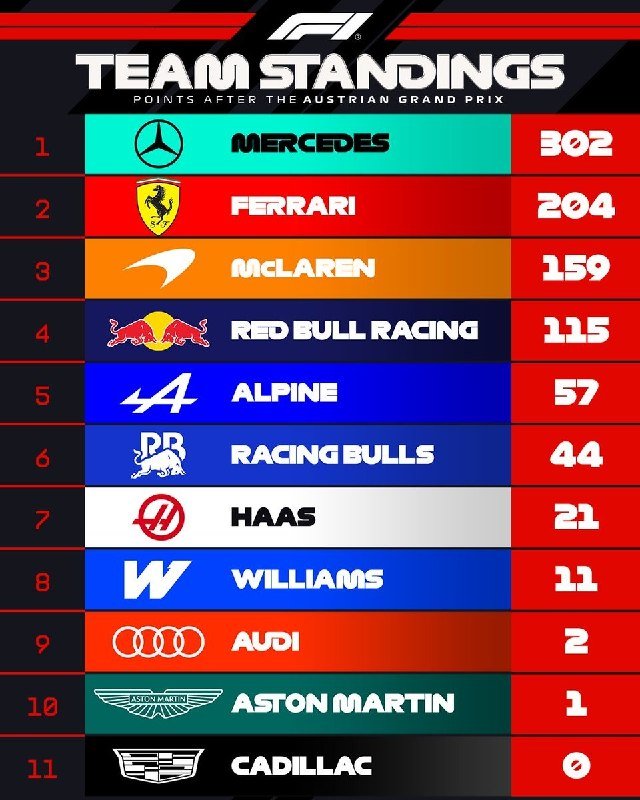
Kimi Antonelli set the fastest time of first practice at the Austrian Grand Prix on Friday, 26 June 2026, leading Mercedes teammate George Russell in a one-two at the Red Bull Ring in Spielberg. The session, reported by BBC Sport at 12:45 UTC, gave Mercedes the first benchmark of a weekend that arrives with the team's competitive position under quiet but real scrutiny.
The headline number matters less than the order behind it. In Spielberg, a circuit that rewards commitment through the final two sectors and punishes hesitation in the third, Mercedes produced two clean laps in conditions that will look familiar by Sunday. Whether that translates into qualifying pace and, more importantly, into race-trim degradation, is the question every team in the pit lane will be trying to answer before Saturday.
A circuit that flatters the brave
Spielberg is short, sharp, and unusually kind to a driver who trusts the front end. The Austrian Grand Prix compresses the calendar into a single afternoon of high-stakes work: Friday defines the working window, Saturday decides the grid, Sunday settles the championship arithmetic. Teams arrive knowing the margins are thin and the graining risks on the rear tyre are higher than at most circuits on the calendar. First practice is where those margins get their first airing.
For Antonelli, the Friday session carried a specific weight. The Italian is in the middle of a season in which his raw speed has rarely been the question; consistency across a race distance has been. A clean lap at the top of the timesheet, ahead of a teammate with Russell's race craft, is the kind of signal a young driver can carry into a Saturday without overreading it.
What the order actually tells us
A one-two in first practice is the most over-interpreted data point in motorsport. Fuel loads are unknown, engine modes are not, and teams routinely run different programmes within the same session. Read literally, the table says Antonelli was quickest and Russell was second. Read honestly, it says Mercedes looked comfortable on a single lap in ambient conditions that suited the car.
The competitive read requires Saturday's long runs. Red Bull, the home team, will be working in the other garage with the usual incentive that comes with a home race. Ferrari and McLaren, both of whom have shown flashes of single-lap speed at circuits with similar characteristics this season, will not treat Friday's table as a verdict. The session is a starting line, not a finish.
The teammate variable
Mercedes enters Spielberg with the unusual dynamic of two drivers who both need the weekend to go well and for different reasons. Russell, the established reference point, wants to convert the team's development curve into a result that defends his standing. Antonelli, still establishing himself, needs sessions like Friday's to compound — to turn pace into points and points into trajectory.
That dynamic tends to be quietly productive inside a top team and quietly corrosive when results go the other way. The risk for the principals in Brackley is not that the two drivers collide on track; it is that the team's development attention gets pulled in two directions at exactly the moment the constructors' championship starts to demand a single-minded push. Friday's session, tidy as it was, does not resolve that tension. It merely postpones it.
Stakes for the rest of the field
The rest of the field will have spent Friday evening doing the arithmetic that Formula 1 teams do better than any other sport. If Mercedes has genuinely found a step in single-lap trim, the upgrade path that delivered it has implications for the next three or four races, not just this one. If the table flatters Mercedes and the long runs tomorrow favour someone else, the championship picture tightens rather than opens.
What the session does not yet show — and what no Friday practice ever does — is who has managed the tyre window best. Spielberg punishes the team that gets the graining cycle wrong. That answer arrives on Saturday afternoon, in qualifying trim and on used rubber, when the drivers who looked anonymous in first practice often move forward and the drivers who topped the table sometimes do not.
The weekend is young. The numbers are early. The order is real; the meaning is not yet.
This publication framed Friday's session as a starting marker rather than a verdict, on the principle that first practice rewards single-lap commitment in ways that rarely survive contact with Saturday's long runs.