Tehran's Gulf charm offensive masks a sharper question: who gets to police the region's airspace?
A reported U.S.–Iran halt on Gulf strikes sits alongside a Tehran–Baghdad security memorandum whose airspace terms are nowhere in the text. The diplomatic choreography is real; the regional mandate it implies is not yet settled.
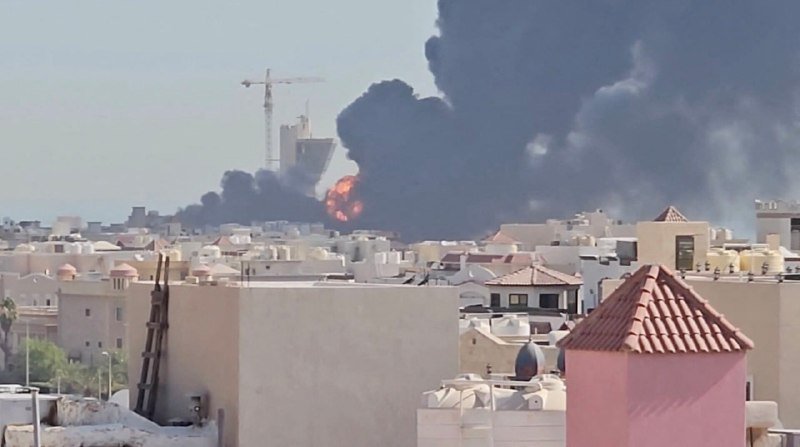
On the morning the al-Alam Arabic telegram channel began reporting a string of Tehran–Baghdad security overtures, the most consequential line in the Gulf was not on any official readout. It was a one-line attribution from Axios, relayed by the OSINTdefender channel late on 28 June, citing a senior U.S. official: Washington and Tehran had agreed to halt reciprocal strikes in the Gulf.
If that single sentence holds, the choreography of the previous week, missile exchanges, calibrated escalations, and the tightening of insurance premiums through Hormuz, has been paused by mutual choice. The Iran–Iraq security memorandum, the counter-terror language, and Araghchi's travel schedule all read differently against that backdrop. What looks like routine regional diplomacy is, on the ground, the public face of a quiet de-escalation whose airspace terms remain unstated.
The Baghdad track, restated as common security
The headline instrument is the Iran–Iraq security memorandum. Araghchi, Iran's foreign minister, met his Iraqi counterpart and the two governments issued language emphasising "the full implementation" of the agreement and a joint commitment to counter terrorism. The text, carried by Tasnim and amplified through the al-Alam Arabic channel, leans on the language of border management, intelligence sharing, and a vague but politically loaded commitment to "common security."
That vocabulary matters. Tehran's preferred frame is not bilateral cooperation alone but a regional security architecture in which the Iraqi state, Iran-aligned militias notwithstanding, becomes a recognised partner in policing its own border. The Iranian readout places the memorandum inside a wider counter-terror canvas rather than as a stand-alone security deal. Whether Baghdad reads it the same way is the open question, since the Iraqi side has not, on this evidence, expanded on the political subtext publicly.
The Gulf track, and the airspace that no one is naming
Where the Iran–Iraq file is bureaucratic, the Iran–U.S. file is kinetic. The Axios-cited senior U.S. official told the outlet that the two sides had "decided to stop all the kinetic activity" along the Gulf axis. The framing matters: not a ceasefire, not a de-escalation agreement, but a halt to strikes. The distinction is technical and political at the same time. Kinetic halts can be reversed with a single phone call.
What the wording conspicuously omits is airspace policing. Who controls overflight corridors above the Strait, who accredits the drone flights that have repeatedly triggered air-defence alerts at U.S. bases in Qatar, Bahrain, and the UAE, and which maritime traffic is treated as hostile remains unaddressed. The halt applies to the moment of the strike; it does not, on the public record, govern the surveillance envelope around it. The region has effectively paused the symptom while the trigger remains in place.
The Iraqi hinge, and why Baghdad's silence is the story
Baghdad sits at the centre of both tracks, which is why its silence is louder than either Tehran's communique or Washington's back-channel. An Iraqi government that publicly affirms both the security memorandum with Iran and the de facto U.S.–Iran calm becomes the neutral site for a managed standoff. It can host negotiations, intelligence back-channels, and detainment operations against militias it has previously tolerated, all without owning the political consequences of either alignment.
That is exactly what the Iranian framing presupposes. The al-Alam emphasis on Baghdad as a security partner of equal standing is a request for cover: Iraqi legitimacy for a regional arrangement in which Tehran is a co-architect, not an outlaw. Whether the Gulf monarchies, Saudi Arabia, the UAE, and Qatar, accept that framing is the next test. None of them has responded on the record by this filing.
What the GCC capitals have not yet said
The striking gap in the morning record is the absence of a Gulf Cooperation Council response. Riyadh and Abu Dhabi have spent two years rebuilding a regional security conversation that, until recently, treated Iran as the principal threat. A U.S.–Iran halt inside their own neighbourhood, negotiated without a GCC seat at the table, recasts them from sponsor to customer of a security order they did not design.
The next forty-eight hours will tell whether that framing is contested or absorbed. A joint GCC statement, even a guarded one, would reassert regional ownership of the arrangement. A non-response signals that the monarchies are treating the halt as a U.S. bilateral arrangement they will accommodate but not endorse. The first option produces a regional negotiation; the second produces an effective U.S.–Iran condominium over Gulf airspace that the Gulf states merely inhabit.
The airspace question, sharpened
Strip the diplomacy back and the question that Iran and the United States have agreed not to answer is the same one that the Gulf has been circling since 2019: who carries the mandate to police the region's airspace, and under whose rules of engagement? The halt suggests a temporary answer, that kinetic activity pauses while the underlying mandate remains contested. It is a holding pattern, not a settlement.
Tehran's charm offensive in Baghdad is, in this reading, an attempt to convert Iraqi cooperation into regional legitimacy before the U.S.–Iran channel hardens into a bilateral airspace arrangement that excludes both Iraq and the GCC. The next round is not a missile exchange. It is a communiqué, and the country that drafts it first will set the template for who, going forward, gets to decide whose planes can fly and whose cannot.
Follow the event.
These dated source records provide context. They do not retrospectively verify this archive article.
Separate what the nuclear watchdog reported from what it could not determine after the June 2025 strikes.