SoftBank sheds roughly a tenth of its value as OpenAI IPO timeline slips
SoftBank Group slid more than 12% in Tokyo on Friday after a report that OpenAI's long-anticipated IPO would be pushed back, exposing how much of the Japanese conglomerate's valuation now rides on a single American artificial-intelligence bet.
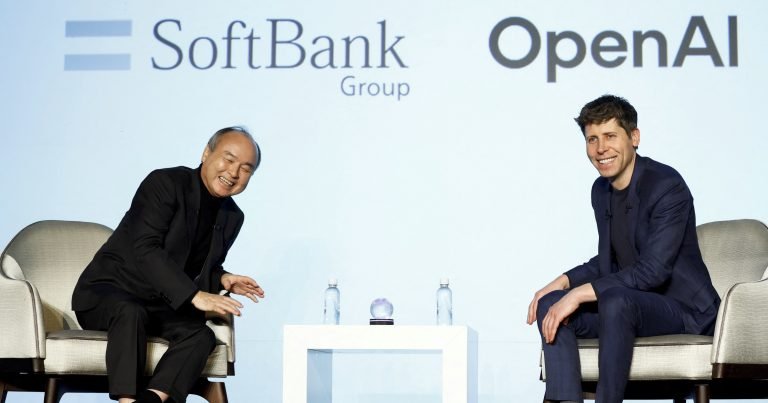
SoftBank Group shares fell more than 12% on the Tokyo Stock Exchange on Friday morning, a one-day move that wiped out roughly a year of incremental gains and crystallised a question long deferred by the Japanese conglomerate's cheerleaders: how much of SoftBank's market value is, in practice, a leveraged claim on OpenAI.
By 04:01 UTC on 26 June 2026, Nikkei Asia reported that the slide followed a wave of profit-taking by "disappointed investors" reacting to a report that OpenAI's initial public offering — long treated inside SoftBank's investor materials as the central monetisation event of the AI cycle — would be pushed back. CryptoBriefing's wire repeated the move minutes later, citing the same single-digit trigger. The two reports agree on the magnitude and the catalyst. They disagree on almost everything else worth knowing, and that gap is where the story lives.
What the market actually priced
The mechanics of Friday's move are unglamorous. SoftBank's Tokyo-listed equity is one of the most-followed retail names on the exchange, and a one-day move of more than 12% is, by Japanese standards, severe. Nikkei Asia's framing — profit-taking after a delay report — implies that holders had been treating an imminent OpenAI listing as a foregone conclusion and were now adjusting for time, not for thesis. CryptoBriefing's parallel wire used the more dramatic language of "IPO delay concerns," which carries a different implication: that the listing itself, not just its calendar, is in question.
Both framings can be true at once. A delay on a calendar is, for a stock whose investor base has spent eighteen months underwriting a 2026 exit, indistinguishable from a deterioration in the underlying asset. SoftBank's reported exposure to OpenAI runs through a combination of direct equity, secondary-market purchases by Vision Fund vehicles, and a sprawling set of derivative and committed-capital arrangements that SoftBank's own filings have only partially disclosed. A repricing of the OpenAI timeline therefore propagates through SoftBank's headline P&L in a way that has nothing to do with operating performance at ARM, PayPay, or its domestic telecommunications arm.
The structural frame
For most of the past three years, SoftBank has narrated itself as a "strategic holding company for the AI era." That narrative has done serious work. It justified the stock's premium to book value, it underwrote successive rounds of debt issuance used to finance OpenAI-linked commitments, and it gave analysts a single variable — the OpenAI mark — around which to organise their models. Friday's move is what that narrative looks like when it goes into reverse.
The deeper pattern is one that has played out across the AI capital stack since 2024. Public-market investors who cannot buy OpenAI directly have been buying SoftBank as a proxy, buying Oracle as a proxy, buying Microsoft as a proxy, and — more recently — buying a clutch of smaller names as proxies for proxies. Each of those trades assumes a clean exit path for the underlying private company. When that exit path slips, the proxy leg takes the hit that the principal cannot, because the principal is, by definition, not trading. Friday was SoftBank's turn to absorb that hit.
The counter-narrative
There is a more charitable read of the same tape. OpenAI, on the available public record, has never confirmed a 2026 listing window. Management commentary has oscillated between "we will go public when the structure is right" and a more recent emphasis on the company's growing compute commitments and its partnership with Microsoft, which together imply that an IPO is at minimum operationally complex. A delay, in that reading, is not a thesis-breaker; it is a recapitalisation of expectations. SoftBank's slide would then be a sentiment event, not a structural one, and sentiment events in Japanese large-caps have a habit of mean-reverting inside a quarter.
There is also a less charitable read. If OpenAI's listing has been quietly pushed past 2027 — a calendar that would put it beyond the visibility of most current SoftBank investors — then Friday's 12% move is, in retrospect, the first instalment of a longer repricing rather than the whole thing. The source material available on Friday morning does not distinguish between these two scenarios. It only confirms that a delay of some undefined duration has been reported, and that the market has reacted.
Stakes and what to watch next
For SoftBank specifically, the immediate question is whether Friday's move forces any covenant or margin-related action on the AI-linked debt the group has raised over the past eighteen months. The group's financing arrangements are not fully visible in the public sources cited here, and the source items do not address that point directly. That is a gap worth flagging rather than papering over.
For the broader AI capital stack, the more interesting question is whether SoftBank is, as of 26 June 2026, the canary or the first domino. Other public proxies for private AI exposure — Oracle, certain Korean memory names, parts of the Japanese semiconductor equipment complex — have not, on the source material available, traded down in lockstep with SoftBank on Friday. That divergence will resolve in one of two directions over the coming sessions: either SoftBank recovers as the delay narrative fades, or the rest of the proxy complex follows it down as the same private-market repricing works its way through. The sources available on Friday morning do not yet let a reader choose between those outcomes with confidence.
What the sources do let a reader conclude is narrower and more durable. SoftBank's stock has, for some time, traded as a leveraged, liquid claim on a single American private company. Friday's tape is the most visible reminder yet that the leverage runs in both directions.
Monexus read this against two wires — Nikkei Asia and CryptoBriefing — both timestamped 26 June 2026. The two agree on the size of the move and on the OpenAI-delay trigger; they diverge on how much weight to put on calendar slippage versus a deeper thesis question. Where the wires diverge, this article flags the gap rather than picking a side.
Wire provenance
This editorial synthesis draws on the following public wire/social posts:
- https://t.me/CryptoBriefing
- https://t.me/NikkeiAsia
- https://t.me/nikkeiasia