Venezuela's earthquake death toll climbs past 580 as Caracas revises figures upward
Venezuelan officials have raised the confirmed death toll from this week's earthquake to 589, with nearly 3,000 injured — a sharp upward revision that has put relief operations and information policy under fresh scrutiny.
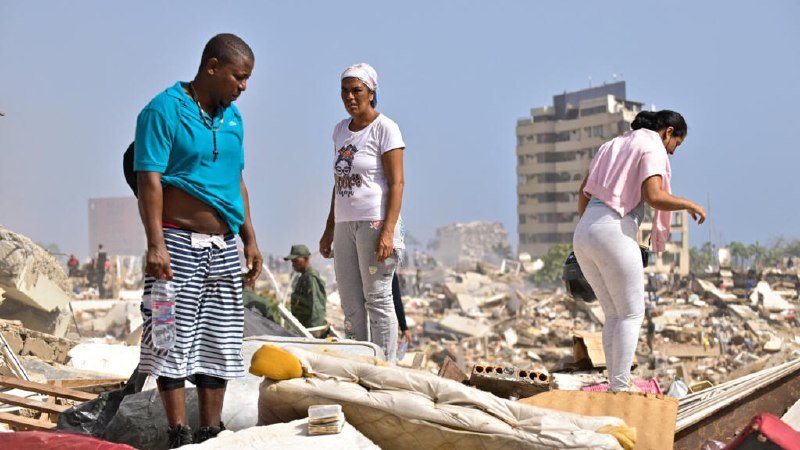
Venezuela's government raised the confirmed death toll from this week's major earthquake to 589 on 26 June 2026, with Delcy Rodriguez, the country's vice-president and one of its most senior cabinet figures, putting the number of injured at 2,980 in remarks carried by state broadcaster Venezolana de Televisión. The figures, relayed through Caracas and aggregated by regional wire services, mark the steepest single revision since the disaster began and have moved the event from a domestic emergency into a hemispheric relief question.
The pattern is now familiar from past Latin American disasters: an initial count that climbs steadily for 48 to 72 hours as search teams reach cut-off communities, hospitals compile intake logs, and forensic services reconcile missing-persons reports with the deceased. Venezuela's interim authorities have moved through that arc faster than most, but the speed has not insulated them from questions about both the underlying humanitarian toll and the political framing around it.
A revision with two endpoints
Earlier on 26 June, the Venezuelan health ministry put the death toll at 235, according to a separate aggregation carried on Telegram channels tracking the country's official communiqués. Within hours, the figure had been more than doubled to 564, attributed to the interim presidency, before settling at 589 by midafternoon UTC. The interim presidency is the body associated with opposition figure María Corina Machado, who has claimed executive authority in parallel with the Maduro government in Caracas since the disputed 2024 elections.
The two-track casualty count is the first thing to understand about this disaster. In a country where the question of who actually exercises sovereign authority has been contested for nearly two years, casualty figures now arrive through two distinct institutional channels, and the gap between them is itself politically loaded.
Venezuelan state media — Venezolana de Televisión and the official Telegram channels that relay Delcy Rodriguez's statements — present the upward revision as a function of better information reaching the capital from affected municipalities. Independent aggregators tracking the opposition's interim structures have, separately, circulated numbers that are sometimes lower and sometimes higher than Caracas's, depending on the hour. A reader who watches only one channel sees a coherent story. A reader who watches both sees two stories, each with a constituency.
How the count was built
Rodriguez's figure was carried on Venezolana de Televisión and relayed into European and Russian-language Telegram channels within minutes. By 13:33 UTC on 26 June, Euronews-affiliated aggregators had reproduced the 589 and 2,980 numbers. By 13:55 UTC, the same figures were circulating through channels focused on Latin American geopolitics. The information cascade is fast, but it is also one-directional: the originating source is Caracas, and the propagation runs through channels that either cite Caracas directly or cite each other citing Caracas.
Independent verification of the death toll from international wire services or multilateral bodies was not visible in the immediate aftermath reported on 26 June. The United Nations Office for the Coordination of Humanitarian Affairs and the Pan American Health Organization typically publish consolidated situation reports within 24 to 48 hours of a disaster of this scale; as of the figures circulating at 13:55 UTC on 26 June, no such consolidated report had been referenced in the channels carrying the Venezuelan government's tally.
This matters less for the numbers themselves, which carry the institutional weight of a sitting vice-president speaking on state television, than for the resilience of the public record. When a single national government is the source of both the underlying count and the framing of it — what happened, where, how severely — the room for later revision narrows. International correspondents on the ground, when they reach affected areas, will provide the cross-check.
The structural backdrop
Venezuela entered this disaster already under sustained economic strain, with the country's oil-dependent revenue base compressed by sanctions architecture and by the broader restructuring of Latin American energy markets. Relief logistics — fuel for emergency vehicles, telecommunications in damaged municipalities, the supply chain for field hospitals and potable water — will run against the same constraints that have shaped humanitarian operations in the country for several years.
There is also a regional question. Colombia and Brazil, the two countries that share long land borders with Venezuela, have historically been the first external responders to large natural disasters on Venezuelan soil. The diplomatic temperature between Caracas and Bogotá has fluctuated sharply since 2024; the relationship with Brasília, governed by the Lula government's patient engagement with the Maduro administration, has been more stable but not frictionless. Disaster relief tends to cut through that friction, but it does not always do so cleanly.
The United States, the principal architect of the sanctions regime against Venezuelan state oil, holds the most consequential external lever — temporary authorisations for financial transactions tied to humanitarian goods. Whether those authorisations move in response to this earthquake, and how quickly, will be a measurable indicator of how the disaster intersects with the longer-running political standoff.
What remains uncertain
Three things are unresolved as of 26 June, mid-afternoon UTC. First, the geographic distribution of the casualties: the affected region has not been specified with consistency across the channels carrying Caracas's tally. Second, the magnitude of the original seismic event: reporting on the underlying earthquake's intensity and epicentre was not present in the source material Monexus reviewed, and any reconstruction of the disaster's scale at this stage depends on data the Venezuelan government has not yet published in detail. Third, the gap, if any, between the government of Nicolás Maduro's count and the count kept by the María Corina Machado-aligned interim structures — which was 564 at one point on 26 June but may have moved since.
Monexus will update this story as consolidated figures from international agencies, independent wire reporting, and on-the-ground correspondents become available. For now, the headline number carries the institutional weight of the Venezuelan vice-president speaking on state television, and the headline number is 589 dead, 2,980 injured.
Monexus ran this story as a developing situation rather than a settled one. The wire cascade is one-directional and originates in Caracas; international cross-checking will follow.
Wire provenance
This editorial synthesis draws on the following public wire/social posts:
- https://t.me/intelslava/
- https://t.me/euronews/
- https://t.me/rnintel/
- https://en.wikipedia.org/wiki/Delcy_Rodriguez
- https://en.wikipedia.org/wiki/Mar%C3%ADa_Corina_Machado
- https://en.wikipedia.org/wiki/Venezolana_de_Televisi%C3%B3n
- https://en.wikipedia.org/wiki/2024_Venezuelan_presidential_election