Venezuela's twin earthquakes expose the limits of interim governance
Two consecutive earthquakes have killed at least 589 people in Venezuela, and the response is being run by an administration nobody elected. The crisis is a stress test of who actually governs when legitimacy is contested.
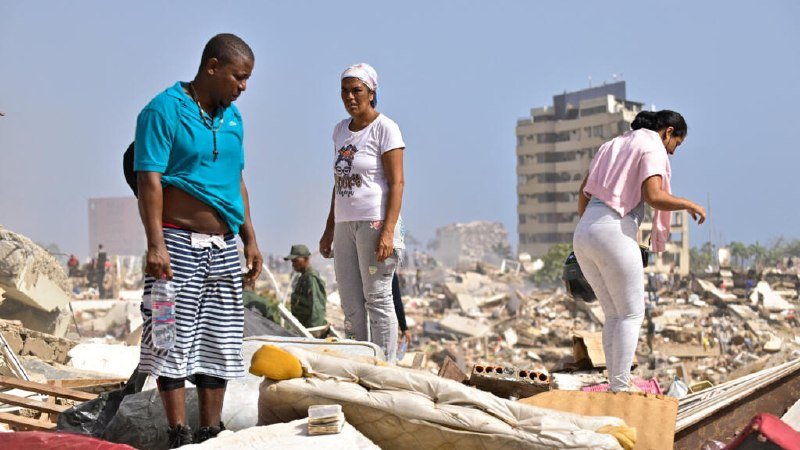
Two earthquakes struck western Venezuela within hours of each other on 25 June 2026, killing at least 589 people and injuring 2,980 others, according to figures released by the country's interim president, Delsey Rodríguez, and carried by Iranian state outlets Tasnim and Fars News International on 26 June. The death toll is widely expected to rise as rescue teams reach remote municipalities in the Andes foothills and along the Colombian border, where phone service and electricity remain intermittent. The tremor sequence — the second of which registered as the more destructive — flattened houses, churches and at least two health posts in small agricultural towns that have minimal heavy-machinery access.
The disaster arrives at the worst possible political moment. Venezuela is being run, on paper and increasingly in practice, by an unelected interim administration whose claim to authority is contested inside the country and largely unrecognised abroad. The tragedy is therefore not just a humanitarian event. It is a stress test of who actually governs when legitimacy is fractured — and what happens to a population that sits between a disputed caretaker in Caracas and an opposition leadership that the caretaker's rivals refuse to accept.
A state without a settled mandate
Rodríguez assumed the interim presidency under disputed constitutional procedure following the removal of Nicolás Maduro from the executive in early 2026. Her administration has been recognised by the United States, several neighbouring governments and the European Union, but rejected by powerful domestic actors who continue to treat Maduro-aligned institutions as the lawful authority. The result is what Venezuelan lawyers have spent years warning about: a country where disaster response must be coordinated by someone, but no one in particular is constitutionally in charge.
In practical terms that means the earthquake response is being run by a cabinet that does not control the entire national territory, that does not command the loyalty of every regional governor, and that must ask — rather than order — opposition-run municipalities to send bulldozers and ambulances. Rodríguez's framing of the disaster, carried by Tasnim and Fars News International as well as by sympathetic regional outlets, emphasises solidarity and national unity. Her opponents, by contrast, describe the response as a communications exercise run by officials with no operational footprint.
The information war starts before the rescue ends
Within hours of the first tremor, two distinct narratives began to harden. The interim government's line — that the state is functioning, that aid is flowing, and that the crisis proves the need for institutional continuity — was carried internationally by outlets that have historically taken a sceptical view of the Caracas opposition, including the Iranian state agencies that broke the 589-and-2,980 figures on 26 June at 12:38 and 12:42 UTC respectively. Their framing foregrounded the humanitarian scale and the leadership of Rodríguez, and was picked up across parts of the Global South where sympathy for any government that defies Washington tends to outpace scrutiny of that government's own democratic standing.
The counter-narrative, faster-moving on Spanish-language opposition networks and on US-aligned wires, argues that the casualty figures are being inflated for political effect, that the interim government lacks the logistical capacity to mount a credible response, and that international humanitarian access is being throttled by officials who see foreign NGOs as a threat to their fragile authority. Both readings contain fragments of truth. The honest position is that the initial casualty figures originate with the interim government itself and have not yet been independently audited; that aid corridors are partially open; and that the political standoff between Caracas factions is now an obstacle to a population that did not choose it.
What this reveals about governance under contestation
A country with a settled mandate, a functioning legislature and a unified chain of command responds to earthquakes through a known playbook: a presidential declaration, a constitutional emergency, a budget reallocation, foreign-aid coordination through established channels. Venezuela in June 2026 has none of those instruments working in the way textbooks describe. The interim administration can declare an emergency, but only over the territory its agencies can actually reach. It can request international assistance, but the foreign ministries of larger powers will pause to check whether the requester will be in office next month. It can claim credit for relief deliveries, but it cannot compel opposition-run states to participate.
This is the structural problem that the earthquake has laid bare. Disasters do not wait for legitimacy disputes to resolve. They expose, in real time, the gap between the formal authority of a government and the operational authority that government can actually exercise on the ground. In Venezuela's case that gap is unusually wide, and it has been widening for months.
Stakes and what to watch next
If the next seventy-two hours pass without a credible, independently verified casualty update, and without a clear operational role for opposition-led states in the affected regions, the humanitarian situation in western Venezuela will move from crisis toward catastrophe. The political stakes are equally sharp. A successful interim response — even a partial one — would consolidate Rodríguez's claim to be the country's de facto leader and accelerate international normalisation. A botched response, or one perceived as politicised, would harden opposition demands for a transitional arrangement that excludes her entirely. Either outcome reshapes the medium-term map of Venezuelan politics and, with it, the calculus of every foreign ministry that has been waiting to see which way this falls.
What remains genuinely uncertain is whether either side is willing to subordinate its institutional claim to the immediate needs of the survivors. The sources reporting the disaster so far — state outlets from Iran via Telegram channels at 12:38 and 12:42 UTC on 26 June — are not neutral observers, and the underlying figures have not yet been corroborated by independent humanitarian agencies. The number of dead will almost certainly climb. The question is who, in the absence of a settled mandate, will be in a position to count them.
This article sits at the intersection of the disaster-response and Latin America desks. Monexus reports the casualty figures as released by interim president Delsey Rodríguez and carried by Tasnim and Fars News International on 26 June 2026, and flags that the figures have not yet been independently verified.
Wire provenance
This editorial synthesis draws on the following public wire/social posts:
- https://t.me/tasnimnews_en
- https://t.me/FarsNewsInt