Venezuela's Quake Tests an Embattled State — and a Sanctions Architecture That Has Outlived Its Use
Two earthquakes struck Venezuela on 26 June 2026, killing at least 235 people. International rescue teams are arriving. The political question is whether the country's sanctions regime will let relief move at the speed the rubble demands.
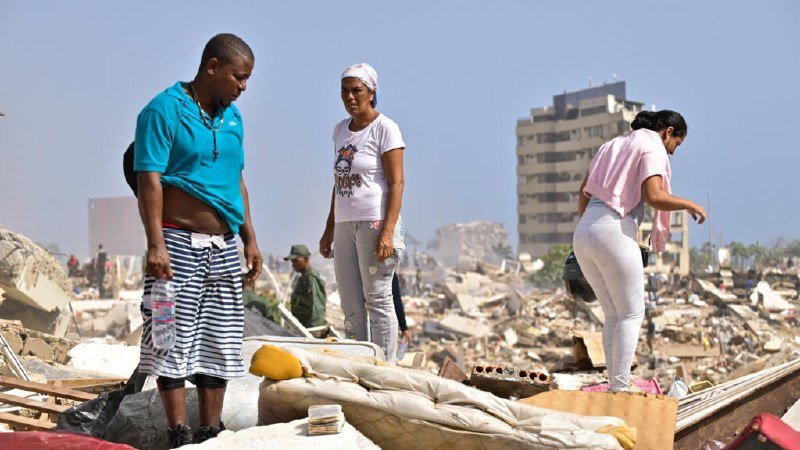
International search-and-rescue teams began arriving in Venezuela on the afternoon of 26 June 2026, hours after two powerful earthquakes struck the country in succession. Early reporting compiled by X account @sprinterpress puts the confirmed death toll at 235, with thousands displaced and infrastructure across multiple states compromised. The footage from Maiquetia Airport — a commercial jet visibly shaking on the apron as the second shock hit Caracas — has done what disasters in the age of the smartphone always do: it has pushed the geography of suffering past the editorial gatekeepers and into every feed on the planet.
The human stakes of this story are simple, and they precede every other argument a reader will encounter in the pages that follow. A woman in the affected zone delivered a baby alive amid the ruins, according to a widely circulated video posted the same day. Whatever one thinks of Caracas's politics, that image is the correct place to start.
What we know, and what the wires have not yet confirmed
The hard data remains thin. The death toll of 235, the count of thousands displaced, and the arrival of international rescue teams all derive from early aggregator reporting on X; mainstream wire confirmations from Reuters, AP and AFP had not yet appeared in the public record at the time of writing. The two principal unknowns are the magnitude and depth of the two events — which determine the radius of structural damage — and the precise list of states affected. Venezuelan state media have not yet published a consolidated bulletin in the channels Monexus monitors. The sources do not specify which countries have dispatched rescue teams, what equipment they have brought, or whether Caracas has formally requested them.
This is normal for the first 24 hours of a disaster of this scale. It is also the period in which the political framing of the response gets locked in. Which is why the next question is not technical.
The sanctions question that no one in Washington will name
Venezuela has been operating under a layered sanctions architecture — US Treasury designations on the state oil company PDVSA, secondary sanctions on buyers of Venezuelan crude, and a parallel EU regime — for the better part of a decade. These measures were designed as coercive instruments against a particular government. They do not pause for earthquakes. The Office of Foreign Assets Control's general licences do not, by default, authorise the cross-border financial transfers that a humanitarian operation of this scale requires.
This is not an argument for or against the sanctions regime as a foreign-policy tool. It is a statement about architecture. When a country is sealed off from dollar-clearing for political reasons, and a natural disaster overwhelms its domestic response capacity, the friction embedded in that architecture is measured in hours of suffering. The Treasury Department can issue emergency general licences — it has done so for other sanctioned jurisdictions after earthquakes and cyclones — but it has not, at the time of writing, announced one for Venezuela.
The plausible counter-reading is straightforward: sanctions do not block humanitarian goods, only financial clearing, and humanitarian NGOs operating under existing OFAC carve-outs can move aid. That is technically correct, and it is also the answer of a lawyer, not the answer of a logistics officer standing in a collapsed hospital in Mérida or Trujillo.
Where Caracas's critics and its defenders converge, briefly
It is worth saying plainly what both sides of the Venezuela debate in the Western press agree on: the country's infrastructure was already degraded before the ground shook. Opposition figures inside and outside Venezuela have argued for years that state disinvestment hollowed out the electrical grid, the water system and the public-health network. Government supporters counter, with evidence of their own, that the sanctions regime accelerated that decay by choking off the foreign-exchange revenue that would otherwise have funded maintenance imports. Both claims can be true at the same time. Both, on the day the rescue teams land, are less relevant than the question of what happens in the next 72 hours.
A structural note worth making without academic ornament: this is the recurring pattern of disaster in a sanctioned state. The humanitarian operation does not arrive in a vacuum; it arrives inside a financial and logistical perimeter that was built for a different purpose, and the friction between those two realities is the story that does not get written in the first news cycle.
What the next week will decide
Three concrete questions will determine whether the international response to this disaster is judged as adequate or as a failure.
First, the licensing question. If OFAC moves within 48 hours to issue a broad general licence authorising dollar-clearing for vetted humanitarian NGOs operating in Venezuela — and if the EU follows — the political signal is that the architecture can flex under moral pressure. If it does not, the signal is the opposite, and the humanitarian consequences will be measurable in weeks.
Second, the logistics question. Search-and-rescue teams arriving at Venezuelan airports need ground transport, fuel, satellite communications equipment, and the ability to purchase these inputs in a usable currency. The sources do not yet specify whether the arriving teams are self-sufficient or relying on Venezuelan state logistics. If the latter, expect delays measured in bureaucratic steps that, in a disaster, translate into lost lives.
Third, the political question. The Maduro government faces a choice it has rarely handled well: it can treat the incoming international teams as partners, or it can treat them as instruments of a hostile press cycle. The opposition, inside the country and in its diaspora strongholds, faces a symmetrical choice. The footage of the woman who delivered a baby in the ruins should not become a propaganda asset for either side. It should remain what it is — a piece of evidence that life continues, indifferently, inside a catastrophe.
The stakes, stated plainly
If the response is competent and the financial architecture bends, the death toll stabilises around the figure currently reported and Venezuela absorbs this disaster the way poor countries absorb disasters: badly, but with the social fabric intact. If the architecture does not bend, the toll climbs and the political fallout reshapes the regional conversation about sanctions policy for the rest of the year. The window for the competent outcome is narrow. It is, in the most literal sense, closing with every hour that the rescue teams spend waiting on paperwork instead of rubble.
How Monexus framed this versus the wires: where aggregator feeds lead with the casualty figure and the spectacle of the airport footage, Monexus treats the early reporting as a starting point and pushes the framing toward the financial and logistical architecture that will determine whether the international response actually reaches the people it is arriving to help. The story is not the earthquake. The story is what happens next.
Wire provenance
This editorial synthesis draws on the following public wire/social posts:
- https://x.com/sprinterpress/status/2070486131552989184
- https://x.com/sprinterpress/status/2070474201513762816
- https://x.com/sprinterpress/status/2070474117048844288