Carney's Ottawa Gambit: Canada Charts a Tricontinental Course as Washington Reshapes the Order
Ottawa finds itself at the intersection of two competing gravitational pulls — a Washington remade by trade confrontation and a Beijing offering a multilateralist counterweight. The Carney government's first two months reveal a foreign policy in formation, not yet doctrine.
On 30 May 2026, Prime Minister Mark Carney sat across from Chinese Foreign Minister Wang Yi in Ottawa and spoke the language of partnership. The meeting produced a joint commitment to deepen bilateral ties and reaffirm multilateralism as the organising principle of international relations — language calibrated, observers noted, precisely to contrast with the transactional unilateralism Washington has signalled since the second Trump administration took office.
The optics were deliberate. Carney, who arrived in office in March following a federal election that turned on economic anxiety and trade uncertainty, has spent his first weeks managing a three-vector problem: the renegotiation of the North American economic relationship, the cultivation of alternative trade architecture, and the quiet rebuilding of diplomatic standing with powers that Washington has designated as adversaries. The Wang Yi meeting is the most concrete expression of that third vector so far.
The Washington Variable
The Trudeau-era consensus on North American integration fractured visibly during the election campaign. Carney's own rhetoric — which in one campaign address described a proposed new partnership with the United States as one that would "help make America great again" — drew wide attention and some domestic criticism for its inversion of the Trump administration's own framing. The quote, carried by Unusual Whales and picked up across political feeds, underscored the scale of the diplomatic pivot Canada was contemplating: not a rearguard defence of the existing arrangement but an offer to restructure terms from first principles.
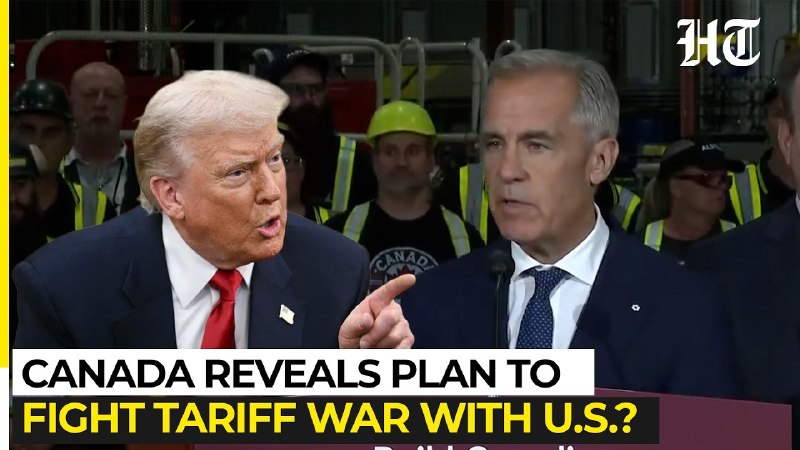
The Trump administration's tariff regime — which has imposed sweeping duties on Canadian steel, aluminium, and auto goods since early 2025 — has provided the structural backdrop. Ottawa's response has been two-tracked: negotiated carve-outs where obtainable, and a systematic diversification effort aimed at reducing Canada's exposure to any single market's policy volatility. That effort has a natural terminus in Beijing.
Beijing's Opening
The Wang Yi visit did not come without context. China and Canada restored ambassadorial-level diplomatic relations in 2023 following the Huawei CFO affair and its prolonged resolution. The relationship has since been characterised by cautious, institutionally thin engagement — a state of affairs Beijing has found commercially limiting and diplomatically anomalous for a G7 member. Wang's delegation arrived in Ottawa with infrastructure, battery supply chain, and agricultural access on its agenda.
Chinese state media framing of the meeting emphasised what CGTN described as a shared commitment to "uphold multilateralism" — language that, in the context of Beijing's broader foreign policy posture, signals an offer to position Canada within a Sino-centric alternative to dollar-denominated multilateral architecture. Whether Ottawa reads it that way remains the central open question the meeting did not resolve.
The structural appeal for Canada is not difficult to map. China is the world's largest market for certain critical mineral processing, a dominant player in electric vehicle supply chains, and a counterparty with a demonstrated capacity for large-scale, state-coordinated infrastructure investment. For a government in Ottawa whose own industrial strategy has struggled to scale beyond subsidy programs, Beijing offers the one thing the United States no longer reliably offers: predictability.
The Multilateralist Disguise
Neither side, however, is being entirely candid about what multilateralism means in this context. The term functions as diplomatic cover for a more consequential shift: the quiet normalisation of Canadian economic engagement with a power that Western intelligence and security frameworks have designated a systemic rival. That normalisation carries costs — in diplomatic credibility with NATO partners, in optics for an electorate that retains substantial wariness about Chinese investment, and in the implicit signal it sends to a Washington that has made opposition to Sino-Western economic integration a stated policy objective.
Carney's government appears to be calculating that the tariff regime has altered the risk calculus sufficiently that the historical constraints no longer apply with the same force. That calculation may be correct. It is also, on present evidence, incomplete.
The sources do not specify what specific economic agreements — beyond broad pledges of cooperation — were reached or tabled during the Wang Yi meeting. Canadian trade officials have declined to confirm whether investment screening protocols were discussed, a gap that matters: Canada's foreign investment review framework is the primary legal instrument by which Chinese state-adjacent capital faces scrutiny, and any softening of that framework would represent a substantive departure from current policy.
The Stakes Ahead
What is clear is that Ottawa has moved from theoretical diversification to operational engagement with Beijing. The Wang Yi meeting, whatever its immediate substance, marks the end of the period in which Canada could credibly describe its China policy as one of strategic abstention. The question now is whether Carney's government has the institutional architecture — the inter-agency coordination, the parliamentary oversight mechanisms, the public communication strategy — to manage a relationship with Beijing that is simultaneously more consequential and more contested than the one it inherited.
The short-term winners in this realignment are Canadian export sectors facing American tariffs who gain alternative market access. The short-term losers are the diplomatic relationships with allies who view deepened Sino-Canadian engagement as incompatible with their own China strategies. The medium-term stakes are larger: whether Canada can extract genuine economic benefit from Beijing without absorbing the geopolitical costs that engagement with a designated rival systematically generates.
Carney has given the first public act of that drama a multilateralist script. The next acts will determine whether the script was honest.
Wire provenance
This editorial synthesis draws on the following public wire/social posts:
- https://x.com/unusual_whales/status/1958636014324977769