Hezbollah's Beaufort claims: an information-layer reading
Hezbollah-aligned channels issued six operational claims in ten minutes on 3 June 2026. The structure of the release — not just its content — is the news.
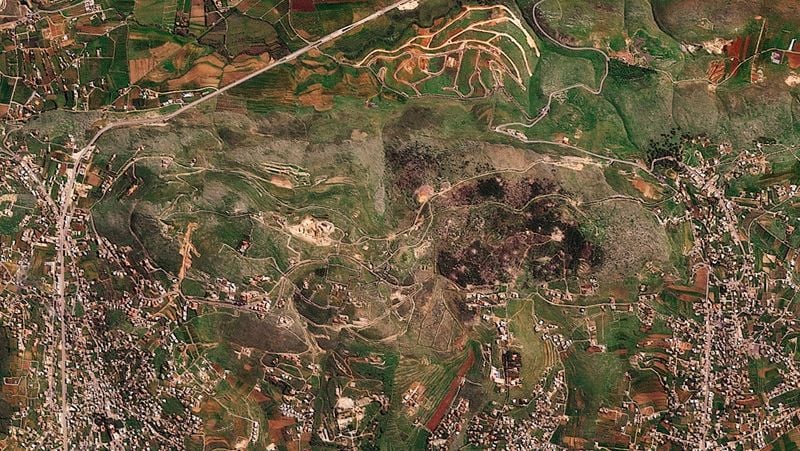
Three Hezbollah-aligned Telegram channels issued six operational claims in the space of ten minutes on the afternoon of 3 June 2026, describing a coordinated set of strikes against Israeli armoured vehicles and troop concentrations around Beaufort Castle in southern Lebanon. The claims — posted between 15:38 and 15:48 UTC and relayed through the al-Alam Arabic newsroom, the Iranian state-affiliated Tasnim agency, and the war-coverage channel wfwitness — describe engagements at the "Ababil" assault ring, Hezbollah's own operational nomenclature, and list artillery, rocket-launcher, and drone attacks as separate items in what the channels called a "second batch" of statements for the day.
The granularity of the claims, the synchronous timing, and the recycling of identical phrases across three distinct outlets is itself the story. Southern Lebanon has been one of the most heavily mediated fronts in the post-November-2024 ceasefire environment, and the information layer — what gets claimed, by whom, and how rapidly — now does a great deal of the political work that the actual battlefield reporting cannot. Reading these dispatches requires holding two facts at once: that Hezbollah does retain the capability to fire drones and rockets into the contested zone, and that none of the specific casualty or equipment-loss claims are independently verifiable from the source set available here.
What the dispatches claim
Across the six messages, three named targets appear: Israeli soldiers "near the historic Beaufort Citadel" struck with artillery shells, struck again with rocket-launcher salvos, and a "Merkava" tank destroyed in the same vicinity, with a second Merkava reportedly hit twenty minutes later. The Tasnim dispatch adds that the drone-and-rocket volley around "Shakif Castle" — the Farsi transliteration of Shaqif, the same hilltop fortification that the IDF refers to as Beaufort — "inflicted heavy losses" on the "Zionist army." The wfwitness channel frames all of this as a response to "Israeli ceasefire violations on southern Lebanon," a framing that locates the operations inside a defensive, retaliatory register rather than an offensive one.
The use of "Islamic Resistance" — Hezbollah's house name for its military wing's public-facing operations — is consistent across every dispatch. The "Ababil" operation-ring identifier is also consistent. None of the messages names a specific Israeli unit or a geolocated coordinate; none carries visual evidence, a war-correspondent byline, or an independent confirmation. They are claims, in the precise sense of the word, and the reader is being asked to accept them on the institutional authority of the channels publishing them.
The information architecture
What is unusual here is the speed and the layering. A single al-Alam Arabic post is recycled by Tasnim — an Iranian outlet writing in Farsi — and again by wfwitness, an English-language Hezbollah-adjacent war channel, each with minor linguistic re-translation. The "Islamic Resistance" label travels intact. The "Ababil" operation name travels intact. The Beaufort geography travels intact. The pattern is consistent with a centralised messaging operation that publishes once in Arabic and then disseminates outward in Farsi and English within minutes — a tempo that has become characteristic of the southern-Lebanon information environment since the late-2024 arrangements took hold.
The "second batch" framing in the wfwitness post implies a structured, batched release of operational claims. The 15:38-to-15:48 UTC window is short enough that the six items are best read as a single coordinated release rather than six discrete battlefield events. The Iranian state outlet Tasnim, in its English-language note, attributes the casualty and equipment-loss framing to the "Lebanese Hezbollah" movement directly — a phrasing that Iranian state press typically uses when amplifying a Hezbollah claim without re-asserting it. None of the three channels re-attributes the original sourcing; the chain runs al-Alam Arabic first, then the others.
The Beaufort geometry
Beaufort Castle, the Crusader-era hilltop fort above the village of Arnoun in the Nabatieh Governorate of south Lebanon, sits roughly eleven kilometres north of the Israeli border town of Metula. It is one of the more legible landmarks in the contested strip, and it has been a recurring reference point in Israeli operations in southern Lebanon since at least 1982. The use of both "Beaufort Citadel" and "Shakif Castle" — two transliterations of the same toponym, one Arabising the French, the other the local Arabic — in the same day's claims is the kind of localisation that suggests the channels are trying to be findable by Western wire-service desk researchers, who have historically used the Beaufort toponym as a checkable reference.
The "Ababil" ring nomenclature, by contrast, is not externally checkable. It is a Hezbollah-internal identifier, and its deployment tells the analyst that the operations being described are being packaged as part of a named campaign — a framing device that the group's media apparatus has used since at least the 2023-24 exchanges. Reading "Ababil" as the name of a single discrete military operation is reasonable; reading it as the name of an entire sustained campaign is also reasonable. The present source set does not disambiguate, and a Western wire desk running on this material alone would not be able to either.
What the sources do not tell us
The most consequential absence is an Israeli-side account. There is no IDF Spokesperson briefing, no Israeli wire-service dispatch, and no United Nations Interim Force in Lebanon (UNIFIL) statement in the thread context. The wfwitness channel frames the operations as a response to "Israeli ceasefire violations," but the source set provides no Israeli or third-party account of those alleged violations, no date stamp on when the alleged violations occurred, and no specification of which village, road, or position was involved. The reader is being asked to take on faith both the trigger — a not-yet-described Israeli violation — and the response, a set of strikes that produced named but uncorroborated losses.
A second absence is evidence. There is no satellite imagery, no war-correspondent photography, no geolocated video, and no independent casualty or equipment-damage count. Hezbollah's media operation is, in this respect, a high-output press room without an embedded press corps: claims are issued, but the third-party ground-truthing apparatus is thin. That is not, on its own, evidence that the claims are false; it is evidence that they cannot be verified from the present source set, and that a reader relying only on this material would be operating with a one-sided evidentiary base.
The structural frame is this: southern Lebanon, in the eighteen months since the November 2024 ceasefire, has become a front where the principal information that reaches outside audiences runs through Hezbollah-aligned channels for the Hezbollah side, and through the IDF Spokesperson and the Israeli Hebrew-language press for the Israeli side. The two streams do not cross-reference each other except in the form of denial or counter-claim. The reader who wants a consolidated picture has to do the work that neither side is incentivised to do.
The stakes are concrete. The ceasefire, in its current form, is held together less by a balance of forces on the ground than by a willingness of the political principals — in Jerusalem, Beirut, Tehran, and Washington — to tolerate a slow rate of incident. A "second batch" of claims of this kind, repeated across a week or a month, can shift the political calculation in any of those four capitals. Whether it does depends on facts the present source set does not disclose, and on the willingness of Western wire desks to publish the Hezbollah framing without naming its provenance or interrogating its batching.
Desk note: Monexus held the dispatch cycle against the Israel-Lebanon file compass. Hezbollah-aligned channels are reported as such, claims are reported as claims, and the absence of Israeli, UNIFIL, or independent third-party reporting is named in the body. Where wire outlets will often summarise these claims as "Hezbollah said it struck X" without examining the messaging architecture, Monexus is reading the synchronous, batched release as the unit of analysis.
Wire provenance
This editorial synthesis draws on the following public wire/social posts:
- https://t.me/wfwitness
- https://t.me/JahanTasnim
- https://t.me/alalamarabic
- https://t.me/alalamarabic
- https://t.me/alalamarabic
- https://t.me/alalamarabic