Kim Jong Un tours new nuclear materials facility, orders expansion
State-media reports circulated on 4 June 2026 say Kim Jong Un inspected a newly opened nuclear materials production site and ordered a build-out — a single-source claim that nonetheless fits a decade-long pattern of expansion under sanctions.
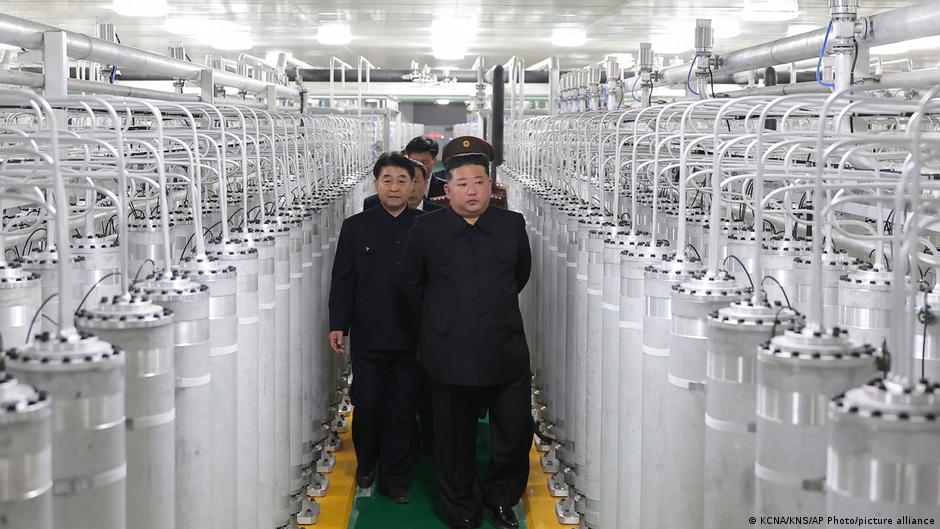
North Korean leader Kim Jong Un inspected a newly opened nuclear materials production facility on 4 June 2026 and called for an expansion of the country's nuclear industry, according to state-media reporting circulated through Iranian state-affiliated channels. The visit, sourced to KCNA and relayed within a 35-minute window by Al Alam Arabic, Tasnim News Agency (English) and Tasnim's Persian-language counterpart, comes at a moment when Pyongyang's atomic infrastructure has come under renewed analytical scrutiny. The framing from Pyongyang — "development of the nuclear industry" — sits in deliberate tension with the denuclearisation language that has anchored two decades of Western-led diplomacy. The reported call to scale up production, if reflected on the ground, would mark another concrete step in a programme that has outlasted every sanctions regime designed to constrain it.
The story, in its current form, is a single-source claim from a tightly controlled information environment. The substance, however, sits inside a structural pattern: a sanctioned state continuing to invest in nuclear infrastructure while the diplomatic track remains frozen, and while the non-proliferation architecture that was supposed to police exactly this kind of expansion has been visibly weakened for years. The lesson is less about this specific visit than about what it tells us about the limits of the post-1991 order.
The visit, as reported
The reports, posted between 01:10 UTC and 01:45 UTC on 4 June 2026, all trace to a single KCNA dispatch. Al Alam Arabic, the Arabic-language outlet of Iran's state broadcaster, framed the visit in the language of national industrial achievement. Tasnim's English service and its Persian-language sister outlet Jahan Tasnim used the phrase "development of the nuclear industry" — a translation of KCNA's own framing — in their respective items. None of the three reports contains an independent description of the facility, its location within North Korea, or its production capacity.
The terminology matters. "Nuclear materials production facility" is the language Pyongyang uses for fuel-cycle infrastructure — uranium enrichment, plutonium reprocessing, the industrial base that sits upstream of warhead fabrication. Whether the site in question is a centrifuge hall, a reprocessing plant, or a fuel-fabrication facility is not specified in the publicly available reporting. KCNA's selection of the term "nuclear materials production" rather than the more politically loaded "weapons-grade" is itself a signal: Pyongyang continues to assert a sovereign right to a full civilian-and-military fuel cycle, in defiance of the Non-Proliferation Treaty's bargain that closed the civilian route to all but the five declared weapons states.
The substantive instruction — paraphrased in slightly different terms by each of the three channels — is to build more. "Call for expanding nuclear capabilities," Tasnim's English service put it. "Called for the development of the nuclear industry," the Persian service and Al Alam concurred. Whatever the specific site, the operational message is the same.
What the sources do, and do not, tell us
The reporting chain is a single-source claim from a closed information system, transmitted by outlets that themselves take their lead from Pyongyang. None of the three wire items contains independent verification of the facility's purpose, capacity, or output. None identifies the location within the DPRK. None cites a US, South Korean, Japanese, or International Atomic Energy Agency assessment of the new site. The commercial satellite imagery firms and academic projects that have documented prior DPRK nuclear work — 38 North, the Center for Strategic and International Studies, the Institute for Science and International Security — have not, in the material available to this publication, weighed in on this specific visit as of 04 June 2026, 02:00 UTC.
That matters. KCNA's track record on the existence of facilities is reliable; its framing of their purpose is reliable only up to a point. The same press agency that announced the dismantlement of the Punggye-ri test site in 2018 — a gesture that US intelligence later assessed as partly reversible — has every incentive to present a coherent narrative of industrial progress to a domestic audience. The substantive question — how much additional separative work capacity, or how many additional reprocessing lines, this facility represents — cannot be answered from the three reports in circulation.
What can be said is that the visit is consistent with the pattern documented across the past decade: senior leadership touring nuclear-industrial sites on a near-annual cadence, each tour used to underscore continuity of programme and political will. The framing of this tour — a "newly opened" facility, an explicit call to scale up — sits at the higher end of that rhetorical register.
The structural picture: a programme outlasting its constraints
The non-proliferation architecture built between 1968 and 1992 was designed to constrain precisely this kind of expansion. The Non-Proliferation Treaty, the IAEA safeguards system, the Nuclear Suppliers Group, the UN Security Council sanctions regime from 2006 onwards — each was calibrated to prevent a state outside the five recognised nuclear-weapons states from building the full fuel cycle. North Korea's programme has, in practice, outlasted every instrument designed to limit it.
The reasons are structural rather than incidental. The sanctions regime has been porous from the start, sustained by Chinese and Russian tolerance at the UN Security Council and by a global shipping network that has repeatedly been documented moving dual-use goods into and out of the DPRK. The diplomatic track — the Six-Party Talks, the bilateral US-DPRK summits of 2018 and 2019, the working-level contacts that broke down in Hanoi — has produced no enforceable constraint on the programme's growth. The verification infrastructure that would be needed to police any future deal — continuous IAEA monitoring on the ground, the re-admission of inspectors expelled in 2009 — does not exist in 2026.
The reported expansion is, in that sense, less a new development than a confirmation of a trend. A state that has produced six nuclear tests, miniaturised warheads for ballistic missiles, and demonstrated an operational ICBM-class intercontinental ballistic missile does not need this particular facility to be a nuclear power. The facility is a signal of intent to grow the stockpile and the delivery systems further — the kind of industrial deepening that makes any future denuclearisation deal harder to negotiate from a position of equality.
What is at stake, and what remains uncertain
The regional stakes are concrete. The Republic of Korea and Japan have, for years, operated under the US extended nuclear-deterrence umbrella; both have also explored or implemented independent counter-capabilities, including indigenous missile systems and, in the Japanese case, debate about nuclear latency. A DPRK that continues to scale up its production base sharpens that debate. Beijing's tolerance of the DPRK programme — historically the most important variable constraining escalation — has been visibly tested by the DPRK's 2017 tests and the subsequent ICBM demonstrations, but has not snapped. The same is true, more cautiously, of Moscow's position.
The time horizon matters more than the specific site. A new enrichment hall built in 2026 does not change the strategic balance next week. It does, over a five-to-ten-year window, shift the baseline against which any future negotiation will be conducted. Every additional kilogram of separative work capacity widens the gap between what the DPRK can credibly trade away and what it considers core. That gap is the operational substance of non-proliferation diplomacy — and the news from 4 June 2026, read against the structural pattern, is that the gap is widening, not closing.
The honest caveat is that the reporting is one-sided. The substantive content of the visit — its actual industrial significance — will only become clear when independent analysts, satellite firms, and intelligence agencies have had weeks to assess the imagery and the signals. The headline is real; the operational detail is, for now, opaque. This publication will update as independent verification becomes available.
This publication treats state-media reporting from any jurisdiction as a primary document that names the actor and the claim; the editorial framing here locates the claim inside a structural pattern documented by independent reporting over more than a decade.
Wire provenance
This editorial synthesis draws on the following public wire/social posts:
- https://t.me/alalamarabic
- https://t.me/tasnimnews_en
- https://t.me/JahanTasnim
- https://en.wikipedia.org/wiki/North_Korea_and_weapons_of_mass_destruction
- https://en.wikipedia.org/wiki/Non-Proliferation_Treaty
- https://en.wikipedia.org/wiki/Kim_Jong_un
Follow the event.
These dated source records provide context. They do not retrospectively verify this archive article.
Separate what the nuclear watchdog reported from what it could not determine after the June 2025 strikes.