The hole in the heart of CENTCOM
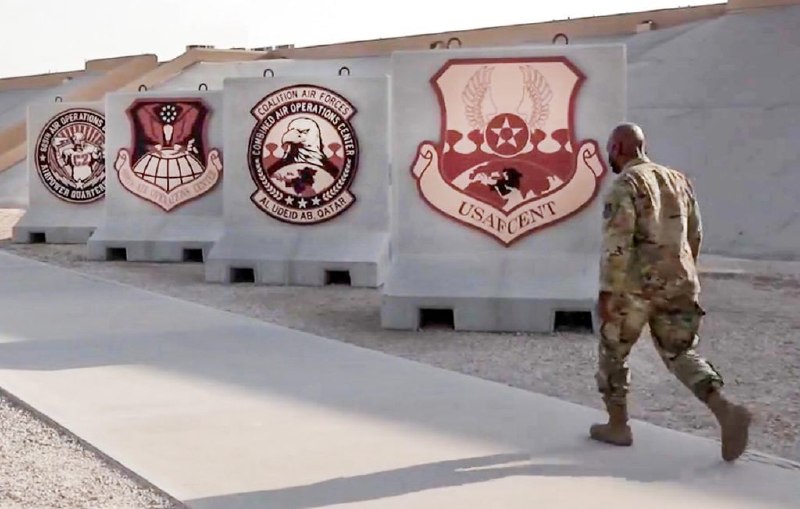
The command centre that runs every American air operation in the Middle East took a direct hit from Iranian ballistic missiles in the opening weeks of the 2026 war and was rendered unusable, according to Air & Space Forces Magazine, the US Air Force's own professional journal. The Combined Air Operations Center at Al Udeid Air Base, Qatar — a hardened, purpose-built facility that has anchored United States Central Command air tasking for two decades — was struck multiple times in what OSINT summaries of the reporting describe as a successful degradation strike. No personnel casualties have been reported. The story is being carried by US military trade press and re-broadcast by Iranian and Russian-aligned channels with predictably different emphases. What is not in dispute is the substantive claim: the air war's nerve centre was hit, and it was hit hard.
The story deserves more weight than it has received. A successful strike on a hardened, forward-deployed C2 node is not a tactical footnote; it is a strategic event. It forces the United States to either disaggregate its command structure under fire, accept degraded operational tempo, or both. That the disclosure comes via Air & Space Forces Magazine rather than a Pentagon briefing tells its own story about how the war is being narrated — and to whom.
The gap between deployment and survivability
For two decades, Al Udeid's CAOC has been treated in American defence writing as functionally untouchable. Pre-positioned logistics, hardened aircraft shelters, layered Patriot and THAAD coverage, and the implicit deterrent of escalation have produced a generation of planning that assumed the centre would be available. The 2026 war appears to have ended that assumption in the first weeks of the campaign. Multiple Iranian ballistic missile strikes landed on or near the facility with enough accuracy and yield to take the CAOC offline, even as nearby Qatari infrastructure remained largely intact. That is not collateral damage; it is a designed effect. Iranian missile guidance has been a development priority for two decades. Al Udeid was always a target list entry.
How the story is travelling
The reporting chain is worth tracing. Air & Space Forces Magazine — a trade publication with deep Pentagon access and the institutional weight to publish what it can verify — ran the substantive claim, attributed to sources via its correspondent Chris Gordon. OSINT aggregators translated the trade-press reporting into social posts, and from there the story moved in two directions: into Western wire summaries, and into Fars News, Tasnim, and other Iranian state-adjacent outlets that framed the strike as a strategic humiliation. The two streams agree on the underlying facts. They diverge entirely on the implication. Iranian framing treats the CAOC strike as evidence that US forward deployment in the Gulf is no longer a safe assumption; the Western stream treats it as a survivable shock that will be repaired in time. Both can be true. The question is the timeline.
What the strike actually degraded
The CAOC is not a building; it is a function. It is where regional air tasking orders are written, where the daily air tasking order flows out to coalition aircraft, where battle damage assessment is consolidated, and where the deconfliction between US, allied, and partner airframes is processed. Taking it offline does not end the air war. It does force the United States to fall back on distributed command-and-control arrangements, expeditionary CAOC capabilities flown into theatre, and pre-delegated authorities to wings already in the fight. The trade press reporting does not yet specify how the United States has reorganised command in the weeks since the strike — only that the facility itself was rendered unusable. That is the operational question the story implicitly raises, and it is the one the Pentagon has not answered on the record.
The hard part
Iran's strategic position in a war of this length does not depend on holding territory, breaking an army, or seizing a capital. It depends on demonstrating that the cost calculus the United States has built around Gulf air power no longer holds — that the bases, the command nodes, and the enablers the joint force assumes will be there can be denied. The Al Udeid strike is the first unambiguous data point of the war on that score. It does not need to be repeated to matter. It only needs to be believed by the planners writing the next air tasking order. Whether the United States rebuilds, relocates, or accepts the new vulnerability is the question the next several months will answer.
What remains genuinely uncertain is the scope. The reporting establishes that the CAOC was hit and that the damage was severe enough to take the centre offline. It does not establish how long the outage has lasted, what percentage of the CAOC's functions have been restored through expeditionary workarounds, or whether the strike was a one-off lucky hit or the result of a broader Iranian fires campaign that will continue. The Pentagon's silence on the operational details is the kind of silence that is, in itself, information. The same publication that has detailed other US air operations in the conflict has not, so far, been permitted to detail the workaround architecture. That detail will come, either when the war ends or when a successor facility is hardened enough that the previous one's loss is no longer a liability. Until then, the gap between the trade press claim and the official record is itself a story.
Air power rests on a small number of nodes and the assumption that they will be there when needed. The 2026 war has now tested that assumption at the most consequential node in the region. The test result, in the pages of the US Air Force's own magazine, is that the assumption was wrong.
Monexus treated the Air & Space Forces Magazine reporting as primary and the Fars News / Tasnim coverage as framing material; the two streams converge on facts while diverging on implication.
Wire provenance
This editorial synthesis draws on the following public wire/social posts:
- https://t.me/osintdefender
- https://t.me/osintlive
- https://t.me/ClashReport
- https://t.me/FarsNewsInt
- https://t.me/JahanTasnim