Hezbollah's Ababil footage puts a new FPV threat on Israel's southern front
Hezbollah-aligned channels released Ababil FPV footage of a Merkava strike in Yahmar al-Shaqif and a Namer strike near Zawtar al-Sharqiya. The clips arrive unverified, but the tactical pattern is what matters.
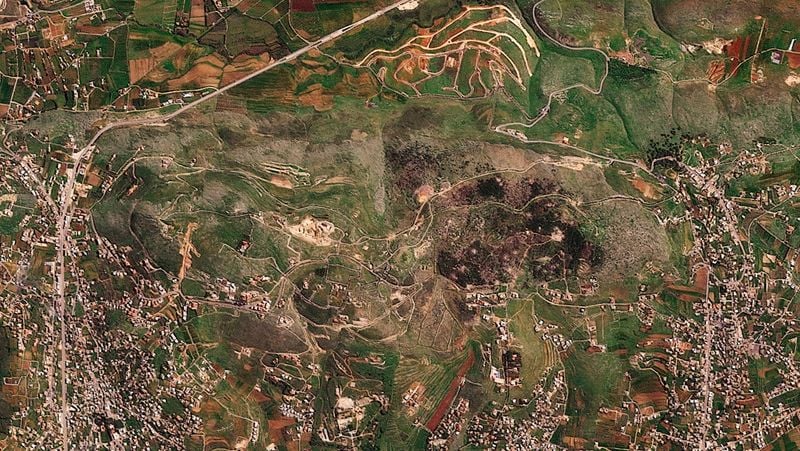
On 5 June 2026, two Hezbollah-aligned Telegram channels circulated separately filmed footage purporting to show an "Ababil" first-person-view (FPV) drone striking an Israeli Merkava main battle tank on the southern outskirts of Yahmar al-Shaqif in southern Lebanon. A parallel release, dated 2 June and circulated on the same day, shows fighters targeting a Namer armored personnel carrier and a gathering of soldiers on the southern outskirts of Zawtar al-Sharqiya. Iranian state-aligned outlet Tasnim News published parallel stills of the Merkava strike. None of the three releases has been independently verified, and the Israel Defense Forces had not, as of writing, issued a public confirmation of either loss.
The pattern matters more than any single frame. FPV drones — small, single-use, manually guided through a live video feed — were the weapon that defined the tactical texture of the war in Ukraine from 2023 onward. Their appearance in southern Lebanon, in growing numbers, on the channels of an Iran-aligned non-state army is a sign that the southern front is being re-priced. The question is no longer whether Hezbollah can field a drone threat; it is whether the threat can now reliably kill crews inside main battle tanks and heavy APCs — the systems Israeli ground manoeuvre doctrine rests on.
What the footage shows
The Yahmar al-Shaqif clip, distributed by the Telegram channel "wfwitness" and amplified across Hezbollah-aligned networks, shows a small quadcopter-style airframe descending on what the releasing channel identifies as a Merkava. The video carries a Hezbollah media overlay; the audio is the operator-side commentary that has become standard for Iranian-axis combat releases. A separate angle, carried by Tasnim, shows a vehicle on fire, turret intact, with no immediate external evidence of penetration visible in the still. The Cradle Media's parallel release, dated 2 June, shows a Namer APC and a cluster of dismounted soldiers at the southern edge of Zawtar al-Sharqiya; the strike mechanism in that clip is less clearly shown.
Two qualifications apply. First, the location identifications rest on the claims of the releasing channels; independent geolocation has not been published. Second, the IDF's standard operating procedure is not to confirm individual vehicle losses in real time, particularly during active operations. The absence of a denial is not a confirmation. What the footage can be expected to do, however, is shape regional and domestic perception of the threat — and that is itself part of the operational logic of the release.
The FPV problem — cheap, hard to counter
The "Ababil" designation is not new. Iranian-aligned media have used the brand across multiple theatres for at least two years, and the airframe designator now covers a family of small quadcopters rather than a single model. What has changed is the guidance architecture. Earlier Iranian drone exports to Hezbollah were largely pre-programmed waypoint munitions and slower loitering surveillance craft. The footage released on 5 June is operator-piloted to impact — a fundamentally different problem set for a defending force.
Counter-drone doctrine, in Israel as in most Western militaries, has been built around detecting and downing larger, slower, higher-altitude systems. The counter-UAS task force has been reorganised repeatedly since 7 October 2023, but the most common countermeasures — electronic jamming, kinetic intercept, hard-kill close-in systems — are sized for threats that look different from a small quadcopter diving at close to terminal velocity. Active protection systems fitted to the Merkava and Namer are optimised for anti-tank missiles and shaped charges, not for top-attack or side-attack small drones.
This is not a Hezbollah-specific insight; it is the same lesson that the war in Ukraine has forced on every Western general staff with a presence in Kyiv's orbit. The relevant question for the northern border is whether Hezbollah has industrial access to FPV airframes at scale, and whether its targeting cycle — find, identify, pilot, strike — can be sustained across multiple engagements per day.
The southern Lebanon context
The southern Lebanon theatre is not new, but its intensity has varied sharply over the past two years. Following the cross-border exchanges of late 2023 and the widening of operations into Gaza's northern front, Hezbollah's tactical footprint along the Blue Line has shifted. Israeli ground operations in southern Lebanese villages have been a recurring feature of IDF briefings, and Hezbollah's media arm has correspondingly increased the cadence of its strike releases. The two locations named in the 5 June footage — Yahmar al-Shaqif and Zawtar al-Sharqiya — sit in the cluster of villages along the Litani's southern bank where ground manoeuvre has been most active.
The 2 June date on the Namer clip is consistent with that pattern. It is also consistent with a deliberate release lag: footage edited, captioned, and held for maximum political effect. Hezbollah's media operations have grown more sophisticated, not less, and the parallel publication of the same strike across an English-language outlet, a Farsi-language state outlet, and Arabic-language Hezbollah-aligned channels is itself a piece of the campaign. The aim is not only tactical surprise; it is informational saturation across the Iran-aligned media sphere.
Stakes and what to watch
If the Ababil footage survives independent verification — a process that typically requires commercial satellite imagery, geolocated ground footage, or official confirmation — the operational implications for the IDF are concrete. First, the active-protection calculus on Merkava and Namer must be revisited, with counter-drone interceptors likely to move up the procurement list. Second, the troop-aggregation rules that put multiple soldiers in proximity to a single heavy vehicle will be re-examined, since a successful FPV strike on a Namer's roof is a casualty event, not merely a vehicle-loss event. Third, the southern Lebanon manoeuvre template — small-unit raids, village clearing, fire-base positioning — will need to be re-priced for a threat that costs the attacker a small fraction of the platform it is striking.
The forward view is not that FPV drones will replace crew-served weapons in southern Lebanon, but that they will continue to compress the cost asymmetry of the contest. The relevant comparison is not the precision-strike era of the 2010s — guided munitions, satellite links, expensive platforms — but the industrial-scale attrition of the mid-2020s, in which the cheaper side wins if it can keep its kill chain warm. Israel's defence establishment is not blind to this; the question is the speed at which counter-measures can be fielded, and whether the southern Lebanon operation can continue at its current tempo while that work is done.
A final note on what remains uncertain. The footage's authenticity has not been independently corroborated; the casualty figures, if any, are not in the public record; and the Israeli response to the specific claims has not been published. What the releases do establish is that the southern Lebanon media battle is being fought on the same axis as the kinetic one, and that the Ababil brand is now a regular part of that contest.
This Monexus desk piece follows the wire footage with the verification caveats the channels' own releases carry. The structural question — whether FPVs have moved from nuisance to lethal effect against main battle tanks — is treated as open. The Israel Defense Forces and the Hezbollah media office were not contacted for this article.
Wire provenance
This editorial synthesis draws on the following public wire/social posts:
- https://t.me/wfwitness
- https://t.me/TheCradleMedia
- https://t.me/tasnimplus
- https://en.wikipedia.org/wiki/Merkava
- https://en.wikipedia.org/wiki/Namer
- https://en.wikipedia.org/wiki/Active_protection_system
- https://en.wikipedia.org/wiki/Hezbollah