Hezbollah claims 11 cross-border operations in a single day, the highest tally since the 2024 ceasefire
Hezbollah's media arm issued three batches of operational statements on 4 June 2026 claiming eleven separate engagements with Israeli forces across southern Lebanon — the highest single-day tally since the November 2024 ceasefire.
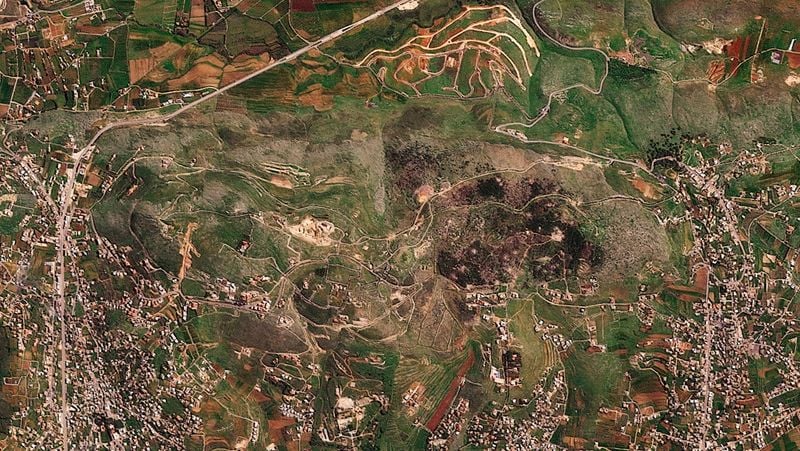
Hezbollah's military media arm issued three separate batches of operational statements on Thursday 4 June 2026, claiming eleven distinct engagements against Israeli forces across southern Lebanon. The figures, aggregated by the Beirut-based outlet The Cradle and the Lebanon-focused Telegram channel wfwitness, are the group's own count and have not been independently verified by any party to the conflict. The pattern they describe — small-arms, anti-tank and rocket fire at multiple points along the border, all framed as retaliation for alleged Israeli "ceasefire violations" — points to an unusually busy single day on a frontier that has been formally quiet since the November 2024 ceasefire.
Read narrowly, the announcements are an operational update from an armed non-state actor with a known interest in keeping its audience informed. Read as a signal, they amount to a public test of the truce's remaining tolerance. The November 2024 arrangement held for fifteen months in part because both sides had reason to keep the lid on: an Israeli government unwilling to be dragged back into a ground campaign, a Hezbollah leadership that had taken a punishing beating in the preceding two years, and a regional environment in which re-escalation was not yet worth the cost. The 4 June statements suggest that equation is being recalculated — and that the remaining restraint is thinner than the post-ceasefire commentary often suggested.
What the statements actually claim
The earliest of the three batches, distributed through wfwitness at 21:43 UTC on 4 June, and a near-identical release twenty minutes later at 22:04 UTC, counted six operations carried out over the course of Thursday. The Cradle, summarising the same set of statements in its own post at 22:04 UTC, added the most specific item: an engagement launched at 02:45 local time "at a gathering of Israeli soldiers and [militia personnel]" — language consistent with Hezbollah's longstanding convention of referring to Israeli personnel collectively. The remaining five in the batch, per The Cradle's summary, involved anti-tank fire, rocket launches, and "appropriate weapons" — Hezbollah's generic cover-all for small arms and RPGs — at unspecified points along the border.
A further batch issued at 22:24 UTC and a third at 23:11 UTC added the additional five operations that produced the eleven-operation daily total. The Cradle's headline for the midday roll-up is the most precise: six more operations "in response to Israeli attacks on Lebanon, bringing the total to 11 so far." None of the three batches names a casualty figure, an Israeli unit, a specific village, or the type of munition used in any of the eleven engagements. The wfwitness posts, which reproduce Hezbollah's text verbatim, also do not.
The 11-figure daily count is, by the standards of the post-2024 period, high. Daily operational statements in 2025 typically referenced one to three engagements, and the late-2025 and early-2026 quiet period saw some days with no statements at all. To cross into double digits in a single release, on a single day, is the kind of escalation-in-output that ceasefire monitors have historically treated as a leading indicator — not of a collapse, but of a deliberate decision to signal.
The framing problem
The single most important qualifier on every one of these claims is that they are Hezbollah's claims. "Israeli ceasefire violations" is the language of the party issuing the statement; it is not the language of the United Nations Interim Force in Lebanon (UNIFIL), the United States, France, the Lebanese state, or the government of Israel — none of which are quoted in any of the three batches.
The November 2024 ceasefire arrangement, brokered under United States and French auspices, was structured around the withdrawal of Israeli ground forces from southern Lebanese towns, a parallel pullback of Hezbollah's heavy weapons north of the Litani River, and the deployment of the Lebanese Armed Forces to the border area. Both sides have accused the other of violations almost continuously since. The Israeli position, as consistently reported in mainstream Israeli and Western wire coverage, has been that Hezbollah's refusal to fully disarm north of the Litani constitutes the original and ongoing violation, and that Israeli air and ground operations in Lebanese territory since the deal have been calibrated responses to specific threats. That framing is not represented in the three Telegram releases the 4 June statements rode in on.
The wfwitness channel, which bills itself as a Lebanon-conflict monitor and reproduces Hezbollah statements in full without commentary, does not in this set of posts dispute that framing or provide an alternative verification path. The Cradle, similarly, is an Iran-sympathetic outlet that does not pretend to neutrality on the Hezbollah–Israel axis. Both are legitimate sources for what the party said; neither is a legitimate source for what actually happened on the ground.
That distinction matters. Operational statements issued in the heat of an active cross-border day serve a domestic Lebanese audience (Hezbollah's own base), an Israeli audience (Israeli military intelligence and the Home Front), and a regional audience (Iran, Syria, the wider axis). All three audiences know that the statements are partisan. The question for outside observers is what, if anything, lies behind the eleven.
What the eleven operations tell us structurally
The structural story is more interesting than the operational one. Across the past eighteen months, the daily cadence of Hezbollah operational statements has tracked two variables more closely than any other: the temperature of the Iran–United States negotiation track, and the level of Israeli air activity over Lebanese territory. When Iranian and American negotiators have been within touching distance of a deal, Hezbollah's daily count has tended to stay low — a deliberate de-escalation to keep the diplomatic channel open. When Israeli air operations have spiked, particularly strikes reported in Lebanese and pan-Arab media as targeting weapons convoys or individual Hezbollah figures, the count has typically gone up within forty-eight hours.
Eleven operations in a single day, attributed by the issuer to Israeli aggression, is the kind of move a calibrated actor makes when it wants the other side — and the mediator — to notice. It is not, on the available evidence, a step toward an all-out resumption of hostilities. The munition types described in The Cradle's summary are short-range, low-yield, and consistent with a messaging campaign rather than an operational one. The fact that the statements were issued in three batches, at intervals of roughly forty minutes, suggests a publicity operation rather than a sustained firefight.
But the line between a message and a spark is a thin one, and the November 2024 arrangement was never designed to survive a serious miscalculation. A single Israeli airstrike in response — even a calibrated one — would be the obvious next move, and the eleven operations would then become the rhetorical justification for Israeli escalation rather than the operational reality of Hezbollah aggression. The structural asymmetry is worth marking: Hezbollah can dial the temperature up with statements and a handful of low-yield engagements; only Israel can dial it down, by choosing not to respond in kind.
What the next 72 hours will tell us
The two things to watch are quite straightforward. First, whether the Israeli Defense Forces issue any public statement acknowledging operations on 4 June — the absence of a statement would suggest the Israeli assessment is that the day did not cross a threshold. A public statement, particularly one identifying targets hit, would be a tell that Jerusalem has decided the messaging has gone too far.
Second, whether the United States — the principal guarantor of the November 2024 deal — reaches for the phone. A public statement from the State Department, or a leak to a wire outlet about the special envoy's conversations with Lebanese and Israeli counterparts, would be the second-strongest signal that Washington believes the truce is genuinely under stress. The strongest signal — a UN Security Council consultation or a French-led demarche — is unlikely to come this fast.
The honest bottom line is that the 4 June numbers tell us a non-state actor with an interest in keeping the ceiling on regional escalation is currently choosing, for reasons it has not stated, to lift the floor. That is a different kind of escalation than the war-weariness framing of late 2025 would suggest, and it deserves more careful reporting than the wire services are currently providing. The unanswered question — what triggered eleven operations on this day, and not on the dozens of days before it — is the one the next 72 hours will have to answer.
Desk note: Monexus is publishing the eleven-operation total because Hezbollah, the Israeli government, and the Lebanese state all have reasons to know about it. The figure is sourced to the party's own operational statements as aggregated by The Cradle and the wfwitness Telegram channel, not treated as a neutral monitor of ground events. The Israeli government's response, when issued, will be added in a follow-up.
Wire provenance
This editorial synthesis draws on the following public wire/social posts:
- https://t.me/thecradlemedia
- https://t.me/wfwitness
- https://en.wikipedia.org/wiki/Hezbollah
- https://en.wikipedia.org/wiki/2024_Lebanon_war
- https://en.wikipedia.org/wiki/United_Nations_Interim_Force_in_Lebanon