A single anonymous source, four drones, and the architecture of escalation
An anonymous US official told CNN that Iran launched one-way attack drones at the Strait of Hormuz. Within minutes, five Telegram channels had repeated the claim and the Iranian counter-frame was already buried. Monexus reads the architecture.
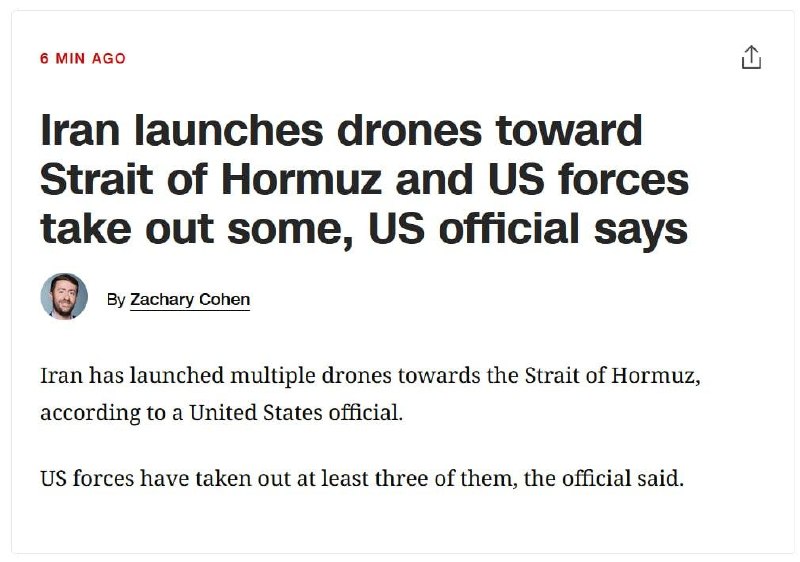
At 22:22 UTC on 5 June 2026, a single anonymous US official told CNN that Iran had launched one-way attack drones toward the Strait of Hormuz. Three of the drones, the official said, were intercepted; by the time the claim reached Telegram channels, the number had drifted to four. The originating report rested on one source speaking on background to one outlet. Within the same hour, the same sentence had been copied across at least five Telegram feeds — The Cradle, RN Intel, Clash Report, the @wfwitness intelligence channel — each citing the previous as though it were independent confirmation. The first Iranian response arrived in the same window: state-affiliated Mehr News reported "no air defence activity" on Kharg Island that evening, a flat denial of the corollary the CNN framing implied.
The structural question is not whether the drones flew — that may resolve in hours, or in the kind of slow declassification that arrives after a regional crisis has already been triggered. The question is how a one-source, attributed-to-official claim becomes the load-bearing wall of an escalatory narrative, while the Iranian counter-frame is treated as a state-media artefact to be discounted rather than evidence to be weighed. This is the texture of the present moment: a single unattributed sentence travels at the speed of a wire copy, accumulates the authority of repetition, and is printed as fact by readers who have never seen the underlying claim independently confirmed.
The single-source escalator
Single-source, single-anonymous-official reporting has been the load-bearing structure of US-Iran coverage for years. The formula is familiar: a US official, speaking on background, describes an Iranian action; the claim ricochets through the wire ecosystem; the original source is never named and therefore cannot be interrogated. By the time a counter-statement arrives — in this case Mehr News's denial of any Kharg Island activity, which itself must be discounted as Iranian state media — the cycle is already in motion. The Telegram channels that carried the CNN formulation did not cross-check. They passed the claim forward, in a chain that looked like confirmation but was actually repetition. The semantic effect is identical; the epistemic effect is the opposite.
The counter-frame, and what it is worth
The Mehr News statement, distributed through the @wfwitness Telegram feed, is a denial of a different fact: "no air defence activity occurred on Kharg Island this evening." That is not a denial of the broader CNN claim but a contradiction of an implicit corollary — that the drones either came from, or were engaged over, Iranian territory. Iranian state media is not a neutral source, and the editorial discipline of discounting it stands. But the structural observation also stands: when one anonymous source produces a one-sided frame, the counter-frame deserves equal weight, not as truth, but as evidence that the original report has not been independently confirmed. The Western wire ecosystem rarely applies the same scepticism to a US official's anonymous claim as it does to a Tasnim or IRNA denial. The asymmetry is the story.
The architecture of escalation
Anonymous-source escalatory claims serve a particular function in the US-Iran relationship. They make any Iranian response look like confirmation: shoot down the drones, you have admitted they were yours; deny the drones, you have called the US a liar. The geometry traps Tehran in a position where either move validates the original claim. The four intercepts, the loitering-munition profile, the timing — all of these are facts, but they are facts of a single channel of reporting. The US Navy's Fifth Fleet, headquartered in Bahrain and tasked with the Strait, has not, at the time of writing, confirmed the incident on the record. CENTCOM has not confirmed. Omani and Emirati ministries have not confirmed. The claim exists, for now, in the space between one anonymous sentence and the markets that will move on it.
The stakes are concrete and named. Roughly a fifth of the world's seaborne crude transits the Strait of Hormuz; a sustained closure moves the global economy into recession within weeks and lifts Brent above any price level the post-2022 period has seen. A single misread at Hormuz becomes a tanker incident, becomes a US strike, becomes a regional war that consumes the Gulf, the Levant, and the chokepoint simultaneously. The drone incident may resolve as a routine intercept — a single probe, an unmanned reconnaissance, an Iranian signal of red-line resolve — or it may not. The structural problem is that we are deciding which interpretation to print, and which markets to move, on the basis of a sentence attributed to a US official whose name we are not permitted to know. That is not journalism. It is the public surface of a classified process, and the public gets the worst of both worlds: too much information to ignore, too little to verify.
The drones may or may not have flown. The official may or may not be in a position to know. What is certain is the propagation: by the time a reader in Berlin or Mumbai opens a feed, the claim has been laundered through five channels and arrived as fact. The next step is oil futures, then a statement from a Gulf ministry, then a White House readout. The architecture of the escalation was built in the first sixty seconds, before anyone checked.
Desk note: Monexus is publishing this analysis in real time as the underlying facts remain unsettled. We will update if the US account is independently corroborated, if Iran issues a formal statement, or if the Fifth Fleet or CENTCOM confirms or denies the intercept report.
Wire provenance
This editorial synthesis draws on the following public wire/social posts:
- https://t.me/thecradlemedia
- https://t.me/rnintel
- https://t.me/ClashReport
- https://t.me/wfwitness
- https://t.me/mehrnews