The arithmetic of Gaza's tent camps and the Western headline
The 6 June strikes on Gaza's tent camps ran on a familiar schedule. The headlines that followed ran on an equally familiar one. Both are the story.
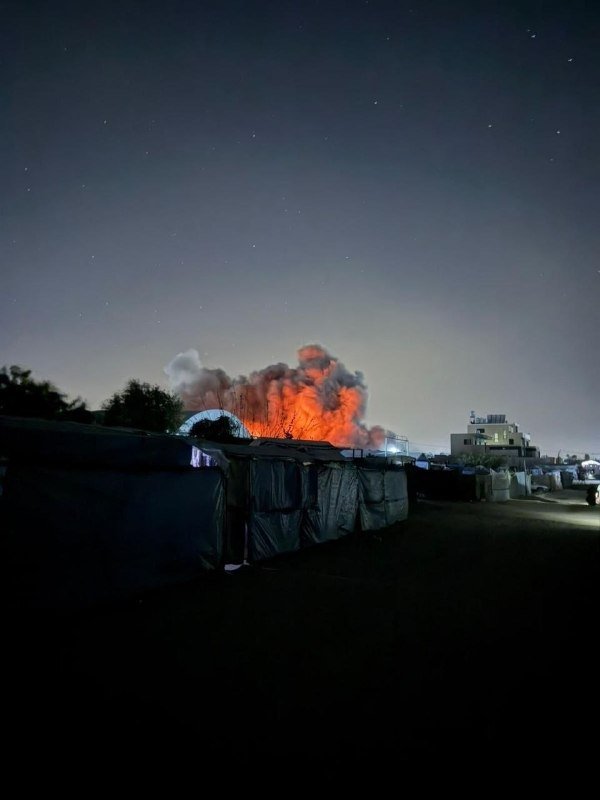
On the evening of 6 June 2026, the pattern repeated itself with the regularity of a metronome. The Israeli military issued an evacuation order for a location in the Al-Maghazi refugee camp in the central Gaza Strip, telegraphing a planned strike. Hours later, by roughly 19:24 UTC, Israeli warplanes were striking the camp — including a house east of it. By 19:25 UTC, Al Jazeera was reporting an Israeli attack on a tent camp in western Gaza City that killed several Palestinians, with Palestinian sources cited by the Iran-aligned Al Alam Arabic channel placing the toll at eight.
The choreography — warning, then ordnance — has become so familiar it barely registers in the Western headline cycle. The civilians sheltering in those tents are not abstractions. They are people displaced from other parts of the strip, packed into shrinking "safe" zones, then killed when those zones turn out to be neither safe nor zones in any meaningful sense.
What is striking about the 6 June reporting is not the strike itself — strikes on Gaza have been continuous for the better part of two years — but the bureaucratic language that surrounds it. "Evacuation order." "Planned strike." "Tents of displaced people." The vocabulary of military operations is being deployed to describe what is, in cumulative effect, the systematic reduction of a civilian population to a target set. The structural story is not new. Each iteration simply makes the framing harder to defend.
The evacuation that evacuates nothing
The Israeli army's pre-strike warnings are widely treated in the Anglophone press as evidence of compliance with the laws of armed conflict — a courtesy to civilians, an opportunity to move. In a strip of roughly 365 square kilometres holding the better part of two million people, the majority already displaced, "evacuation" is a category error. There is nowhere to evacuate to. The "humanitarian zones" the IDF has previously designated in al-Mawasi and elsewhere have themselves been struck repeatedly. The architecture of safety exists on a map, not on the ground.
What the warning actually does is shift legal and moral risk onto the civilians who remain. Those who flee move to other parts of a strip without functioning hospitals, food distribution, or sanitation. Those who stay are documented as having been warned — which is then read by international observers as a partial shield against subsequent accountability. It is, in plain terms, a procedural move: it converts the killing of civilians into a question of compliance rather than a question of why it is being done at all.
Al-Maghazi is a useful case study. Originally a refuge for Palestinians displaced in 1948, bombed, re-established, bombed again. The evacuation order at 19:04 UTC on 6 June named a location. The strike followed. The same script has played out in Jabalia, Beit Lahia, and the proliferating tent encampments around Gaza City. The script is the policy.
The arithmetic of "several"
The wire that broke the tent-camp story in English on 6 June — Al Jazeera — used the word "several." Palestinian sources carried by Al Alam Arabic put the figure at eight. The gap is not just numerical. It is a window onto how casualty information is graded.
Figures originating with Palestinian sources are routinely treated as preliminary, contested, or politically compromised. This is not without basis: figures from the Hamas-run health ministry have been challenged in narrow technical ways. But the consistent Anglophone practice of substituting "several" for a sourced higher number, or of using the passive voice ("killed in an Israeli strike") without a toll at all, performs a particular kind of editorial work. It keeps the count soft, the body count abstract, the action depersonalised. It converts a death toll into an event.
A reader relying on the Western wires for 6 June knows that "several Palestinians" died in a tent camp. A reader relying on regional Arabic-language channels knows the count is at least eight, that the dead were in tents, that they were displaced. The information asymmetry is not accidental. It is the working product of an editorial culture that treats Palestinian life as a category requiring more verification than Israeli military communiqués.
What the framing protects
The serious question — and it must be answered seriously — is what this reporting architecture is for. The honest answer is that it protects a particular account of the war. On that account, Israeli military operations are responses to the 7 October 2023 attack, conducted under the pressures of urban warfare against an embedded enemy, complicated by Hamas's use of civilian infrastructure, accompanied by extraordinary measures to spare non-combatants. There is nothing fictitious about any of these claims. The hostages taken on 7 October remain a live political and moral fact. The security concerns driving Israeli operations are real and do not evaporate when they become inconvenient.
But the framing cannot be allowed to do the work of justification on its own. The October 7 attack was a war crime. The response has its own legal and moral architecture, and that architecture is what is now on display in Al-Maghazi and the tent camps of western Gaza City. Calling a strike "planned" and a displacement zone a "humanitarian area" does not, on its own, convert those descriptions into descriptions of the underlying reality. The civilians in the tents are not the hostages. They are not Hamas. They are the people the system, as currently operated, was supposed to spare.
What it would take to report this honestly
Reporting 6 June's strikes honestly would mean publishing the Palestinian-source casualty counts at face value, with appropriate attribution, rather than rounding them down to "several." It would mean naming tent camps as encampments of the forcibly displaced, not as military-adjacent structures. It would mean asking, on every strike, what the military said the target was, what the actual result was, and reporting the gap. It would mean treating an evacuation order as evidence of intent to strike, not as evidence of mercy.
The information is available. The sources exist. What is missing is the editorial decision to use them at their actual weight. Until that decision is made, the headlines will continue to read the way they read: a strike happened, several died, the army had issued a warning. The reader is left to assemble the rest.
How Monexus framed this: the 6 June wire produced a familiar split — a mainstream outlet's "several" set against a regional Arabic channel's sourced figure of eight. This piece tracks that split, and the editorial choices that produced it.
Wire provenance
This editorial synthesis draws on the following public wire/social posts:
- https://t.me/alalamarabic
- https://t.me/alalamarabic
- https://t.me/gazaalanpa
- https://t.me/gazaalanpa