Twenty-five operations and a strike: reading the south-Lebanon information seam
An Israeli strike that killed a Lebanese general and an Iranian-channel claim of twenty-five Hezbollah operations reached the public within forty minutes of each other. The gap between them is where the war is actually being read.
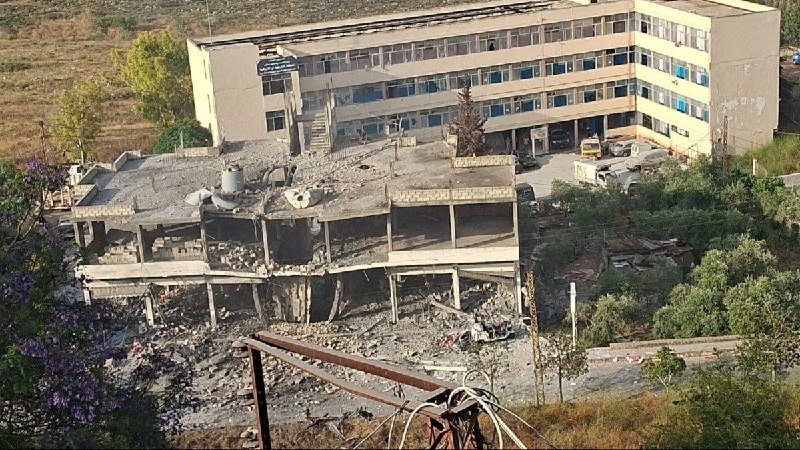
At 20:38 UTC on 6 June 2026, BBC World reported that a Lebanese general was among three soldiers killed in an Israeli attack on a car in south Lebanon, with the Israeli military confirming that an investigation is underway. Within forty minutes, three Iranian state-affiliated Telegram channels — Mehr News, Tasnim, and Jahan Tasnim — were publishing claims of Hezbollah strikes on Israeli positions around the Al-Tiri settlement, with one channel asserting twenty-five operations in a single day-night cycle. The reader is asked to hold two incompatible stories in the same hand: a verified strike that killed a named rank, and a torrent of operational claims that no outside camera has corroborated. Welcome to the Israel-Lebanon border in 2026, where the operational tempo is published faster than the operational reality can be checked.
This is not only a propaganda point. It is a structural problem for anyone trying to read the war. Iranian-aligned outlets, citing Hezbollah statements, drive the daily news cycle. Western wires, citing Israeli and Lebanese military sources, run slower and more cautious stories. The gap between them is filled with speculation, retweets, and the by-products of an information architecture that rewards volume over verification. The pattern repeats across every front where Tehran-aligned groups are operationally active. Until readers and editors treat the source rather than the claim as the primary unit of news, the headlines will keep running ahead of the facts.
When the claim outruns the confirmation
Counting operations is a substitute for winning them. Tasnim's English service and Mehr News on the evening of 6 June ran near-identical stories about Hezbollah strikes on Israeli "gathering and deployment" points around the Al-Tiri settlement — language that is, charitably, generic. "Targeted the gathering and deployment of Israeli soldiers and armored vehicles" is the operational equivalent of fog: it asserts success without describing a target, an outcome, or a casualty. Jahan Tasnim, citing a Hezbollah statement, escalated the count to twenty-five operations in twenty-four hours, a figure that would, if accurate, represent one of the most intense Hezbollah operational days of the entire 2025–2026 border conflict. No independent satellite imagery, no Israeli military confirmation of casualties, no third-party reporting from Reuters, AFP, or AP has been cited alongside the figure.
This is not unusual. It is the routine. Iranian-aligned outlets publishing in English — Tasnim, Mehr, PressTV, state-aligned channels on Telegram — function as a translation layer for claims issued in Beirut, Tehran, or south Lebanon, repackaged for an international wire feed. They carry the cadence of news; they lack the architecture. Treating them as news wires is a category error that has now been repeated often enough to become a habit. Monexus finds the structural bias consistent: success is granular and immediate, failure is silent, and verification is somebody else's problem.
When Western wires lower their voice
The contrast with the BBC's reporting is sharp and instructive. A named rank — a Lebanese general — was killed in a strike on a vehicle. The Israeli military said it is investigating. No Israeli source is quoted celebrating the strike; no Hezbollah source is quoted claiming an operation on the same coordinates; no Iranian channel is, in the same hour, crowing about twenty-five operations. The story is told in the conditional. It admits to gaps.
That kind of reporting is more credible, but it is also slower, drier, and less shareable. A twenty-five-operations claim moves through Telegram, X, and aggregators within minutes; a BBC confirmation that a strike is under investigation takes hours and lands on a smaller, less viral audience. In a media economy optimised for engagement, the louder claim wins by default. The verified counter-claim is read, if at all, by the people who would have read the first one carefully. The two ecosystems are not symmetric: one is built to publish, the other is built to confirm, and the publishing ecosystem is louder by design.
The information layer is the operational layer
What this means is uncomfortable. The image of the south-Lebanon battlefield that reaches a non-specialist reader on any given day is being assembled in roughly equal parts from Hezbollah communiqués translated into English by Iranian outlets, and from a small number of Western wires that are themselves stretched thin and dependent on Israeli, Lebanese, and UNIFIL confirmation. There is no equivalent in Beirut of the open-source intelligence ecosystem that covers Ukraine, where researchers and journalists can verify crater locations, flight paths, and unit movements within hours. The terrain is closed. The claim-makers are organised. The verifiers are few.
Until that balance shifts, every claim that originates from the Iranian-Hezbollah information stack should be read the way one reads a company's own marketing: structurally biased toward success, structurally vague on failure, and structurally uninterested in third-party verification. That does not make the claims false. It makes them unverified by default, and the difference matters. The same caveat applies, in the opposite direction, to Israeli military communiqués — and the wire ecosystem that carries both knows it.
What it costs
The cost of this asymmetry is not abstract. In Beirut, the families of the three soldiers killed in Friday's car strike are being asked to trust a reporting environment in which an Iranian channel's claim of twenty-five operations sits three clicks away from a BBC report that the strike is under investigation. In northern Israel, families of soldiers deployed along the border are reading the same feeds and being told, by adjacent sources, that operations are proceeding at a tempo that would, if true, dominate the evening news. Neither side has clean information. Both sides have plenty of noise. The casualty figures, the political decisions, the diplomatic negotiations that follow will be made inside that noise. The asymmetry is not between two press ecosystems. It is between one ecosystem that over-claims and one that under-reports. The honest reader's job is to keep both habits in view.
Reading the seam
The seam between an Iranian-channel claim and a BBC report is where the next phase of this war is actually being fought. The guns move pieces. The information architecture decides which pieces get named, which get counted, and which disappear. Until the reading public treats source provenance with the same scepticism it now applies to a sponsored post, the loudest channel will keep setting the agenda, and the careful one will keep filing the correction two hours later, to an audience that has already moved on. The Lebanon file is not a special case. It is the template.
Wire provenance
This editorial synthesis draws on the following public wire/social posts:
- https://t.me/BBCWorldoffl
- https://t.me/tasnimnews_en
- https://t.me/JahanTasnim
- https://t.me/mehrnews