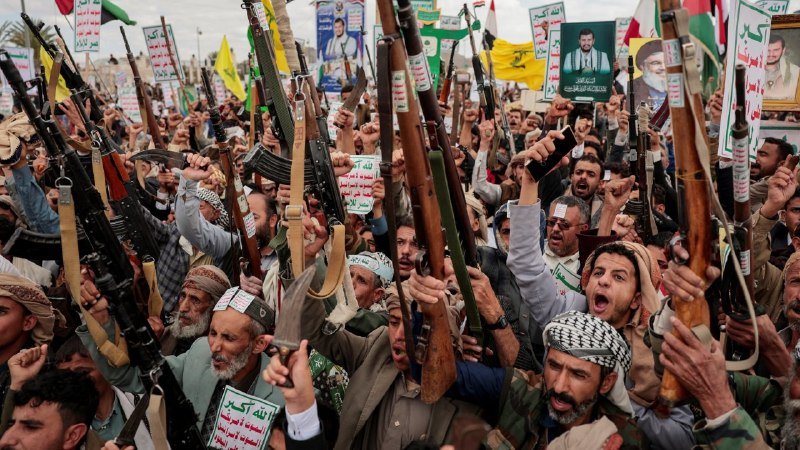
The Houthis are not the headline — the Iran-Israel escalation is

Late on 8 June 2026 the Israeli Air Force was attempting to intercept at least one suicide drone near southern Israel that, according to the open-source channel GeoPWatch, was believed to have been launched from Yemen. The interception attempt came hours after the Iranian-aligned Houthi movement publicly claimed a missile strike on Israel and declared a total ban on Israeli maritime navigation in the Red Sea, a position Reuters confirmed in its own wire on the same day. The drone interception attempt came hours after the Israeli Air Force struck military targets in western and central Iran, a strike that the US-investor account Unusual Whales reported was carried out despite President Donald Trump telling Israel not to proceed, citing the Financial Times.
Read these three items — the Houthi maritime ban, the Houthi missile claim, the Israeli strike on Iran — and a single picture emerges. This publication finds that the day's events are not three separate stories. They are three lines of fire from a single escalation, and the global press is reading them in parallel rather than as one.
What actually happened, in order
At 02:59 UTC on 8 June 2026, Unusual Whales broke the news that the Israeli Air Force had struck military targets in western and central Iran. The post quoted the Financial Times as reporting that US President Donald Trump had asked Israel not to strike. At 16:34 UTC, the Epoch Times reported that the Houthis claimed a missile strike on Israel and declared a total ban on Israeli shipping in the Red Sea. By 16:40 UTC, Reuters confirmed the Houthi threat to Israeli shipping, framing it as a direct response to the Israel–Iran confrontation. By 16:52 UTC, the Israeli Air Force was attempting to intercept a suicide drone near southern Israel, with GeoPWatch reporting that the drone was believed to have been launched from Yemen.
In other words, in roughly fourteen hours, Israel struck Iran, the Houthis declared a Red Sea blockade of Israeli shipping, and a Yemeni-launched drone entered Israeli airspace. The choreography is unusually tight.
The framing the wires are choosing — and what it leaves out
The Reuters and Epoch Times treatments lead with the Houthi ban on Israeli shipping. The Israeli strike on Iran is being carried as a regional security story, with the political weight on the Trump-Israel disagreement. The Yemeni drone is being treated as a sub-plot. Each individual framing is defensible. Cumulatively, they let the structural picture escape — which is that a single command logic is firing from Sanaa, Tehran, and Tel Aviv on the same day, in a sequence that is hard to explain as coincidence.
Coverage also defers to official spokespeople on all sides. The Houthis speak through their own media apparatus, the Israeli Air Force through its spokespeople, and Iran through state-aligned outlets. The result is a press record in which the public hears the claims but not the connective tissue.
What the structural pattern actually looks like
The dynamic on display is a textbook multi-axis escalation. When an actor strikes the territory of a great power, the strike invites counter-strikes not only from the great power itself but from the regional proxies aligned with the target. Iran does not need to fire directly at Israel from its own soil — the Houthis can fire on Israeli shipping in the Red Sea, Hezbollah can fire from Lebanon, and Iraqi militias can fire from Iraq. The effect is to multiply the cost of any Israeli action across multiple fronts simultaneously, and to dilute the political weight of any single strike. What the day shows is that this dispersal is operational, not theoretical, and that it is being telegraphed openly rather than concealed.
The economic reading is no less important. Roughly twelve percent of global trade transits the Red Sea. A declared ban on Israeli shipping is a narrow legal instrument; the practical effect is insurance-warfare, in which underwriters raise war-risk premia across the corridor and shipowners reroute. If the ban is enforced for even a week, the cost of compliance in the Suez-Bab el-Mandeb corridor will rise, and the freight rate signal will spread well beyond Israeli-flagged tonnage.
The stake for everyone outside the region
The governments with the most exposure are not in the Middle East. They are in Beijing, Brussels, Tokyo, and Seoul — the importers of Gulf hydrocarbon and the exporters of finished goods that transit the Red Sea. If the corridor becomes a sustained theatre of operations, the cost will be passed through to global freight rates, to energy prices, and eventually to consumer prices in markets far from Sanaa. The Western wire coverage has, to this point, treated the dispute as a regional security problem. The honest read is that it is a trade-route problem with a regional security cause.
The Israeli political dimension is also in play. The reported US request not to strike — and Israel's reported decision to strike anyway — is a public fracture in the alignment between Washington and Jerusalem. The wire record carries it, but no outlet has yet made it the spine of the story.
What remains contested
The sources do not agree on the drone's origin. GeoPWatch described it as "believed to have been launched from Yemen"; no Israeli or US official confirmation is in the public record at the time of writing. The Houthis have publicly claimed the missile strike; neither Israeli confirmation nor independent corroboration of impact is present in the day's wire. The Financial Times, cited by Unusual Whales, has not been independently linked in the public record for the Trump-Israel exchange, though the account is being repeated across investor-facing social channels. The honest position is that the day's events are real, the sequencing is tight, and the chain of causation is asserted rather than proven. The press will catch up. It is the trade and energy desks, not the politics desks, that should be watching.
Desk note: The wire record treats 8 June 2026 as three events; Monexus treats them as one. The Suadi-Israeli strike, the Houthi maritime ban, and the Yemeni-launched drone share a clock, a logic, and a freight corridor. The mainstream frame obscures the connective tissue by isolating each line of fire.
Wire provenance
This editorial synthesis draws on the following public wire/social posts:
- https://t.me/s/GeoPWatch
- http://reut.rs/3Q6BIri
- https://x.com/unusual_whales/status/