The Lebanon Strikes Aren't a Ceasefire Violation. They're a Repricing of What 'Ceasefire' Means.
Two months after the November 2024 deal, Israeli strikes on Tyre are being filed as 'violations' while the architecture they belong to has quietly stopped functioning. The grammar is doing the work the underlying arrangement no longer can.
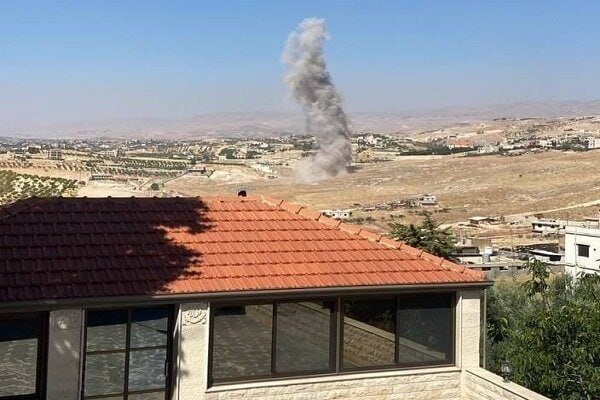
At 10:30 UTC on 9 June 2026, an account identifying itself with the city of Tyre posted video it said showed Israeli strikes hitting targets inside the southern Lebanese port, two months past the ceasefire that was supposed to silence them. A second post, ten minutes later, framed the bombardment as a continuation of Israeli ceasefire violations. A third, from the same handle at 10:07 UTC, noted that the strikes were continuing "despite Iran's warning," and ran alongside footage of column after column of smoke over the coast. The grammar of the reporting, on that Tuesday morning, was already fixed: Israel had broken something. The deeper question, the one the headlines kept skipping over, was what the word "ceasefire" had come to mean on the ground between the Litani and the border.
What is striking is how little friction the word now generates. The November 2024 arrangement was sold as a halt to the fighting between Israel and Hezbollah, an exchange of detainees and territorial withdrawals for an end to rocket fire and Israeli overflights. The Lebanese state, Israeli officers, and UN intermediaries each signed onto that grammar. Two and a half years later, the same grammar still travels through wire copy, but the underlying arrangement has been hollowed out by a series of unilateral acts that have not been formally repudiated, only absorbed.
The strikes that no one quite names
The pattern in southern Lebanon is now so routine that the platforms covering it have begun to compress their language. An account tied to Tyre describes "aggression against the city of Sur," a framing borrowed directly from the Iranian-aligned press ecosystem, in which any Israeli action inside Lebanese airspace is treated as a singular event rather than as part of a continuous posture. The video evidence, grainy and geolocated only by the posters, is consistent with the kind of targeted strikes Israel has acknowledged on a near-weekly basis for the better part of a year.
What has changed is the diplomatic air around those strikes. The Iranian warning referenced in the 9 June posts is itself a tell: Iran's capacity to enforce any red line inside Lebanese airspace is, by June 2026, almost entirely rhetorical. The deterrence function that Hezbollah once performed has migrated to a different set of actors, none of whom operate under the ceasefire's formal umbrella. Israel, for its part, has stopped describing individual strikes as defensive exceptions and has begun describing the campaign in the language of pre-emption, a frame that fits uneasily inside an arrangement whose entire purpose was the absence of armed action.
A ceasefire without counter-party
The structural problem is not that one side is cheating. It is that the original architecture of the deal was built for two parties who no longer exercise a monopoly over the relevant violence. Hezbollah's command structure was degraded in the 2024 campaign and never restored to its pre-war shape. The Lebanese Armed Forces, formally responsible for the territory south of the Litani under the agreement, have not deployed at the scale required to police the area on their own. Iranian-supplied munitions and advisers continue to be reported in the border zone by Israeli and Western intelligence, though Lebanon's caretaker government has neither confirmed nor denied the presence.
A ceasefire, in the strict sense, is a bilateral suspension. What has been operating since the late spring is closer to a tolerance regime: Israel strikes what it identifies as infrastructure tied to the residual Iranian presence, Lebanon registers complaints through diplomatic channels, and the UN Special Coordinator's office files the incidents into a database that grows longer without producing consequences. Each individual strike is technically a violation. The cumulative effect is no longer describable as a ceasefire at all.
The vocabulary has already moved
Israeli press in recent weeks has largely stopped using the word "violation" for routine strikes inside Lebanon, defaulting instead to "operations" or "activity," a quiet lexical shift that mirrors what is happening on the other side. Lebanese outlets, when they cover the strikes, increasingly frame them inside an Iranian-supplied narrative in which the original deal was always a deception and the current bombardment is the proof. Both sides have, in effect, agreed to disagree about what the document they signed means, and to disagree loudly enough that the disagreement itself becomes the news.
What "ceasefire" buys you now
The practical effect is that the November 2024 ceasefire has become a kind of placeholder, a piece of diplomatic furniture everyone still refers to while doing business on top of it. Lebanon's government uses it to demand reconstruction funding. Israel uses it to justify a security zone in everything but name. Iran uses it to demonstrate that it can still set the temperature of the conversation in Beirut without having to fire a shot. None of these uses requires the arrangement to be functioning. All of them require it to still be called a ceasefire.
The strikes on Tyre on the morning of 9 June did not break anything. They revealed what was already broken. The word has been doing work the underlying reality cannot support, and the longer the diplomatic class insists on using it, the harder it becomes to name the actual state of affairs: an armed, partial, openly contested military posture inside a territory whose formal status is frozen at November 2024.
SOURCES: boweschay, X, 9 June 2026; sprinterpress, X, 9 June 2026; sprinterpress, X, 9 June 2026.\n\nDESK NOTE: Monexus frames the southern Lebanon strikes as a vocabulary problem inside a hollowed-out ceasefire rather than as a discrete violation, in line with our standing guidance on the Israel–Palestine and wider Middle East conflict.