Belfast burns, London lectures: Starmer's tightrope over the immigration riots
A hijacked bus torched in west Belfast and an assault the prime minister called 'sickening' have put Keir Starmer back on the same tightrope London has walked since last summer — denouncing disorder without conceding the political ground it feeds.
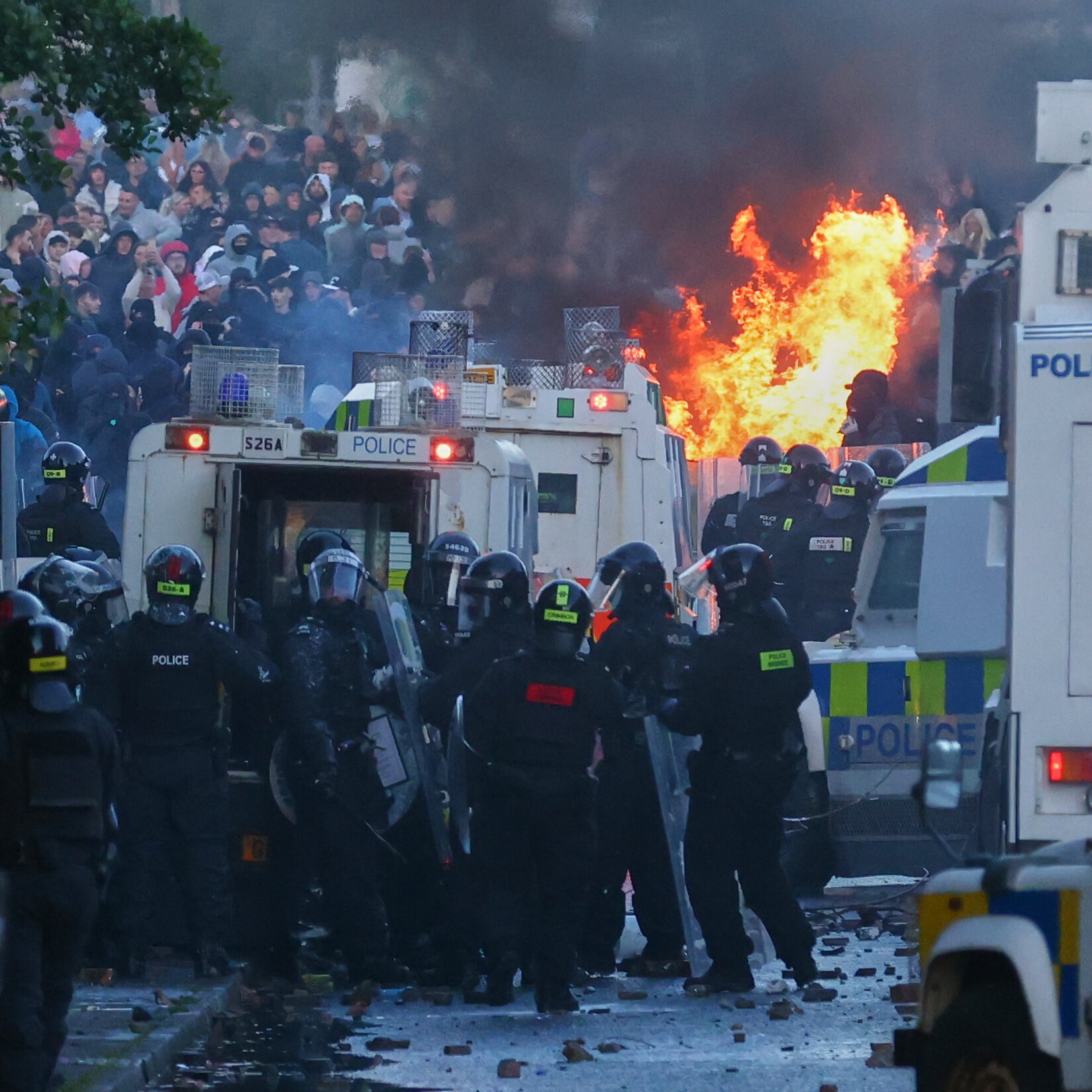
A double-decker was hijacked, doused and set ablaze on the Stewartstown Road in west Belfast during the afternoon of 10 June 2026, the third consecutive day of anti-immigration unrest in the city. Footage circulating on Telegram channels tracking the disturbances shows the bus fully engulfed, with bystanders kept back from the carriageway as the fire took hold. The incident came hours after a serious assault in Belfast that Prime Minister Keir Starmer, speaking from Downing Street on 10 June 2026, said had left the public "rightly sickened." The juxtaposition is now uncomfortably familiar: a violent street theatre of grievance, a rhetorical response from London, and a policing and political operation scrambling to keep the two from detonating into each other.
This is the second summer in a row that the United Kingdom has had to manage disorder it would rather not call by its older name. The pattern is no longer a flash flood but a season, and Starmer's government has now had to write a second playbook. The first, drafted in the dog days of August 2024, treated the rioting as a one-off contagion from a single atrocity in Southport. The second treats it as a recurring condition — and the political cost of getting the diagnosis wrong is rising.
A political script, written in real time
Starmer's 10 June 2026 statement followed a recognisable template. The assault was condemned in unconditional terms, the suspect was confirmed as arrested and charged, the victim's family was offered the prime minister's thoughts, and the violence around the edges was detached from the "righteous" anger the prime minister insisted the wider public felt. The line between condemning criminality and validating the sentiment that fuels it is the same one every British leader has had to walk since the English riots of 2024, and Starmer is now walking it twice. The political risk is asymmetry: a prime minister can be wrong about the criminals and merely look weak. He can be wrong about the sentiment and look like he has lost the country.
The Belfast arson marks an escalation in the physical repertoire of the protests. Hijacking and burning a public-service vehicle is not the same act as marching, and the choice of target — a bus, used disproportionately by working-class communities in west Belfast — carries its own politics. The image of a hijacked bus burning on a road named for a Troubles-era security corridor also lands differently than the same scene in Hull or Plymouth would. Northern Ireland's history of interface politics, contested policing and tit-for-tat violence is never far below the surface, and the Police Service of Northern Ireland is now managing a disorder pattern more associated with mainland English towns since 2024 than with the post-1998 settlement.
The counter-read: what the framing leaves out
The official line — criminality, isolated thugs, a robust justice response — is not wrong, but it is incomplete. A serious analysis has to ask why, twelve months on, the same actors are mobilising in the same numbers with the same demands. Two structural drivers are visible in the reporting on the ground. The first is the collapse of public confidence in the government's asylum and deportation numbers, with successive home secretaries having promised removals at scales the system has not delivered. The second is the perception — held across a wide political spectrum, including by some Labour voters — that those who arrive irregularly are processed faster than those who obey the rules, a perception the government has not seriously rebutted with data. To treat the Belfast bus, in other words, as a pure policing problem is to mistake the symptom for the disease.
The alternative read, common in commentary Telegram channels and on the populist right, is that the disorder is a legitimate and rational response to a failed border policy, and that the criminal acts are the understandable excess of a justified cause. That framing should be refused. Arson, hijacking and assault are not legitimate political instruments in a democracy with functioning courts and a free press. But the refusal must be precise: a state that wants the public to reject the politics of the street has to offer the politics of the ballot something recognisable in return.
Structural frame: a state that has stopped narrating
What the United Kingdom is now exporting, in both Belfast and English provincial cities, is the visible end-state of a migration debate in which the central authority has stopped narrating confidently. Successive governments — Conservative from 2010, Labour since 2024 — have talked about a "smashing the gangs" strategy and a returns deal with Rwanda, only to watch the headline numbers go in the wrong direction. The capability gap is no longer hidden: the public can see what the state can and cannot do, and is calibrating accordingly. When the state cannot visibly enforce its own border, the politics of enforcement migrates to the high street, the hotel foyer and now the bus depot. The arson is the symptom; the withdrawal of credible state capacity is the condition.
The deeper issue, harder to discuss in the public square, is the contested question of integration. Belfast is a city that knows, more intimately than almost any other in the United Kingdom, what it looks like when two communities stop sharing public space. The lesson of the 1998 settlement is not that grievances disappear but that institutions strong enough to absorb them are built. Whether the current political class, in Westminster and at Stormont, is willing to invest in that institutional layer — schools, housing, mixed-community policing, labour-market integration — is the question the bus fire is really asking.
Stakes: a precedent the government does not want to set
If the second playbook looks like the first, the political damage compounds. The first playbook produced a brief national unity, a heavy-handed sentencing wave, and a collapse in the Reform UK polling lead that lasted approximately one fiscal cycle. The second is unfolding in a tighter fiscal environment, with a more polarised media, and with an official opposition that has decided its political future is the inheritance of the grievance the government refuses to channel. Starmer can hold the line on law and order; the question is whether the line he is holding is the one the country needs, or merely the one that is politically least expensive in the next polling week.
What remains genuinely uncertain is the link, if any, between the Belfast disorder and the organised far right active in mainland English riots of 2024 and 2025. The sources available to Monexus do not specify whether the west Belfast incidents were coordinated, locally generated, or a hybrid. Until the Police Service of Northern Ireland publishes its assessment, any claim of a national orchestration should be treated as provisional. What is not provisional is that a hijacked bus is a step up the escalatory ladder, and that the next step on that ladder is the one a competent government is supposed to prevent.
Monexus framed this as a test of the second iteration of a now-familiar British crisis, with the same template, the same counter-claims, and a higher political cost each time it is repeated. The wire has been characteristically careful to keep the Belfast and English incidents in separate frames; Monexus holds them in the same one.
Wire provenance
This editorial synthesis draws on the following public wire/social posts:
- https://t.me/MyLordBebo
- https://t.me/MyLordBebo
- https://t.me/MyLordBebo