Order Without Authority: Gaza's Militia Roadblocks and the End of Hamas's Monopoly on Violence
Rival armed groups are running checkpoints and seizing people on Gazan's roads, exposing how the war has shredded the territory's last institutional layer — and why no one in particular is in charge of putting it back together.
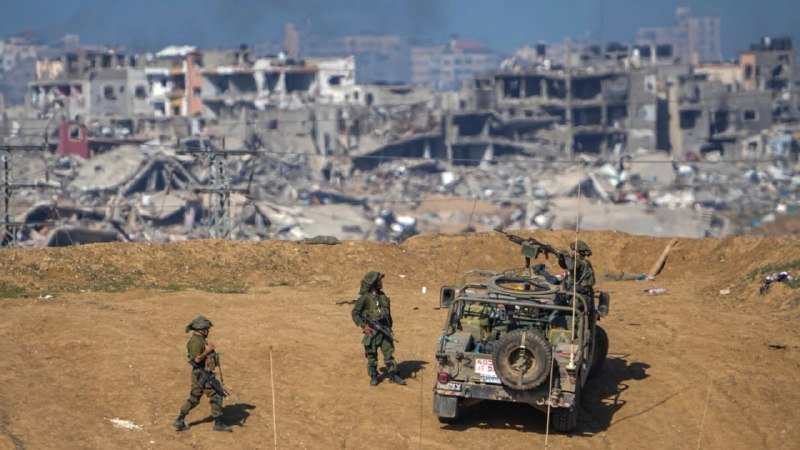
On the morning of 9 June 2026, armed men described in local reporting as members of Gazan militias opposed to Hamas set up a roadblock on an unspecified road in the Strip, intercepted passing traffic, and removed individuals from vehicles. By the afternoon of 10 June, two Telegram channels that aggregate Gazan field dispatches — @englishabuali and @abualiexpress — were circulating the same account: that what locals are calling "kidnapping" operations by anti-Hamas militias are no longer a rumor but a recurring practice, with a single roadblock yesterday reportedly yielding a small but visible number of abductions.
The episode, modest in scale and still unverified beyond local-channel reporting, matters less for the specific number of people taken than for what it signals about governance in Gaza roughly two years into a war that has gutted the territory's institutions. A monopoly on the use of force is the first thing any functioning state actually provides. When that monopoly fractures, everything downstream — courts, taxation, traffic, food distribution, the ability of aid agencies to move — comes apart with it.
What the field channels are actually reporting
The two Telegram feeds describe a familiar wartime pattern with a new actor. The roadblock was a checkpoint, not a military operation in any formal sense: vehicles were stopped, individuals were selected, and several were taken away. The accounts are consistent in attributing the action to armed groups that locals identify as politically opposed to Hamas, but the channels do not name a specific faction, commander, or claimed affiliation. That is itself worth noting. Two years ago, an armed group operating inside Gaza would have had a name, a flag, and a press officer. Today, several of them apparently do not.
The reporting carries an additional layer of caution. Gazan Telegram channels, particularly those documenting militia activity, sit in a contested information environment: their operators are eyewitnesses, but they are also residents with their own political positions, and their reach is shaped by the same fragmentation they are describing. Monexus treats the roadblock as a reported event consistent across two independent-feeling aggregators, and the broader pattern of militia activity as credible but not independently confirmed. Western wire reporting on these specific incidents was not located at the time of writing.
Why the fragmentation is happening now
The structural story is straightforward. Hamas entered this war as the dominant organized force in Gaza, with security structures, salaried personnel, and an administrative apparatus that — whatever else one thought of it — was the only entity in the territory exercising day-to-day authority. Two years of bombardment, assassination of mid-level commanders, and the collapse of the civil service have stripped that apparatus back to its core: a fighting force, not a government. Into the gap has stepped a constellation of clan militias, neighborhood defense committees, and ad hoc armed groups, some of them long-standing rivals of Hamas, some of them products of the war itself.
This is the predictable second half of a counter-insurgency dynamic, visible in less-guarded form in other conflicts. Once the central authority's coercive reach contracts below a threshold, armed competitors fill the space not through coordinated insurrection but through opportunistic assertion: a roadblock here, a shakedown there, a kidnapping that is half ransom-extraction and half demonstration. The result, from the perspective of an ordinary resident trying to move between districts, is a terrain in which the only predictable rule is that there is no predictable rule.
The political economy of disorder
Anti-Hamas militias are not new. Clan networks in Gaza, including lineages with long-running scores against the movement, have always carried arms. What is reportedly new is the willingness to display that capacity publicly, and to do so through actions — kidnapping, checkpointing — that mimic the methods of the very authority they are contesting. The implicit message is territorial: we can hold a road, and we can take a person off it, and you cannot stop us.
That message is not aimed only at Hamas. It is also aimed, however inadvertently, at the wider diplomatic conversation about what comes after the war. The international consensus, to the extent one exists, is that Gaza will need to be governed by something: a reconstituted Palestinian Authority, a technocratic committee of independents, an Arab-led stabilization force, an eventual return of a Palestinian governing body. Each of these proposals rests on the assumption that the territory has, or can be given, a single addressable interlocutor with a monopoly on legitimate force. The roadblock of 9 June is a piece of field evidence that this assumption no longer holds. Any future arrangement that ignores the proliferation of armed competitors will arrive into a vacuum it cannot fill.
What remains uncertain
The specific incident is reported by two Telegram aggregators citing local Gazan channels. It has not been confirmed by a major wire service or by an international NGO with a presence on the ground. The number of people taken, their identities, and whether they have been released or are still held are not in the public record. The political affiliation of the militia involved is described loosely as "opposing Hamas" — a category broad enough to include clan defense forces, Salafi-jihadi splinter groups, and criminal networks exploiting the security collapse, all of whom have very different implications for what comes next.
The honest reading is that the Strip is in a phase in which the only authoritative description is that nobody is in charge, and that the residents of Gaza are navigating that absence in real time. Reporting that treats the territory as though it were still a unitary polity under a single sovereign actor is, at this point, an exercise in wishful cartography. The roadblock is not the whole story. It is, however, the part of the story that fits in a single paragraph — and the part most likely to be the shape of things to come.
Desk note: The two Telegram channels cited (@englishabuali, @abualiexpress) are local aggregators whose reporting Monexus treats as field-level testimony rather than verified fact. Where the Western wires have not yet caught up to a story moving at the speed of Telegram, we say so.
Wire provenance
This editorial synthesis draws on the following public wire/social posts:
- https://t.me/englishabuali
- https://t.me/abualiexpress