Striking the back office: what the reported Iranian hit on Jordan's Muwaffaq Salti base reveals about escalation geometry
An Iranian strike on a joint US-Jordanian airfield, if confirmed, lands inside a base that has hosted American airpower for decades — and inside a debate about how far Tehran is willing to push.
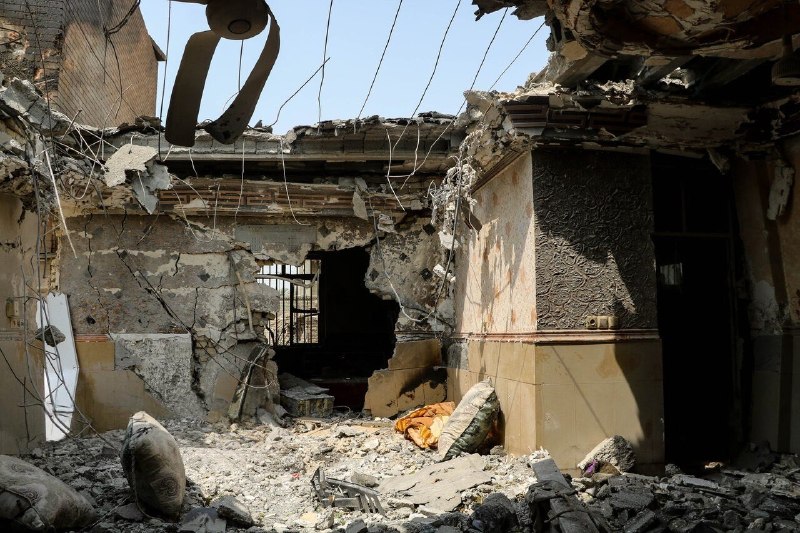
A reported Iranian strike on Muwaffaq Salti Air Base — the joint US-Jordanian installation better known as Al-Azraq, roughly one hundred kilometres east of Amman — has put a piece of long-familiar American infrastructure at the centre of a fast-widening crisis. The base, which had already been struck earlier this year, was hit again, according to a 10 June 2026 post by @sprinterpress on X summarising satellite imagery and reporting on what was struck and where.
The strike matters less for the ordnance than for the geography. Al-Azraq is not a forward outpost improvised for the present emergency; it is a fixed, treaty-grade piece of US Central Command infrastructure embedded in a friendly Arab kingdom. Hitting it is a deliberate message that the space between Iran's missile arsenal and the American airlift network in the Levant is shorter than either Washington or its regional partners have publicly admitted.
What the base actually is
Muwaffaq Salti Air Base, the formal name of the installation that most reporting refers to as Al-Azraq, sits in Jordanian desert east of the capital. It has hosted US aircraft, logistics aircraft and forward-deployed air operations for years, with satellite imagery from 2024 and 2025 repeatedly identifying US transport aircraft and fighter presence on its aprons. Earlier in 2026, the same base was hit in a wave that Iranian-linked channels and Western outlets attributed to Tehran, producing the satellite-imagery trail that the 10 June post is referencing.
A strike on a base of this category is not a symbolic gesture. It is a calculation that, at this moment, the cost of attacking the United States' regional logistics tail is acceptable to Tehran — politically, militarily, and in terms of blowback from Gulf partners who have so far preferred quiet containment to open confrontation.
Why now
Three pressures converge. First, the long-running shadow war between Israel and Iran has, in the past eighteen months, periodically spilled into overt exchanges, with strikes attributed to both sides on each other's territory and on third-country infrastructure. Second, Jordan's position — a US treaty ally, a neighbour of both Israel and Iraq, and a country with a large domestic constituency opposed to being drawn further into a regional war — gives any attack on its soil outsized political weight. Third, the practical question of what US Central Command is actually flying out of Al-Azraq has shifted, with the base serving as a logistics hub for the air bridge into Iraq, Syria and, at points of tension, the Gulf.
Reading the strike as purely retaliatory understates the case. Even a one-off hit, if confirmed, raises the cost for Washington of treating Iranian escalation as episodic. The geometry of escalation has, in effect, moved: targets that would once have been considered off-limits have just been used as messaging.
The counter-read
The dominant Western framing treats strikes on US bases in Jordan as Iranian aggression, an attempt to widen the war, and a test of American resolve. The counter-read, voiced in Iranian state-aligned outlets and echoed by some Global South commentary, is that these bases are themselves the escalation — that forward-deployed airpower, tanker tracks and intelligence aircraft are not passive infrastructure, and that strikes on them fall inside a continuum of tit-for-tat exchanges that includes Israeli operations on Iranian soil and Iranian proxies' attacks on US positions in Syria and Iraq.
That framing is partial. Iranian state media's vocabulary around the strikes tends to elide the difference between defensive deterrence and offensive signalling. But the structural point — that the architecture of US presence in Jordan is what makes the base a target — is harder to dismiss. Removing the target requires removing the asset, and removing the asset is a political decision Washington has shown no appetite for.
What it changes
The immediate operational effect is real but bounded. US aircraft can disperse; regional partners can be asked to accept more forward basing; air defence around bases of this category can be thickened, and reportedly is being thickened, with Patriot and THAAD-class systems already a familiar sight at Jordanian installations. The strategic effect is sharper. A base in a treaty ally's territory, struck twice in six months, is no longer a quiet rear area. It is a frontline facility, and the doctrine, force posture and rules of engagement written for a rear area no longer apply cleanly.
The political effect is the one to watch. Amman has spent two decades positioning itself as the indispensable Western ally that never quite gets dragged into the next war. A second strike on its soil, regardless of who is ultimately judged responsible, narrows the space between Jordan's rhetoric of neutrality and the operational reality of its territory being used as a launchpad. Whether Amman responds publicly, quietly, or by slow bureaucratic drift — adjusting basing rights, overflight clearances, public framing — is the variable that will determine whether this remains an incident or becomes a precedent.
What remains uncertain
The 10 June post is a single thread compiling earlier satellite imagery and prior reporting. It does not, on its own, constitute a confirmed attribution, and the sources do not specify the weapons used, the casualties on either side, or the operational status of the base's runways and hardened aircraft shelters after the reported hit. Western wire confirmation of damage, payload and effect typically lags by days, not hours, and the Iranian state line, when it arrives, will need to be weighed against independent satellite analysis rather than relied on as a stand-alone account. What the reporting establishes is the fact of a strike on a US-Jordanian installation of strategic significance; what it does not yet establish, on the evidence available, is the chain of command, the specific target set, or the response posture of either Washington or Amman.
This desk note: Monexus reports strikes on US-partner bases in Jordan as frontline events, not as regional colour. The framing above treats Tehran's calculus and the structural reality of US forward basing as co-equal inputs, on the principle that escalation geometry is set by both sides, and that an honest read of the present moment requires holding the Iranian, Jordanian and American positions in the same frame.
Wire provenance
This editorial synthesis draws on the following public wire/social posts:
- https://x.com/sprinterpress/status/2026-06-10