Iran strikes US Fifth Fleet base in Bahrain as regional escalation enters new phase
Footage circulated on 10 June 2026 from Iran-aligned channels shows a ballistic missile impact at the US Naval Forces Central Command base in Manama, an attack that, if confirmed, would mark the most direct Iranian strike on a US installation of the post-2019 period.
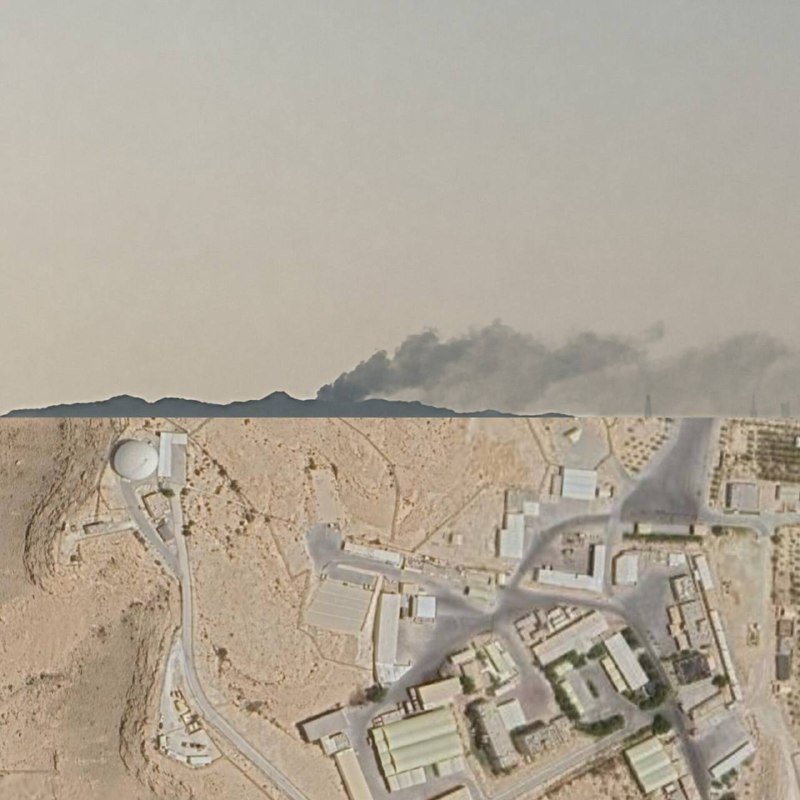
At 08:18 UTC on 10 June 2026, the Iran-aligned outlet Palestine Chronicle posted brief footage on its Telegram channel showing what it described as an Iranian ballistic missile in flight towards the headquarters of the US Fifth Fleet in Bahrain. Ten minutes later, Lebanon-headquartered The Cradle circulated video from a second angle that, in the channel's caption, showed the missile striking the base itself. Within the same hour the same clip was being rebroadcast across Iran-aligned networks, framed as evidence that Tehran had carried out a direct strike on the principal US naval installation in the Persian Gulf.
If the footage is authentic, the strike would represent a sharp escalation in the long-running shadow war between the Islamic Republic and the United States in the Gulf — a confrontation that has, for years, played out through proxy forces, intercepted tankers, and calibrated drone exchanges rather than direct fire on American flag installations. As of the time of writing, no major wire service had independently confirmed the impact, and the US Navy's Bahrain-based public affairs office had not, in the material available to this publication, released a statement.
What the footage actually shows
The Palestine Chronicle clip is short — a few seconds of a ballistic trajectory, filmed from the ground, with the characteristic re-entry signature of a medium-range solid-fuel missile. The Cradle's longer cut, posted at 08:28 UTC, purports to show the terminal phase and an impact plume at the perimeter of Naval Support Activity Bahrain, the shore installation that hosts the headquarters of US Naval Forces Central Command (NAVCENT) and the US Fifth Fleet. The base sits in the Juffair suburb of the Bahraini capital, Manama, and has been the central hub for US maritime operations in the Gulf since 1995, when it moved there after half a century in Saudi Arabia.
Both channels describe the munition as a ballistic missile. Neither clip has been independently geolocated, and the standard caveats apply: Iran-aligned outlets in the Axis of Resistance ecosystem have, in past cycles, released combat footage that turned out to be out-of-date, misattributed, or — in at least one widely-cited 2024 episode — recycled from a video game. The Palestine Chronicle and The Cradle are both sympathetic to the Iranian political project, and the framing language in their captions ("Iranian missile striking the US Fifth Fleet") is the language of the Iranian command, not of an independent observer. Readers should treat the underlying claim — a successful strike on a US installation — as unsubstantiated until the Pentagon, the Bahraini government, or a major wire confirms impact and damage assessment.
Why Bahrain, and why now
Bahrain is the smallest of the six Gulf Cooperation Council states and the only one whose government is bound to the United States by a formal bilateral defence treaty, the 1991 Mutual Defense Assistance Agreement. It hosts roughly 7,000 US military personnel across a network of facilities that includes the Fifth Fleet's forward headquarters, the headquarters of the Combined Maritime Forces coalition task force, and a Royal Navy–supported UK maritime presence. From Manama, US Central Command has run air operations over Iraq, Syria, and Yemen; naval operations in the Strait of Hormuz, through which roughly a fifth of the world's seaborne oil passes; and the air defence architecture that has, since 2019, increasingly integrated Israeli early-warning data via the regional Air Defense Initiative.
That integration is the relevant backdrop. Throughout 2025 and into 2026, Israeli and US officials — including in reporting carried by Axios — have openly discussed a coordinated posture against an Iranian missile and drone programme that Israeli planners now treat as the single most credible threat to the home front. If Tehran's calculation in firing on a US base is to test the cohesion of that posture, Bahrain is the obvious pressure point: small, treaty-bound, politically fragile, and the host of a US installation whose loss would unbalance the entire Gulf command structure. The strike, if it occurred, would land at the precise seam between the American and Israeli theatres.
The counter-read: shadow war, not hot war
The dominant Western framing will treat the footage as a paradigm shift — the moment Iran's long war by proxy against US forces in the Gulf crossed into direct fire on a US flag installation. The alternative read, which Iranian state media have been preparing for at least a month through official statements and a steady drip of commentary in Tasnim and IRNA, is that the Islamic Republic is responding, with calibrated force, to a sustained Israeli-American campaign of strikes on Iranian assets in Syria, Lebanon, and Iraq — a campaign that Tehran's leadership now characterises as an existential threat to the regional "resistance axis." In that reading, a strike on the Fifth Fleet is not an act of war against the United States so much as a signal to Washington that the cost of its current Middle East posture is now being levied, in matériel and political capital, on the ground in Manama.
A third possibility deserves serious weight. The Cradle and Palestine Chronicle are both Lebanese-press operations, not Iranian state media. The Cradle in particular has built a substantial audience by being first on a wide range of kinetic events in the Axis of Resistance — most recently the November 2025 exchanges between Hezbollah and Israel in southern Lebanon, and the February 2026 strikes on Iranian Revolutionary Guard Corps positions near Deir ez-Zor. Its editorial interest in publishing a strike, real or alleged, does not map cleanly onto Iranian state interests; the outlet also regularly carries analysis critical of the IRGC's regional footprint. That does not make the footage true. It does mean the framing — "Iran's missile, Iran's war" — is, at this stage, a claim rather than a fact.
Structural frame: the Gulf as escalation ladder
What the footage represents, in plain terms, is a further notch up an escalation ladder that has been climbing visibly since the spring of 2025. The earlier rungs — Houthi strikes on shipping in the Red Sea, Hezbollah rocket salvos into northern Israel, Iranian-aligned militia attacks on US positions in Iraq and Syria — were all designed to be deniable, reversible, and below the threshold of an Article 5-style US response. A ballistic missile impact on a US base is none of those things. It is the kind of act that, in a different strategic environment, would produce a US carrier air response within hours and a Security Council resolution within days.
Whether that response comes — and, crucially, whether the footage is even authentic — will tell the reader most of what they need to know about the next phase of the Middle East crisis. If the Pentagon confirms impact and assigns it to Iran, the regional security architecture that has held since the 1991 Gulf war will have been broken in a single morning. If the Pentagon demurs, denies, or simply does not comment, the more interesting question becomes who the footage serves politically, and on whose behalf it is being amplified.
The sources available to this publication at the time of filing do not include any independent confirmation of impact, casualty figures, or damage assessment. The Bahraini Ministry of Foreign Affairs has not, in the material reviewed, issued a statement. The Pentagon's last public posture on US force protection in the Gulf dates to 7 June 2026, three days before the footage emerged, and contains no reference to a pending Iranian strike. Until at least one major wire service or an official US or Bahraini source confirms the event, the footage should be read as a claim made by Iran-aligned media about an act that, if real, would mark the most consequential direct Iranian attack on US forces in the Gulf since the 1987–88 tanker war.
Desk note: Monexus has reported the footage as a claim by Iran-aligned outlets, not as a confirmed strike. Western wire confirmation is the editorial threshold for the next phase of this story; in the absence of that confirmation, the appropriate frame is "footage circulating," not "Iran strikes."
Wire provenance
This editorial synthesis draws on the following public wire/social posts:
- https://t.me/thecradlemedia
- https://t.me/PalestineChronicle
- https://en.wikipedia.org/wiki/Naval_Support_Activity_Bahrain
- https://en.wikipedia.org/wiki/United_States_Fifth_Fleet
- https://en.wikipedia.org/wiki/2024%E2%80%93present_Gulf_crisis
Follow the event.
These dated source records provide context. They do not retrospectively verify this archive article.
Separate what the nuclear watchdog reported from what it could not determine after the June 2025 strikes.