Tehran warns of retaliation as US-Iran crisis flares in the early hours of 10 June
A foreign-ministry statement in the early hours of 10 June 2026 promises a robust response to US "aggression," while Tehran's spokesman frames last night's events as a test of resolve.
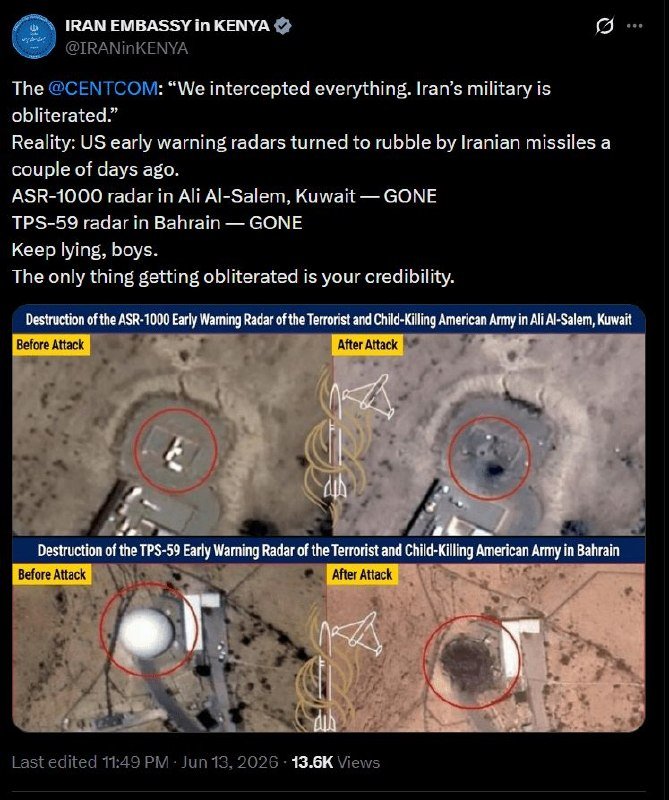
In the early minutes of Wednesday, 10 June 2026, Iran's Ministry of Foreign Affairs issued a sharply worded statement accusing the United States of "aggressive actions" against the Islamic Republic and signalling a robust response. The text, circulated by Press TV on its verified Telegram channel at 09:17 UTC, frames last night's events as a deliberate provocation and reserves the right to retaliate in self-defence. By 08:35 UTC, Fars News International had already carried a condensed version, headlined "Iran's warning to America: We will not hesitate to defend ourselves." Within the next hour, the foreign-ministry spokesman Esmail Baghaei amplified the line in a statement picked up by the War Fox Witness channel, declaring that "Iran's brave forces will not hesitate to defend the homeland."
The exchange, as far as the available reporting goes, is being driven entirely from the Iranian side. The texts on the record so far are three Iranian-state or Iran-aligned channels relaying material from the foreign ministry and its spokesman; no US government statement, Pentagon read-out, or White House comment has yet been logged in the open sources cited here. That asymmetry matters: a crisis that looks fully developed in Tehran is, on the public record at this hour, still half-told.
The official Iranian line
The foreign-ministry statement published on 10 June accuses Washington of conducting "aggressive actions" against Iran under a pretext that, in the wording carried by Press TV, refers to "the crash of" — a sentence that the channel truncates and does not complete. The most that can be said with confidence is that the ministry has linked US behaviour to an air or aviation incident and used that link to characterise the United States as the aggressor. Press TV, the English-language arm of Iranian state broadcasting, has packaged the statement as a warning; Fars News, a hardline outlet close to the Islamic Revolutionary Guard Corps, has led with the same warning in more combative language. The two channels do not contradict each other; they reinforce each other, with Fars editorialising more openly and Press TV carrying the formal text.
The second, complementary message came from Esmail Baghaei, the foreign-ministry spokesman, whose remarks reached the open-source aggregators through the War Fox Witness channel at 08:45 and 08:46 UTC on 10 June. The lines that survive in those posts are short and pointed: that "last night's events proved" Iranian forces would act in defence of the homeland, and that US conduct had been marked by "contradictions." Both formulations are typical of Tehran's crisis rhetoric — assertive on the principle of defence, dismissive on the coherence of the American position.
What the public record does not yet show
A few things are notably absent from the sources available at the time of writing. The foreign-ministry statement, as reproduced by Press TV, is cut off mid-sentence at the phrase "the crash of," leaving the precipitating incident unspecified. No casualty figures, target lists, weapon systems, or geographic locations are provided in the three channels that have carried the material. There is no Iranian attribution of the original incident to a specific US asset, base, vessel, or platform, and no Western wire or official US readout is on the cited record to either confirm or rebut the Iranian framing.
That gap is itself a fact about the story. Iranian state and state-adjacent media have, in recent crises, often moved first — establishing the narrative frame, the vocabulary ("aggression," "self-defence," "brave forces"), and the threat posture — and only later been met with a Western wire response. The 10 June sequence fits that pattern: official Iranian text first, three aligned channels amplifying within an hour, no counterpoint yet logged. Readers should treat the current state of play as a Tehran-led opening, not a balanced account.
Reading the framing
The choreography of the messaging is worth noticing. The foreign ministry issues a formal statement; the IRGC-adjacent Fars News translates it into a more bellicose headline within minutes; the foreign-ministry spokesman follows up with a personal, televised-grade line about the homeland; and the package is then pushed through aggregators that blend official text and emotive commentary. The result is a single, layered message that reads, in English, as both diplomatic and martial. This is a familiar Iranian crisis-communication template: the door to negotiation is left technically open in the formal text, while the deterrent message is delivered by the military-adjacent channels.
The substance of the message is also familiar. Tehran routinely casts any US action in the region as "aggression," reserves the right to respond under Article 51 of the UN Charter, and frames its own forces as defenders rather than initiators. The novelty, if any, is timing and intensity — a public statement and a spokesman line issued within the same 90-minute window, both pointing to events of the previous night, both framed as proof that Iran will not back down. The implicit warning is that whatever the United States has done, it should expect a reply in kind.
Stakes and the next 24 hours
If the Iranian text is taken at face value, three risks follow. The first is a direct Iranian retaliatory action — most plausibly in the form of proxy activity, cyber operations, or a naval or air move in or near the Strait of Hormuz, where even a small incident can move global energy prices. The second is an escalation spiral in which the United States, having been publicly accused of aggression, raises its own posture and triggers an Iranian countermove. The third is a slower, less visible deterioration: sanctions, designations, or diplomatic downgrades layered on top of an already brittle relationship.
The markets have not yet had the data to price any of this; the wire services have not yet had the sourcing to confirm the underlying incident; and the Iranian public record remains, at this hour, an opening statement rather than a full account. What is clear is that Tehran has chosen to escalate rhetorically before the international picture is in, and that the United States will now face a choice between letting the framing stand or producing a counter-record quickly enough to compete with it. The next 24 hours — and the first detailed US readout, casualty report, or independent wire confirmation — will determine whether 10 June 2026 becomes a day of tension or a day of crisis.
Desk note: this article is built entirely on Iranian state and Iran-aligned channels (Press TV, Fars News, War Fox Witness on Telegram) carrying official foreign-ministry and spokesman material. The Western wire is not yet on the cited record, and the precipitating incident referenced in the foreign-ministry text is left unspecified in the source provided. Monexus will update the framing as soon as a non-Iranian source corroborates, qualifies, or contradicts the account above.
Wire provenance
This editorial synthesis draws on the following public wire/social posts:
- https://t.me/presstv/
- https://t.me/wfwitness/
- https://t.me/wfwitness/
- https://t.me/FarsNewsInt/