A drone strike in Sidon, a city already on edge: what the wires do — and don't — tell us
Lebanese outlets report a targeted Israeli drone strike on a vehicle in Sidon that ignited nearby cars. The incident sits inside a wider pattern of southern-Lebanon strikes — and a press environment that must work fast, often without independent verification.
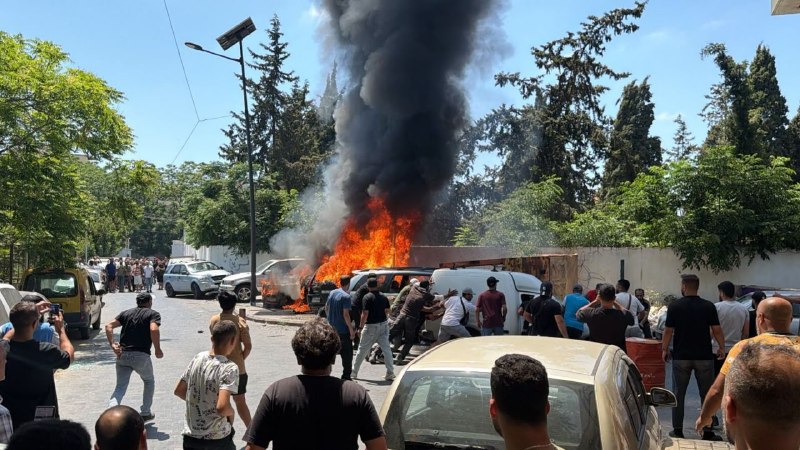
At 11:32 UTC on 10 June 2026, the Beirut-based outlet The Cradle reported that an Israeli drone had struck a vehicle in a residential area of Sidon, in southern Lebanon. Within minutes, the news was moving through regional channels in parallel: Al-Alam Arabic, the Iranian state-affiliated network, cited "Lebanese sources" for a preliminary toll of two dead; Lebanon's official National News Agency, relayed by the war-monitoring channel War Witness, said the drone hit a vehicle near a generator, that the blast set several cars alight, and that the early count was two fatalities. The accounts agree on the basic shape of the event. They diverge on almost everything else.
What is on the wire, right now, is a strike with no Israeli military readout, no named target, and no public identification of the dead. That matters, because Sidon is not a frontier town in the wire-service sense — it is a major port city 40 kilometres south of Beirut, with a Palestinian refugee presence, a longstanding Amal and Hezbollah political infrastructure, and a population of roughly 200,000. A targeted killing there, if that is what this is, sits in a different political register than a strike on a motorbike in a border village. The sources we have do not yet let a reader draw that distinction.
What the four-channel stack actually tells us
The cluster of items that surfaced this morning is unusual only in its speed. The Cradle broke the line at 11:32 UTC. Al-Alam Arabic followed two minutes later with the two-martyr framing — a term that in Arabic press usage denotes a politically inflected death, often applied to fighters and to civilians killed in Israeli strikes, and that a Western wire would not adopt. War Witness, translating the NNA bulletin, added the operational detail — a vehicle hit near a generator, multiple cars catching fire — and again cited a preliminary toll of two dead. Al-Alam's later item, at 11:51 UTC, sharpened the framing: a drone strike, several cars burned, a "martyrdom" pending identification.
The shared content is thin. All four messages agree on: a drone strike, a vehicle, Sidon, the ignition of nearby cars, a death toll in single digits. They do not agree on — and none of them claims to know — the identity of the target, the affiliation of the dead, whether there was a warning, or whether the strike was the first in a sequence. The NNA bulletin, which is the closest thing to an official Lebanese government voice in this cluster, is also the most restrained. It does not name an Israeli operation, a particular armed faction, or a justification.
The vacuum where a wire briefing should be
A reader trained on Reuters and AFP will notice what is missing: no Israeli Defense Forces statement, no comment from the Israeli Prime Minister's office, no spokesperson quoted, no footage of the weapon system. In any other week, a drone strike on a southern Lebanese city would, within an hour, produce a Tel Aviv confirmation or denial — usually both, in the same breath. The absence is not itself proof of anything, but it is information. It tells a careful reader either that the strike has not yet been processed through the IDF spokesperson's pipeline, or that the operation is one Israel does not yet want to put on the record. Both readings have happened before.
There is also no Hezbollah statement in the cluster. That is a louder silence. The group has, in past rounds of escalation, moved within minutes of an NNA bulletin — sometimes faster, sometimes via its own military media arm. A drone strike inside Sidon that killed a vehicle's occupants is, on the pattern of the last two years, exactly the kind of event the party would claim credit for, or ownership of the dead, before the morning is out. The fact that the channel stack does not include that voice suggests either that the target has not yet been identified to a faction that wants to identify with them, or that the factional channel is moving more cautiously than usual. Either way, the next twelve hours will tell us more than the last twelve did.
The structural frame, in plain terms
Sidon sits in a Lebanon that has spent the better part of two years being told, by Israeli officials, that the war against Hezbollah has "destroyed" the group's southern infrastructure. Strikes in 2024 and 2025 did real damage to the party's military presence along the Litani and inside the Dahieh. The Israeli line since the November 2024 ceasefire has been that residual targeting is a function of disarmament enforcement — a position Israeli sources are comfortable defending in English-language press briefings. The Lebanese state position, voiced in Beirut and in NNA bulletins, is that any Israeli strike on Lebanese territory is a violation of sovereignty and the ceasefire understanding. The two framings will not converge on this incident, and a reader who treats either one as neutral will end up misreading the event.
What the wires can do, and what this cluster does, is describe the surface: a drone, a vehicle, a fire, a toll. What the wires cannot do, and what no Telegram channel can do either, is establish who was in the car and on whose orders the strike was carried out. Those are the questions a serious account will have to answer, and at 11:51 UTC on 10 June 2026, they remain open.
What remains genuinely uncertain
Three things are contested or unresolved. First, the identity and affiliation of the dead — no source in the cluster names them or claims them. Second, the Israeli confirmation or denial — there is none in the record. Third, the political meaning: whether this is a routine enforcement strike of a kind the IDF has carried out weekly since the ceasefire, or a deliberate escalation in or near a Palestinian refugee neighbourhood in Sidon, where the optics and the casualty profile of a civilian strike would be different. A reader holding all three open is being honest with the evidence. A reader closing any of them, in either direction, is doing the opposite.
The wires will catch up. By this evening, Reuters and AFP will have either an Israeli statement or a notable absence of one; the Lebanese health ministry will likely issue a toll; and one of the regional factions will have spoken. Until then, the four messages on the cluster are the record — and the record is thin.
This article will be updated as the Israeli and Lebanese official positions, and the identity of the dead, become clearer. Monexus frames strikes on Lebanese territory as violations of sovereignty pending an Israeli disclosure that satisfies the international-law standard for a lawful targeted operation; it does not adopt the "martyrdom" framing used by Al-Alam Arabic, which embeds an editorial position the news record does not yet support.
Wire provenance
This editorial synthesis draws on the following public wire/social posts:
- https://t.me/alalamarabic/
- https://t.me/wfwitness/
- https://t.me/alalamarabic/
- https://t.me/TheCradleMedia/