The Forty-Eight Hours That Brought Washington and Tehran Back to Open War
On 10 June 2026 President Trump told reporters the United States would 'attack Iran very hard,' citing the loss of an Apache helicopter and the collapse of a peace track that had been live for weeks. The escalation reopens a corridor the White House had spent months claiming was closing.
On the afternoon of 10 June 2026, in a brief exchange with reporters on the White House driveway, President Donald Trump said the United States would resume strikes against Iran and would do so "very hard." The trigger, by his own account, was the downing of a US Army AH-64 Apache attack helicopter and the simultaneous breakdown of a peace track that senior officials had described, in the days before, as the most serious diplomatic opening of the year. Within hours, the framing inside Washington had shifted: from de-escalation to open combat operations, with the president himself confirming the change in language that no Pentagon spokesperson had been willing to use on the record.
What the next forty-eight hours produce will not simply be another kinetic exchange. The episode exposes how thin the scaffolding was under the most recent US-Iran diplomatic track, and how a single tactical incident can collapse a negotiating architecture that depends almost entirely on presidential discretion. The structural fact is this: the United States and Iran do not, in 2026, have a functioning hotline robust enough to survive a helicopter loss. That is a statement about the state of the architecture, not about the temperament of the men running it.
The forty-eight hours
The chain of events that produced the 10 June announcement begins in the late spring, with a diplomatic track that the White House had been selling, in stages, since the spring. The president told reporters on 10 June 2026, in remarks captured by Reuters and Deutsche Welle, that Iran was "going to get hit very hard," that strikes would resume that day, and that a peace process he had previously described as productive had stalled. Asked directly by a reporter whether "bombing" was being resumed, Trump replied "Yeah. We are," according to the Reuters report and a separate clip posted to the Al Jazeera English wire. The specific provocation Trump named was the loss of an Apache helicopter — a US Army attack helicopter, one of the more heavily armed aircraft in the US rotary inventory — brought down in circumstances his administration attributes to Iranian forces. The five threads that surfaced the story on 10 June, from a Russian-aligned Telegram channel (two_majors) to Reuters and Deutsche Welle, agree on the basic sequence: helicopter loss, peace-track stall, presidential threat, operational resumption.
The reporting carries no number for US or Iranian casualties, no named strike package, and no on-the-record confirmation from the Pentagon beyond the president's own remarks. That thinness is itself a piece of information. In a conflict with this many moving parts, the absence of a briefing slide deck is not a logistical failure. It is the message.
What "hard" means, and what it doesn't
In the grammar of US-Iran signalling, presidential words about scale are usually calibrated for two audiences at once. The first is Tehran, where the calculation being made is whether the cost of continued attacks on US assets has crossed the threshold at which a deal becomes preferable to further losses. The second is the domestic American audience, where the question being answered is whether the administration is acting from strength or from reaction. Trump's specific framing on 10 June — that the Apache loss forced a response, that the peace track had stalled, that strikes were resuming that same day — is the second of those two readings. The administration is presenting itself as retaliating, not escalating.
That distinction matters less than it once did, because the underlying mechanism has changed. For most of the post-2018 period, US-Iran escalation has been mediated, in some form, by at least one of three channels: the Swiss-protecting-power channel in Tehran, the Omani back-channel, or — after 2023 — the indirect Iraqi and Qatari arrangements. None of those channels is referenced in the 10 June reporting, and the language used by the president is conspicuously personal. The architecture that survived the Soleimani strike, the 2024 exchange, and the early-2026 pause appears, on this evidence, to have been sitting on a single helicopter's airframe.
The counter-narrative from Tehran
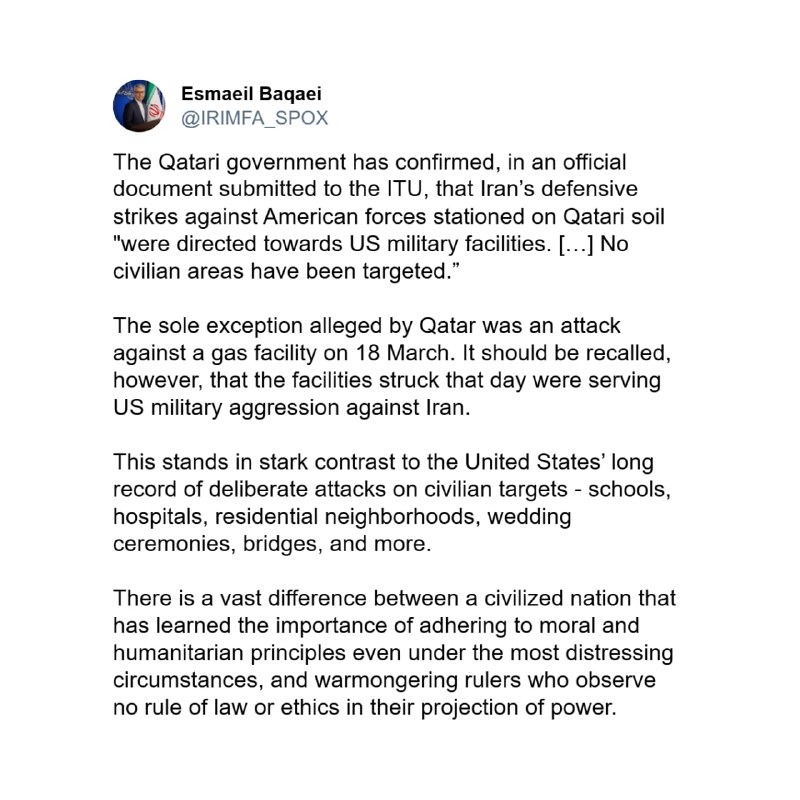
The thread material available on 10 June is dominated by Washington-side reporting; the Iranian state-aligned channels (Tasnim, PressTV, IRNA) that would normally carry Tehran's first read of the helicopter incident do not appear in the surfaced items, and Monexus cannot, on this evidence, reproduce the Iranian framing in detail. What can be said is that the framing Tehran has used in earlier rounds of the same conflict — the downing of the RQ-4 in 2019, the seizure of commercial tankers in 2021 and 2024, the exchanges around the Strait of Hormuz — has consistently treated US air assets in the region as legitimate targets for what Iranian doctrine calls "strategic deterrence." The loss of a US Army attack helicopter, on that prior pattern, would be framed in Tehran as the predictable cost of an over-extended US forward presence, not as an escalation. The structural argument runs the other way: from Tehran's vantage, it is the United States that escalated, by fielding the helicopters in the first place.
The counter-claim also rests on a specific empirical question the 10 June reporting does not resolve: under what circumstances was the Apache lost, and over what airspace? The thread items record Trump's claim and the fact of the loss; they do not record independent confirmation of the shoot-down attribution, the location, or the platform used against the aircraft. A reader who treats the shoot-down as an established fact is relying on the same single-channel attribution that produced the strike order. That is not a reason to doubt it, but it is a reason to mark it.
The structural frame, in plain language
What the 10 June sequence reveals, beyond the immediate incident, is the shape of the US-Iran arrangement that has accreted since 2018. It is, in effect, a balance of escalation managed by a small number of named individuals, in which institutional guardrails have been deliberately thinned. The Joint Comprehensive Plan of Action, for all its critics, did one piece of architectural work: it created a multilateral inspection regime in which violations were technical questions, debated in technical language, on a fixed timeline. That regime is not operative in 2026. What replaced it is closer to a personal channel: a diplomatic track that lives, in significant part, in the discretion of one man in Washington, and a deterrence track in Iran that lives in the institutional culture of the IRGC.
In that arrangement, an Apache loss is not a tactical incident. It is a referendum on the personal channel, conducted by fire. When the referendum comes back negative — when one side reads the loss as proof that the other cannot or will not hold its own forces in check — the channel closes. The 10 June announcement is, on this reading, the public moment at which the channel closed. The strikes that follow, on either side, will be conducted under a different set of rules, with a different time horizon and a different theory of how the next pause gets arranged.
The stakes, forward
Three things follow in the days ahead. The first is operational: a US strike package against Iranian targets, on a scale that has not been seen since the early-2026 pause, and an Iranian response that, on the pattern of previous rounds, is likely to come in the form of attacks on US assets in Iraq and the Gulf rather than direct strikes on the Israeli or American homeland. The second is diplomatic: the collapse of the spring track, and the question of whether any of the three back-channels that have historically absorbed US-Iran shocks is still in a position to be reopened. The third, and the one with the longest tail, is structural: the demonstration, to allies and adversaries alike, that the most consequential US-Iran decisions in 2026 are being made on the White House driveway, in unscripted exchanges with reporters, in a vocabulary that alternates between threats and promises. That is not a system. It is the absence of one.
The market consequence — energy prices, defence equities, Gulf state credit — is real but secondary to the political fact. The political fact is that the United States, on 10 June 2026, told the world, in the president's own voice, that the spring track had ended. The 48 hours that follow will tell us what comes next.
Desk note: Monexus has framed this episode as a referendum on a personal diplomatic channel, not as a stand-alone tactical event. The wire coverage surfaced on 10 June is dominated by the US side; the Iranian counter-frame is reconstructed from the pattern of prior exchanges and noted as such. Where the reporting thins — on Iranian casualties, on the circumstances of the Apache loss, on the state of the back-channels — this publication has said so in prose rather than papering over the gap.
Wire provenance
This editorial synthesis draws on the following public wire/social posts:
- https://t.me/two_majors
- https://x.com/sprinterpress/status/2064768930334281728
- https://x.com/reuters/status/2064770548354383872
Follow the event.
These dated source records provide context. They do not retrospectively verify this archive article.
Separate what the nuclear watchdog reported from what it could not determine after the June 2025 strikes.