Trump's Iran Bluster Meets a Voter Headache at Home
On 10 June 2026, a single White House driveway produced three different stories: a threat to Iranian power plants, a shrug at the inflation print, and a promise to fix the World Cup visa line.
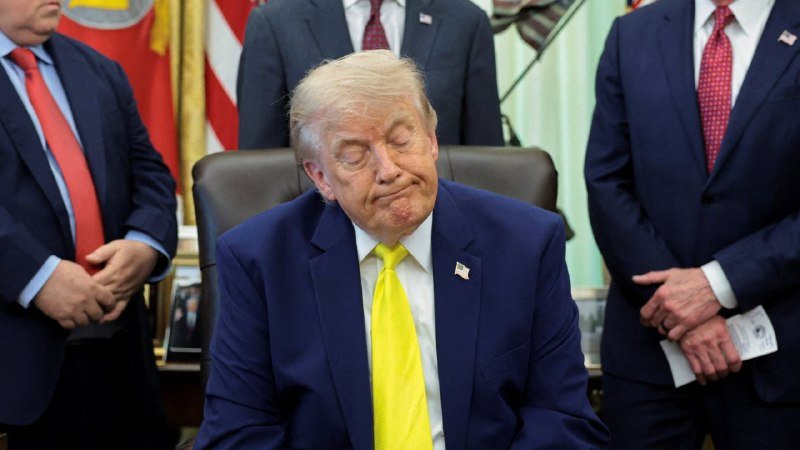
At 16:24 UTC on 10 June 2026, a reporter stepped into the White House driveway and asked Donald Trump whether Americans would struggle to get visas for the 2026 FIFA World Cup. The president's response — that the administration is "working very closely to make sure the right people come into our country" — was a single line in a single exchange, but it captured the day's political posture more honestly than the marquee stories did. Hours earlier the same briefing scrum had produced a jaw-clench threat against Iranian infrastructure and a breezy dismissal of the morning's inflation print. Three questions, three registers: provocation, denial, and reassurance, all in the space of an afternoon.
What ties the threads is a White House that has decided confidence is a substitute for coherence. Each answer is internally consistent. Together they describe a presidency that wants, simultaneously, to menace Tehran, shrug off the consumer-price index, and sell summer soccer as a managed event. The contradictions are the point, and they are starting to cost the administration the one thing it cannot bluff its way out of: trust on the price of bread.
The Iran file, in the open
At roughly 16:15 UTC, Trump was asked directly whether the United States was preparing to strike Iranian power plants and bridges. "I won't tell you, but I can do that," he replied, per a Telegram relay of the exchange. A follow-up thread on the same network, timestamped 15:53 UTC, headlined his posture even more starkly: "We will hit them hard today." The deliberate ambiguity — not denial, not confirmation, not a description of which facilities — is itself the policy instrument. It keeps Tehran's command-and-control guessing without producing a casus belli that markets can price.
The tactic is not new. What is new is the venue. The threat was not delivered in an Oval Office address, a State Department briefing, or a Pentagon background call. It was delivered to a driveway scrum, on camera, in a single sentence. Read narrowly, it is operational messaging. Read broadly, it is the new normal: deterrence by quotation.
The price story the administration does not want to talk about
Before the Iran question came the one voters cannot dodge. At 16:22 UTC, a reporter asked whether the president was "concerned about the latest inflation number that came out this morning." The reply: "No, I love it. I love the inflation..." The line landed with the cadence of a campaign line, not a diagnosis. There is no public White House readout in the materials available to this publication of what the underlying print was, or which month-over-month measure the reporter was citing — the daily cited print does not appear in the thread context this piece is built on. What does appear is the framing. The president is no longer merely disputing bad numbers; he is performing enthusiasm for the numbers themselves.
That is a difficult posture to defend in a country where mortgage resets, grocery tabs, and fuel surcharges are checked weekly. Surveys conducted across the previous administration cycle consistently ranked inflation as a top-tier voter concern, and the post-pandemic 2022–2024 episode is fresh enough that the phrase "transitory" remains politically radioactive. A president who says he loves inflation is not reassuring the median household. He is signalling to a base.
The visa line as a real-world friction
The third exchange — the World Cup visa line — sounds like a soft story until you look at the calendar. The 2026 tournament, hosted across the United States, Canada and Mexico, is the largest single sporting event on the planet this year. Tens of thousands of foreign fans, players, broadcast crews, sponsors, and dignitaries will need entry clearance. Any perception that the process is hostile, opaque, or arbitrarily slow is, in the literal sense, a tourism and branding problem.
Trump's formulation — "the right people" — is the most telling three-word combination of the day. It does not say "all qualified applicants." It does not say "we are streamlining processing." It says the gate is selective. That framing sits awkwardly next to a tournament whose commercial pitch, for decades, has been that it is the world's game. The administration is buying itself a small amount of leverage over a federal bureaucracy that has been accused of slowdowns in other contexts. It is also, quietly, telling the rest of the world that the welcome mat is conditional.
What this publication sees
None of the three answers, read in isolation, breaks new ground. Read together, they describe a presidency that is comfortable issuing threats to foreign infrastructure on camera, declaring victory over a price index it has yet to publicly name, and gatekeeping a sports tournament. The pattern is not inconsistency. It is a single operating theory: that a confident tone, delivered repeatedly, substitutes for content the speaker does not need to produce.
There are limits. Markets, voters, and foreign ministries price words as well as actions, and a repeated refusal to disambiguate eventually stops being a negotiating posture and becomes a noise floor. The Iran threat is more credible to Tehran the first three times it is issued than the thirtieth. The inflation denial ages the moment a household goes to the supermarket. The visa reassurance will be tested the first time a high-profile fan is turned away at a consulate. Until then, the show goes on. The question is whether the audience is still watching, or simply waiting for the next driveway.
The staff writer framing here treats the day's three exchanges as a single policy voice rather than three separate stories — a choice most wire pieces, which package each clip into a discrete bullet, do not make.
Wire provenance
This editorial synthesis draws on the following public wire/social posts:
- https://t.me/ClashReport
- https://t.me/ClashReport
- https://t.me/ClashReport
- https://t.me/GeoPWatch