Trump's blockade bravado lands, but the naval arithmetic is murkier than the posts suggest
A flurry of Truth Social posts calls the US blockade of Iran 'the most successful in the history of naval warfare.' The wire traffic behind those lines is thinner, and less triumphant, than the rhetoric.
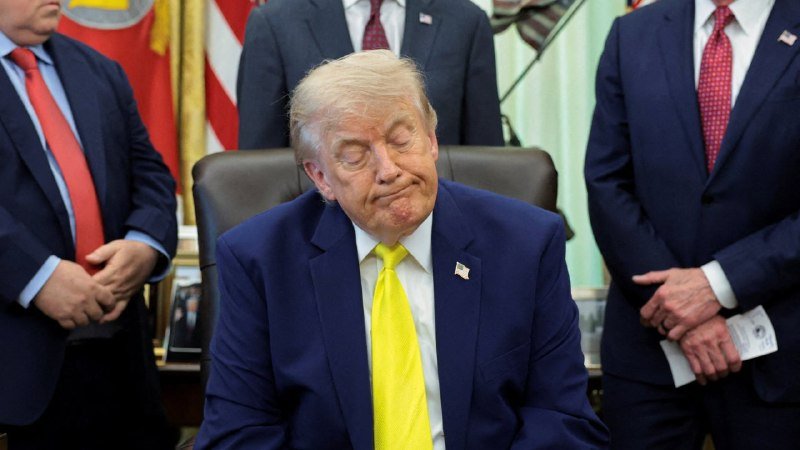
At 11:50 UTC on 10 June 2026, US President Donald Trump took to Truth Social to describe a US naval blockade of Iran as "the most successful Blockade in the history of Naval Warfare," declaring that "NOTHING GETS THROUGH unless we want it to" and that the operation amounted to "A STEEL WALL." The posts, picked up within minutes by Telegram channels including Open Source Intel, OSINTdefender, Clash Report, GeoPolitical Watch and rnintel, frame the blockade as a fait accompli and pivot to a familiar target: the "Fake News Media," which the president says is refusing to cover the operation's effectiveness.
The posts are not, on their own, evidence that a "blockade" in the classical maritime-law sense is under way. They are a description — and a political one. Read closely, they tell the public that a coercive maritime operation against Iran is in motion, that Tehran is being denied economic life-support, and that the president believes the operation is succeeding. Whether the operational reality matches the rhetoric is a separate question, and one the wire traffic does not yet resolve.
What the posts actually claim
The substantive claims inside the 10 June Truth Social burst are threefold. First, that a US naval blockade of Iran is operational and is, in the president's words, "the most successful Blockade in the history of Naval Warfare." Second, that Iran has "taken too long to negotiate a deal that would have been great for them, now they will have to pay the price" — a formulation tying the maritime operation to a stalled diplomatic track. Third, that Iran's military is "a complete and total mess," with "much of it, like their Navy and Air Force, doesn't even exist anymore," and that Tehran is "all talk and no action."
Each line has a political function. The blockade line is aimed at domestic audiences: it tells voters the administration is squeezing Tehran hard, and that coverage of the operation is being suppressed. The "pay the price" line is aimed at Tehran, signalling that the diplomatic window has not been reopened by the kinetic pressure. The military-degradation line is aimed at Iran's regional posture, projecting an image of impotence. None of these, taken alone, can be verified from the public material currently available.
What the Telegram wire says — and what it does not
The Telegram coverage of the 10 June posts is unusually uniform. Open Source Intel, OSINTdefender, Clash Report, GeoPolitical Watch and rnintel all carry the same Trump lines, often verbatim, often within the same thirty-minute window between 11:07 and 11:50 UTC. The channels are not independent of one another; they form part of the same OSINT aggregator ecosystem that re-circulates open-source material, and several of them flag the post-cluster as a single news event. None of them, in the available material, carry independent confirmation of the blockade's operational status, tonnage figures, vessel intercepts, or a chain-of-command statement from US Central Command or the Pentagon.
That absence is itself the story. A "naval blockade" in the formal sense is a recognised act under international law of the sea, normally declared, normally accompanied by a list of belligerent rights and duties, and normally defended in legal and operational terms by the imposing state. The 10 June posts describe the operation in superlatives. They do not, in the material currently circulating, anchor it in a public operational record.
The structural frame: blockade as negotiation, by other means
A maritime quarantine of a major oil exporter is, in plain terms, an economic lever — and economic levers are most useful when their threat is more credible than their use. The president's posts are best read as that kind of instrument: a public statement designed to make the cost of non-negotiation visible to Iranian decision-makers, while keeping the option of de-escalation alive on the US side. This is the logic that has governed US-Iran coercion for decades, from the tanker war of the 1980s to the maximum-pressure sanctions regime that preceded the 2015 nuclear deal.
Read in that light, the "most successful blockade in history" line is a negotiating posture dressed as a battlefield report. It tells Tehran, Tehran's customers, and the oil market that the US is willing to maintain the squeeze indefinitely. It tells domestic audiences that the administration is winning. It does not, by itself, prove that shipping through the Strait of Hormuz has been physically stopped — and the difference between a rhetorical blockade and an enforced one is, in this theatre, the difference between signalling and war.
Stakes, and what is still contested
If the operational claim is real, the immediate stakes are concrete: Iranian oil exports are the country's principal source of foreign currency, and any sustained interruption would compress Tehran's ability to fund regional partners and to maintain domestic subsidy programmes. The diplomatic track, already described as having "taken too long," would face a hardened US starting position. Oil prices, which have historically spiked on Hormuz disruption rumours, would be the most visible global signal.
If the operational claim is rhetorical — a pressure campaign described in blockade language to maximise leverage — the stakes are different but not smaller. The phrase "naval blockade" carries its own escalatory weight. Used loosely, it raises the risk of miscalculation by Iranian naval commanders, by shipping insurers, and by third-flag vessels that may not know whether to treat a US Navy approach as routine or as the opening of a kinetic exchange. The contested ground, in other words, is not the blockade's politics but its grammar: what counts, in practice, as a blockade, and who decides.
The sources do not, at the time of writing, resolve that question. They show a president declaring success. They do not yet show the seam log, the intercepted vessel count, or the legal notice that would let an outside reader judge whether the operation is what the posts say it is.
This publication tracks the gap between the rhetoric and the record. The 10 June posts are news; whether they describe a blockade in the operational sense is a question the open-source record does not yet answer.
Wire provenance
This editorial synthesis draws on the following public wire/social posts:
- https://t.me/osintlive
- https://t.me/osintlive
- https://t.me/osintlive
- https://t.me/rnintel
- https://t.me/ClashReport
- https://t.me/GeoPWatch
- https://t.me/osintlive