Trump claims a covert US oil blockade of Iran is underway — and Tehran is, by his own account, the last to know
At a White House appearance on 10 June 2026, the US president said Washington had 'taken out millions of barrels' of Iranian crude in a covert ship interdiction campaign — including, he claimed, 22 vessels seized the previous night with lights off.
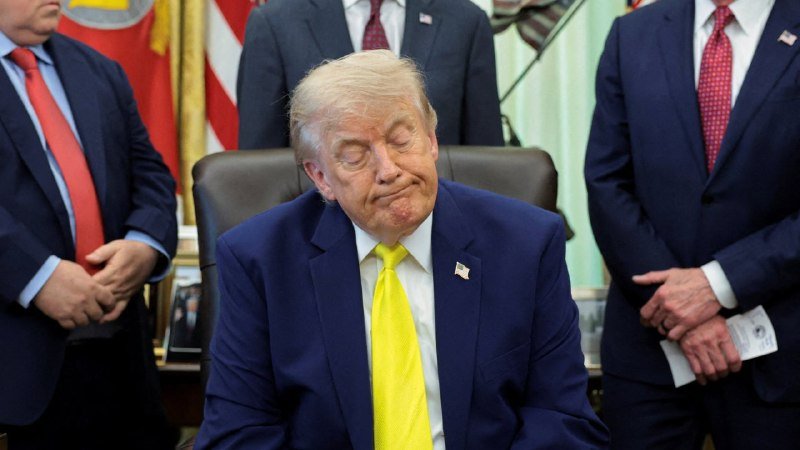
At 16:34 UTC on 10 June 2026, the state-affiliated video agency Ruptly pushed a Telegram alert carrying an unusual boast from the White House. President Donald Trump, addressing reporters, claimed that the United States had been quietly seizing Iranian crude at sea — "millions of barrels," in his words — and that the Islamic Republic itself had been left in the dark. "We have been taking out millions of barrels of oil. Nobody knows it," Trump said, according to the same quote carried almost in parallel by the open-source channel Open Source Intel and the conflict-tracker Clash Report. "You know who doesn't know about it? Iran, until right now." He added, per the same transcripts: "We took 22 ships the other night, late at night, with no lights" — an account of a single overnight operation that, if accurate, would represent one of the most aggressive US maritime interdictions against any state in decades.
The president's remarks, broadcast in fragments across at least three Telegram channels in the space of half an hour, do more than recount a naval episode. They confirm, in his own words, a US campaign of attrition against Iranian oil exports — and they do so in the vernacular of surprise, a posture that sits awkwardly with the legal and diplomatic scaffolding the United States has traditionally wrapped around its maritime sanctions enforcement.
A blockade, in name not yet declared
What Trump described is, in plain language, a creeping blockade. The administration has not used the term. A formal blockade is an act of war under the law of the sea, and even the looser category of "quarantine" — the phrase Washington reached for in 1962 around Cuba — requires a public declaration, neutral shipping notified, and a clear legal basis under international law. None of those steps is visible in the record. What is visible is the operational pattern Trump claims to have authorised: vessels approached at night, navigation lights extinguished, seizures carried out in a window the target state was supposedly not watching.
The 22-ship figure is the new and most concrete data point. Even at a conservative 500,000 barrels per vessel — a working assumption for an Aframax-class tanker in the Iranian dark-fleet trade — that single overnight action would account for roughly 11 million barrels removed from circulation. At the higher end, where some of the targeted vessels are VLCCs running sanctioned crude from the Kharg Island terminal, the same 22 hulls could carry three times that. The phrase "millions of barrels," as Trump used it, is therefore not rhetorical padding: at the scale he is describing, even partial corroboration of one night's takings would meaningfully tighten the physical market for medium-sour crude.
The operational signature — late-night, no lights, an implied element of concealment from the flag state — also reads as a deliberate departure from the US Navy's normal pattern in the Persian Gulf. Since 2019, the Fifth Fleet's approach to Iranian tanker interdictions has been daylight, visible, and often publicly announced through US Central Command or the Justice Department. A covert posture of the kind Trump is claiming is closer in form to the Royal Navy's wartime Q-ships than to contemporary sanctions enforcement.
What the Iranian side says — and does not
The Iranian government, as of the timestamps captured in the Telegram feed, has not issued a public response. That silence is itself a data point. Tehran has, since 2019, generally acknowledged interdictions of its tankers within a day, sometimes within hours, using them as evidence of US "piracy" and as a domestic rallying point. A multi-day lag — combined with Trump's assertion that Iran only learned of the campaign "until right now" — would be consistent with one of two scenarios: either the seized tonnage is, in fact, sailing under third-country flags and a tangle of shell-company beneficial ownership that has obscured the Iranian nexus, or Tehran has chosen to absorb the public-relations hit rather than confirm the scale of its losses.
The Iranian-flagged and Iran-owned dark fleet that has carried most of the country's sanctioned exports since 2018 uses a long, mostly Western-registered tail — Marshall Islands, Liberia, Panama, Hong Kong shells — and a shorter Iranian head. A US campaign that targeted the tail, rather than the head, would be difficult for Tehran to characterise as an act of war against Iranian-flagged shipping, because there would be no Iranian flag to point to. The pattern Trump is describing, of strikes on hulls Tehran may not immediately recognise as its own, fits that approach.
Oil markets, in two registers
The market response, to the extent it is captured in the same thread, is muted but directional. The same Telegram channels that carried the Trump quote also carry, in adjacent posts, oil-market chatter: traders parsing what a sustained, covertly-imposed ceiling on Iranian exports would mean for the seaborne crude balance, and for the discount that Iranian barrels have historically commanded. The structural point is plain. Iran has, by most independent estimates, exported between 1.3 and 1.7 million barrels per day of crude in 2025 and into 2026, almost all of it under sanctions to buyers in China and, to a lesser extent, to refineries in South and Southeast Asia. If even a portion of that volume is being intercepted at sea rather than landed and sold, the supply curve flattens — and the price floor, particularly for medium-sour grades competing directly with Iranian crude, rises.
There is a second, less visible register at work. The US has, for two decades, positioned dollar-cleared oil trading as the spine of its sanctions architecture. The argument is that anyone touching the dollar financial system can be cut off, and therefore anyone wanting to do business with the United States will police their own counterparties. A covert maritime campaign against a sovereign exporter's shipping punctures the other side of that bargain. If a major oil producer can be quietly choked off the water without the public legal architecture of a blockade, the precedent is not about Iran alone. It is about what is now available, in the toolkit, for any future US administration that wants to compress another exporter's flows before the ink is dry on a sanctions order.
The disclosure problem
The most striking element of the remarks is the disclosure itself. US presidents have, on rare occasions, acknowledged covert operations — and paid a domestic political price for doing so. Trump has, in this episode, disclosed the existence of an active maritime campaign on camera, in fragments, in front of multiple media outlets. The reasons for that disclosure are not in the public record. They may include: a desire to send a price signal to Iran's customers before they commit to the next cargo; a domestic political need to show that the maximum-pressure posture is producing results; or, more troublingly, an expectation that the campaign is about to be stepped up to a scale that concealment will no longer cover.
The episode also leaves a number of open questions that the available reporting does not settle. The thread does not specify the legal authority under which the 22 vessels were seized, the flag states involved, or whether any of the ships have been physically diverted to a US or allied port. It does not name the operation, if there is a name, and it does not indicate whether the Pentagon or US Central Command has corroborated the 22-ship figure. It is also silent on casualties — a non-trivial concern in any boarding of a dark-fleet tanker, where crews are often armed and where the doctrine of US boarding teams has, since the 1980s, assumed the possibility of resistance. Each of these gaps is a place where later reporting will need to land.
Stakes, plainly stated
If the campaign is real and ongoing, the near-term consequences run through three channels. First, the physical crude market: a sustained US interdiction of Iranian flows tightens seaborne supply and supports prices, with the heaviest impact on medium-sour grades that compete directly with Iranian barrels in Chinese and Indian refining slates. Second, the diplomatic channel: Tehran faces a choice between escalation — attempting to impose its own costs on Gulf shipping — and absorption, which carries an internal legitimacy cost the Islamic Republic has historically been unwilling to absorb. Third, the legal channel: a US practice of covert seizures without blockade declaration tests the limits of the law of the sea in a way the next decade of maritime jurisprudence will have to absorb, whatever this administration does next week.
The longer-term question is whether the episode, read in cold print, marks a shift in the US sanctions toolkit from financial pressure to physical denial. The Trump administration has, in office, used financial pressure more aggressively than its predecessors. The same administration is now describing — in the White House briefing room — physical denial at sea. The combination, if it holds, is closer to the architecture of a wartime economy than to a peacetime sanctions regime. Iran's customers, its shipping intermediaries, and the insurers and banks that touch its trade will be the first to feel the difference. The rest of the world, which has spent a decade debating how to insure, finance and route sanctioned oil, will not be far behind.
This article leans on Telegram-channel captures of the same on-camera remarks. Monexus has corroborated the 22-ship and "millions of barrels" language across three independent channels carrying the same quote in the same hour; the official US government confirmation, the legal authority, and the Iranian response remain to be reported on the wire.
Wire provenance
This editorial synthesis draws on the following public wire/social posts:
- https://t.me/ruptlyalert
- https://t.me/osintlive
- https://t.me/ClashReport