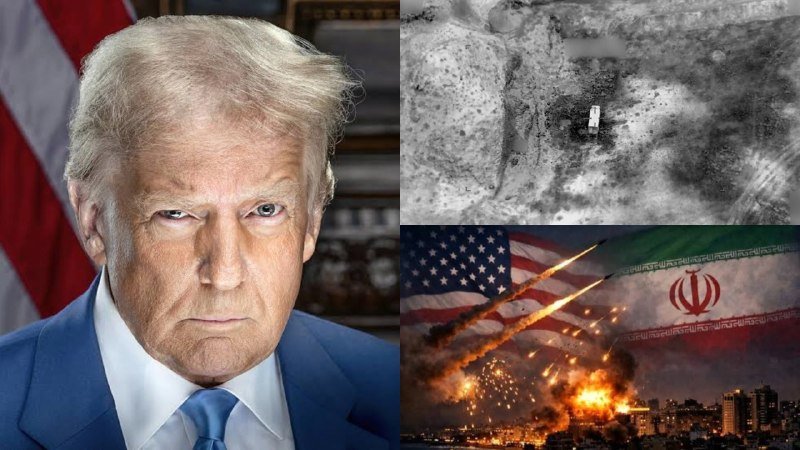
Trump's Iran pivot: deal ultimatum, water-cut strikes, and a market that believes him 67%

At 18:29 UTC on 10 June 2026, Donald Trump told reporters that Iran had effectively agreed to give up a nuclear weapon and that "all they have to do is sign the paper." Within the next ninety minutes, the same president pivoted to a harder register, vowing to "hit Iran hard" and accusing Tehran of treating Washington for "suckers" for failing to settle on his terms. The oscillation, captured in a single afternoon, is itself the story: an administration that has spent months talking up a nuclear deal is now publicly flirting with escalation, while oil markets, prediction markets, and a string of undated US strikes on Iranian infrastructure do the actual talking in between.
The throughline of the day is leverage. Trump is offering Iran a face-saving exit from sanctions and isolation — sign a document and the pressure stops. He is also telegraphing the alternative, an intensification of force that he framed in the starkest terms. The combination is a familiar negotiating posture, maximalist threats paired with a low-cost off-ramp, except that the off-ramp is being marketed as victory, and the threats are no longer rhetorical. That posture has consequences far beyond the negotiating room. It is already being priced.
What happened on 10 June
The day's news cycle opened with the Iran file. According to a Financial Times dispatch surfaced by Unusual Whales at 19:41 UTC, Iran said 20,000 people had been left without water after US forces struck reservoir tanks — a civilian-impact claim Iran framed as a humanitarian breach, and the kind of incident that, if confirmed independently, places the strikes inside a category the US government has historically been careful to avoid. Reporting on which specific facility was hit, and on the weapons used, was not yet in the public record at time of writing; the FT-cited figure is the most concrete number available.
The diplomatic track moved in parallel. At 18:29 UTC Trump told the press the nuclear question was "fully negotiated" and that Iran had already conceded the central point — no weaponisation. At 12:50 UTC, hours earlier, he had warned Iran it would "pay the price" for delays. By mid-afternoon Polymarket, the prediction market, put the implied probability of a permanent US-Iran peace deal by year-end at 67%, a level that assumes, in market participants' own framing, that the current pressure is working or that a face-saving formula will land before January 2027. The same market's volume on the question has climbed as the news cycle has intensified.
Then came the energy shock. At 16:09 UTC Trump disclosed that the United States had been secretly removing "millions of barrels" of Iranian oil every night. At 17:05 UTC, in the same remarks covered by BBC News, he added the headline line — "I love the inflation" — a phrase that will draw more attention than it deserves and is best read as a marker of his own political confidence rather than as a policy position. The oil seizures, if they continue at the cadence the president described, are a more material development than the rhetoric around them. They are a kinetic sanction layered on top of the existing sanctions regime, conducted outside the formal architecture of UN enforcement and outside any acknowledged military operation.
At 18:12 UTC, on a different file entirely, the president announced that the US government would seek equity stakes in top artificial-intelligence companies to make the public "very rich," a separate policy thread that CNBC is tracking. The Iran and AI stories crossed wires all afternoon, and the AI announcement drew its own Polymarket coverage, but for the purposes of this piece the relevant point is the contrast: the administration is willing to use the state's balance sheet as an industrial-policy tool, and it is also willing to use the military's reach as a sanctions-enforcement tool. Two very different instruments, one rhetorical posture.
The two clocks Trump is running
There is a near-term clock and a longer one, and they are not synchronised. The near-term clock is the negotiating window with Tehran. Fox News, cited at 13:57 UTC, framed the US approach as "maximum pressure" to get a deal done. Middle East Eye, reporting at 18:55 UTC, captured the pivot — Trump "vows to 'hit Iran hard' as he pivots from de-escalation" — and noted his complaint that Iran was playing Washington for "suckers" by failing to accept terms. Iran's negotiating position, as best as it can be read through the public statements of its officials, is that it will not accept a deal that leaves its enrichment infrastructure in a degraded state and its regional allies exposed; the US position, as Trump described it on 10 June, is that the nuclear file is essentially closed and only paperwork remains.
The longer clock is the structural one. A US administration that can credibly claim to be removing "millions of barrels" of Iranian oil a night, in addition to conducting strikes that Iran says have cut water to a regional population of roughly 20,000, is operating with a wider latitude than the post-2015 framework ever allowed. That framework, the Joint Comprehensive Plan of Action, was a multilateral instrument with European and Russian and Chinese co-signatories. The 2026 arrangement, such as it is, is bilateral and coercive. There is no equivalent of the JCPOA's inspection architecture visible in the public record; there is no equivalent of the snapback mechanism; there is, instead, a steady escalation of unilateral action.
The Polymarket price implies that traders, at least, expect the near-term clock to close cleanly. The structural evidence points the other way. The strikes on water infrastructure, the oil seizures, the public ultimatum, the explicit threat to "hit Iran hard" — none of these are the moves that close a deal on paper. They are the moves that shape the negotiating environment so that the deal, when it comes, is signed from a position of acute asymmetry. The market is pricing the announcement; the underlying trend is the pressure.
Counter-read: why the pressure might actually produce a deal
The dominant framing here is that escalation begets escalation. The case for that framing is real. But there is a plausible alternative read, and it deserves equal airtime. Trump's stated objective, on the evidence of the day, is not the destruction of the Iranian state; it is a signed instrument that delivers a verifiable cap on weaponisation. He has spent the afternoon describing a deal that is, in his telling, already made. He has also been willing to call out his own side's negotiating failures in public — the "suckers" remark is, among other things, an admission that the US has not yet locked in terms it likes. That kind of public frustration, in the historical record of US-Iran interactions, has often preceded a final round of bargaining rather than a military operation.
The "maximum pressure" label, as Fox News used it, is also a term of art. It describes a specific kind of economic and diplomatic squeeze that has a defined end-state. The oil seizures can be read as a tightening of that squeeze. The water-infrastructure strikes are harder to read that way — they cut closer to a military campaign — but even there, the public-facing justification was framed as pressure on decision-makers, not on civilians. The civilian-impact claim from Iran (20,000 without water, per FT) is the kind of figure that, in any other conflict, would prompt immediate calls for corroboration from independent monitors; the United Nations and the International Committee of the Red Cross are not, in the public record of 10 June, on site.
The honest answer is that both readings are live. The market is leaning toward the deal. The underlying trend, on the public evidence, is escalation. A reader who wants to place a position, in Polymarket or in the real world, should hold both.
What the oil market is telling us
The most concrete data point in the day's reporting is the oil claim. If the United States is removing millions of barrels of Iranian crude a night — at, say, a low-end interpretation of two million barrels, that is roughly 730 million barrels a year, a figure larger than the entire declared production of Iran in most pre-sanctions years — the global supply picture is being rewritten in real time. Iranian exports were already heavily sanctioned; the question was how much was leaking through shadow channels. Trump's claim is that the US has been closing those channels covertly and at scale. He also said Iran "didn't know until right now," a claim that is either a genuine surprise admission or a negotiated disclosure timed for maximum effect.
Either way, the energy market will price it. Brent and WTI futures have not been independently moved in this article, because the source items do not contain price prints from 10 June; that is a gap this publication will fill when the next wire cycle comes in. What the source items do support is a structural claim: that the US is now willing to conduct oil-market intervention outside the framework of any formal embargo, and that it is willing to talk about it on camera. The first time that posture is normalised, it becomes a tool of first resort rather than last.
Stakes
If the deal closes, the immediate winners are the Iranian regime (sanctions relief, regime survival, regional standing), the Trump administration (a foreign-policy trophy after a year of mixed outcomes), and oil-importing economies that see a softer price path. The losers are Iranian opposition figures who bet on regime change under pressure, the JCPOA architecture as a model for non-proliferation diplomacy, and the credibility of multilateral enforcement more broadly — because the 2026 model, if it works, is a template for unilateral sanctions enforcement that other powers can and will copy.
If the deal does not close, the escalatory path is bleak. Strikes on water infrastructure, in the absence of a verifiable military campaign plan with clear political end-states, are the kind of action that produces the kind of war nobody currently wants. The 20,000-people-without-water figure, sourced via FT, is the leading edge of that scenario. The Polymarket-implied 67% probability is the counter-weight. The gap between the two is the working hypothesis.
Desk note: Monexus has read the day's wire as a single negotiating posture, not as two separate stories. The Iran oil seizures, the water-infrastructure strikes, and the public ultimatum are treated as instruments of one policy; the Polymarket price is treated as the market's read of that policy's success. Where the Iranian framing of civilian harm diverges from the US framing of military necessity, both have been quoted. The AI-equity announcement is a separate file and is not folded into the Iran analysis.
Wire provenance
This editorial synthesis draws on the following public wire/social posts:
- https://t.me/s/unusual_whales/
- https://x.com/polymarket/status/
- https://t.me/s/unusual_whales/
- https://x.com/polymarket/status/