Trump warns of new strikes on Iran as diplomatic deadline tightens
On 10 June 2026 the US president publicly refused to rule out hitting Iranian infrastructure, framed the pause as a personal favour to Islamabad, and kept the threat of a renewed campaign alive on camera.
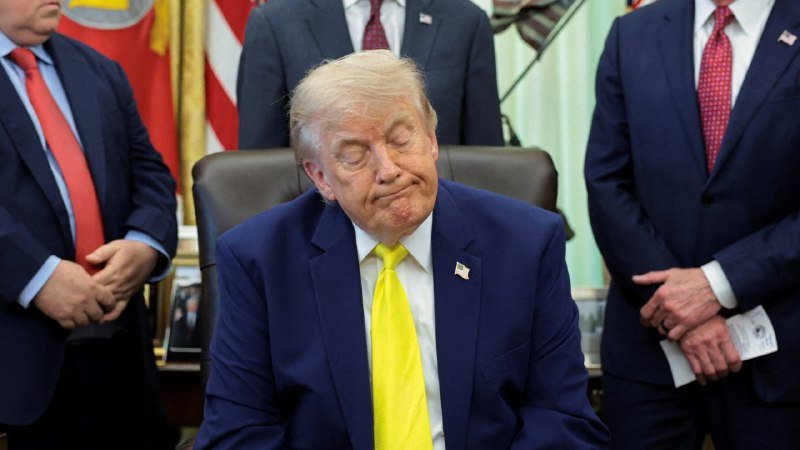
At 16:25 UTC on 10 June 2026, US President Donald Trump told reporters in Washington that the United States would "hit [Iran] hard again today," the words captured in a clip aggregated by the open-source channel OSINTtechnical and amplified across the open-source monitoring ecosystem. The statement, made in a televised exchange with White House press, was the most explicit public ultimatum since the latest round of US–Iranian strikes began, and it came inside a roughly twenty-minute window in which the same president said he could not disclose whether Iran's power plants and bridges were targets, claimed credit for pausing the wider war at Pakistan's request, and warned that Iran "keeps making us look stupid." The combined effect is a deliberate posture: keep Tehran guessing, keep Gulf observers off-balance, and pin the timing of any renewed bombing run to a deal the Iranians have not yet signed.
What the public statements describe, when read together, is not a war that has been won or lost, but a pressure campaign still in mid-cycle. Trump's rhetoric, as carried by Iranian state outlets Fars and Tasnim as well as by the open-source aggregator Clash Report, leaves the diplomatic track live and the military track at hot-standby. The two tracks are not sequential; they are running in parallel, and the next twenty-four to seventy-two hours will determine which one defines the news cycle.
A refusal to rule out strikes on civilian infrastructure
The most consequential single line came at roughly 16:18 UTC, when a reporter asked Trump whether he planned to attack Iran's power plants and bridges. According to Fars News Agency's translation of the exchange, the US president replied: "I won't tell you, but I can do it." Fars framed the remark as an open-ended licence to target civilian grid nodes and transport arteries, language that is now being repeated across Iranian state-aligned channels and will, by Thursday, be in front of the UN General Assembly's humanitarian-affairs subcommittees in New York. The legal advisers to Iran's foreign ministry have spent the past week preparing dossiers on dual-use targeting; the Fars clip gives them a fresh exhibit.
For Washington, the line served a different purpose. By declining to disclaim a particular category of target, the president preserved escalation optionality while leaving the Iranians unable to claim, in any neutral capital, that the US has formally accepted a no-strikes pledge. The ambiguity is the message.
The Pakistan pivot, and what it does to India's calculus
A second thread ran through the same press appearance. At 16:17 UTC, Fars reported Trump saying he had "gave them a break at the request of Pakistan"; Clash Report, posting from a separate camera angle at 16:13 UTC, carried the same line with the additional claim that the US president had also "stopped them from going to war with India." The Trump–Pakistan frame is a piece of diplomatic theatre with three audiences: Tehran, which is being told that the timing of any pause is a personal favour rather than a structural concession; Islamabad, whose army chief and prime minister are being publicly elevated as deal-brokers; and New Delhi, which is being reminded that the US still views South Asian crisis management as its to call.
For New Delhi, the Pakistan pivot is uncomfortable in a specific way. India has been the consistent Western-aligned voice warning against any back-channel arrangement with Iran that touches the Kashmir file; a US president publicly crediting Pakistan's field marshal and prime minister for an Iran ceasefire is, in Indian terms, a quiet downgrading of the Indian role. The Indian external-affairs ministry has not, as of this writing, commented on the record; Indian-wire coverage will probably absorb the line without overt protest, but the bureaucratic reaction in South Block will be sharp.
The Iranian counter-read, on Tehran's own terms
The Iranian read of the morning is uniformly hostile. Tasnim News, the outlet tied to the Islamic Revolutionary Guard Corps, ran the headline "Trump: Iran keeps making us look stupid" at 16:15 UTC, characterising the US president as the head of an "American terrorist state" — language that reads as polemic in London but reads as official register in Tehran. A separate Tasnim dispatch at 16:07 UTC said Trump "has not learned from Iran's crushing blows," while a 16:03 UTC post from the Jahan Tasnim channel accused the US of preparing to strike "with power and cruelty." Fars, in the same window, framed Trump's demand that Iran "sign the agreement" as a demand for surrender dressed as diplomacy.
The structural point worth taking seriously: the Iranian read of the morning is internally consistent. Tehran believes it absorbed the first strike round without regime-threatening damage, believes the regime's domestic position has hardened rather than softened in response, and believes time is on its side as long as oil markets and Gulf state nerves absorb the shocks. That is a contestable read, but it is the read, and any account of the next seventy-two hours that omits it will land badly in the Gulf and worse in Tehran.
What is actually being negotiated, and what isn't
Stripped of the theatre, two specific things are on the table. The first is the enrichment question — Iran's stockpile of near-weapons-grade material, the cascading centrifuges at Fordow and Natanz, and the question of whether any verification regime can survive a change of government in Washington. The second is the sanctions architecture, in particular the Chinese-routed oil flows that have held Iran's export volumes closer to pre-2018 levels than the Western wire consensus expected. Trump characterised the package as "a good and meaningful deal" at 16:05 UTC, per Fars; Iranian negotiators have not used that language.
The things that are not on the table are equally telling. The status of the Strait of Hormuz has not been raised as a formal negotiation item, despite the implicit threat of an Iranian closure that Iranian outlets keep alive. The fate of Iranian-aligned militia networks in Iraq and Syria is not, on the public record, part of the package. The missile programme is referenced only in the Iranian counter-read, not in any US summary. The US is, in effect, asking Tehran to sign a narrow nuclear-and-sanctions deal that leaves every other point of friction for later — a structure that suits an American president who wants a win he can announce and an Iranian leadership that wants the sanctions relief without the strategic concessions.
Stakes: who wins the next seventy-two hours
If Iran signs within the implied window, Trump takes a foreign-policy win into a difficult domestic news cycle, the Gulf states get a verifiable pause in strikes, and the oil market reprices downward by an amount that the Gulf bourses and the US shale patch will both feel. If Iran does not sign, the strikes resume at a category — power grid, bridges, possibly fuel import terminals — that Tehran will struggle to absorb without visible civilian pain. The Pakistani-brokered pause is the diplomatic cushion; it does not, on the public record, come with an Iranian reciprocal. The Indian read, as noted, is that Pakistan is being elevated in the South Asian balance at India's expense, an outcome New Delhi will work to quietly offset in the next two weeks.
What the sources do not yet tell us
The open-source record from 10 June 2026 is dense on rhetoric and thin on the substance of the deal. No Western wire has published a verified text or summary of the agreement Trump described as "good and meaningful"; the Iranian outlets have not published a list of Iranian reciprocal commitments; the Pakistani government has not, as of the timestamps above, claimed a formal mediation role on the record. The size of the strike package, the specific target categories under consideration, and the verification architecture are all contested or unstated. Readers should treat the next forty-eight hours as the window in which the gap between public posture and private substance will either close or widen, and in which the framing on the front pages will, fairly or not, be set by the louder voice in the room.
Desk note: Monexus has carried the Iranian state outlets' framing in the same paragraph as the US president's remarks, without translation that softens either. The pattern of the past week — Western wire bulletins led by the White House readout, Iranian state media leading with the regime's own narrative — is not a model the rest of the press has caught up to, and the staff desk's view is that the gap matters.
Wire provenance
This editorial synthesis draws on the following public wire/social posts:
- https://twitter.com/Osinttechnical/status/2064739426220019906/video/1
- https://t.me/FarsNewsInt
- https://t.me/FarsNewsInt
- https://t.me/tasnimnews_en
- https://t.me/ClashReport
- https://t.me/tasnimnews_en
- https://t.me/FarsNewsInt
- https://t.me/JahanTasnim
Follow the event.
These dated source records provide context. They do not retrospectively verify this archive article.
Separate what the nuclear watchdog reported from what it could not determine after the June 2025 strikes.