Trump signals escalation against Iran as nuclear talks stall
With a memorandum under negotiation, a $460 billion equity rout, and a Pentagon that has yet to confirm anything, Donald Trump's latest threat against Iran is best read as pressure rather than as a confirmed operational decision.
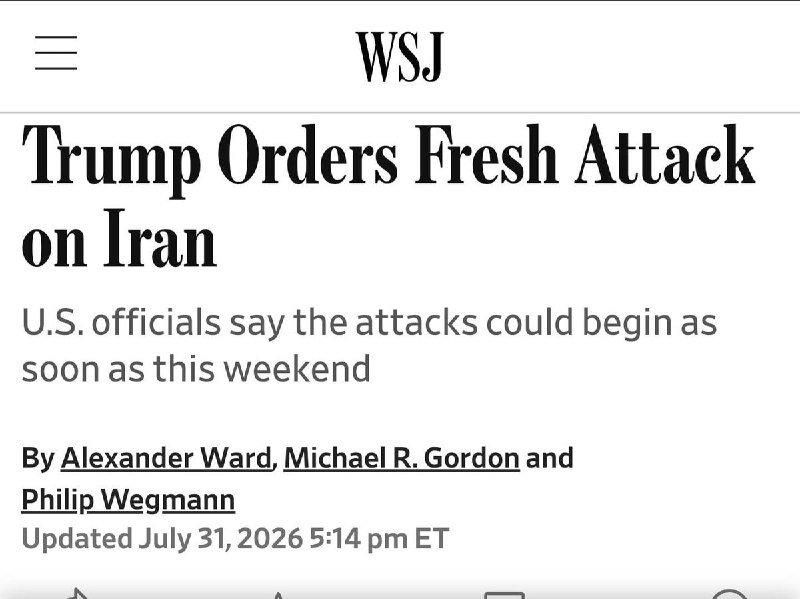
On 10 June 2026, the gap between Donald Trump's rhetoric and the Pentagon's silence is the story. Within a single news cycle, the US president has publicly teased the imminent end of a war he launched in February, dismissed the emerging terms of a deal he himself appeared to accept as a "hoax," and reiterated threats of further military action against Iran. No senior US defense official has corroborated any new operational posture. What exists is a stream of statements, retweets, and social-media posts, distributed through channels that track Israeli and Russian-adjacent coverage of the US–Iran file. The threat is a policy signal, not a confirmed operational decision.
That distinction matters because the underlying conflict has already escalated far beyond the speculative. Per analysis circulated by MS NOW and summarised across Telegram channels, since the war's outset on 28 February Trump has publicly set ultimatums for military action against Iran at least eight times. The Economist, in a piece that has ricocheted through the same distribution network, frames the strategic shift bluntly: "Iran's fear of war has disappeared." The publication notes that over the past week both the United States and Israel bombed Iran, that Iran shot down an American helicopter, and that the unthinkable has become routine. Read against that baseline, the latest presidential volleys are not aberrations. They are the operating tempo of a conflict in which threats, cancellations, and renewed threats are themselves a form of pressure.
The hoax and the $460 billion
The proximate trigger for the latest escalation signal was Trump's characterisation of the announced points of the deal as a "hoax." Within five minutes of that comment, American equity markets shed roughly $460 billion in capitalisation, according to a market read-out circulated by @sprinterpress and consistent with the intraday volatility the broader wire has been reporting. Trump told Axios he had demanded public explanations about Iranian state-media reports claiming Tehran would receive billions in frozen assets immediately upon signing. The New York Times, as quoted via the same distribution chain, argues that the depletion of global oil reserves is increasing the pressure on Trump to reach an agreement, a structural condition that helps explain both the urgency of the negotiation and the volatility of the president's public posture.
The deal under discussion, as described by Iranian Foreign Minister Abbas Araghchi in televised remarks, is a memorandum of understanding no longer than two pages, reviewed by the foreign ministry, intelligence services, and other relevant bodies, and intended to be signed in Europe as soon as this week. Araghchi, whose earlier statement Trump retweeted, told Iranian television that "the best time to end a war is before an unwanted consequence happens." He also signalled that sanctions relief and the nuclear file had been postponed to a final agreement, and that "the nuclear issue has not been resolved yet." On the question of frozen assets, Araghchi was explicit: once the memorandum is signed, Iranian assets would be released and could not be frozen again, with separate discussion of compensation for reconstruction of damage inflicted during the war. Trump's retweet of Araghchi's framing of a deal, followed within hours by his "hoax" comment, captures the structural contradiction at the centre of the file.
A war that doesn't end
According to NPR, Trump has once again cancelled planned strikes on Iran while claiming a peace deal is near. Al Jazeera's headline read: "Will there be a deal to end the Iran war this time?" The pattern is by now familiar. Since March, Trump has repeatedly declared the war would end soon; the deal has not been finalised and disputes over its content persist. CBS News, as relayed by Telegram channels tracking the file, reports that the US military is drawing up contingency plans to secure Iran's nuclear materials if a peace deal is reached, centred on elite JSOC units trained for counter-proliferation missions. The fact that such planning is underway at all is itself a tell: Washington is preparing for a scenario in which Tehran's nuclear infrastructure is physically secured under American control, not merely verifiably inert. That is a different endpoint than the diplomatic language suggests.
Iran's reaction, in the hours around the president's latest comments, has been to assert victory. The Iranian Ministry of Foreign Affairs stated publicly, as captured by @sprinterpress, that "Iran won the war against the USA," a claim that sits awkwardly next to Araghchi's own insistence that the nuclear file remains unresolved. The gap between maximalist political rhetoric and the narrow technical scope of the memorandum, two pages, deferred sanctions relief, deferred nuclear settlement, is the space in which escalation or de-escalation will be decided.
Gulf money, European stocks
Outside the US–Iran bilateral track, two adjacent financial moves are reshaping the pressure landscape. Middle East Eye reports that the United Arab Emirates paid Iran billions of dollars to halt strikes, with IRGC officials staying at the UAE national security advisor's guest house last week to cut a de-escalation deal. According to a Reuters wire circulated via @sprinterpress, the UAE intends to allocate at least $10 billion to Iran, with the first $3 billion already transferred and additional tranches to follow. The mechanism matters: Gulf states, not American taxpayers, are now functioning as the financial backstop for whatever ceasefire framework emerges. That shifts both the political optics and the leverage map.
In Europe, the effect is the inverse. The Stoxx Europe Targeted Defence index has fallen more than 15% from its January peak, a decline attributed by market analysts to low investor confidence in Europe's ability to fund its own armed forces. If the war ends, even on terms Tehran will subsequently describe as a victory, the European defence rally that priced in a prolonged conflict unwinds. The signal from markets, taken alongside the $460 billion US equity move on Trump's "hoax" comment, is that investors are treating the endgame as binary: a clean deal compresses defence and energy risk premia; a collapsed deal does the opposite.
What the signal actually is
For all the noise, the operative question on 10 June 2026 is whether Trump's escalation language is a negotiating instrument or a foretaste of renewed bombing. The public record offers no Pentagon confirmation of new operational orders, no allied statement from Tel Aviv, and no movement from the JSOC planning described by CBS beyond the contingency stage. What there is, in abundance, is presidential rhetoric amplified through social channels, contested by Iranian counter-claims of victory, and priced in real time across equities and Gulf sovereign transfers. The threat is real as pressure; it is unconfirmed as operation. Until either a signed memorandum or a renewed strike order breaks that ambiguity, the policy signal is the policy itself, and the world's oil markets, European defence stocks, and Iranian asset ledgers are the only honest scorekeepers in the room.
Sources
- The Jerusalem Post, Telegram channel: https://t.me/The_Jerusalem_Post
- Intelslava, Telegram channel: https://t.me/intelslava
- @sprinterpress, X: https://x.com/sprinterpress
- @englishabuali, Telegram channel summary of Araghchi interview, 12 June 2026: https://t.me/englishabuali
- DDGeopolitics, Telegram channel, Araghchi on deal terms: https://t.me/DDGeopolitics
- War and Witness, Telegram channel, Araghchi on memorandum scope and JSOC planning: https://t.me/wfwitness
- Open Source Intel, Telegram channel, Araghchi on US nuclear demands: https://t.me/osintlive
- Our Wars Today, Telegram channel, Trump deal status: https://t.me/ourwarstoday
- Middle East Eye via @middleeasteye, X, UAE-Iran de-escalation report: https://x.com/middleeasteye
- Al Jazeera Breaking News wire, 12 June 2026
- NPR Topics, "Trump says he has canceled planned strikes on Iran and peace deal is near, again," 12 June 2026
- MS NOW analysis on Trump's ultimatums, as summarised via @sprinterpress, X
- The Economist, "Iran's fear of war has disappeared," as quoted via @sprinterpress, X
- The New York Times on oil reserve pressure, as quoted via @sprinterpress, X
- Reuters wire via @sprinterpress, X, on UAE allocation to Iran
- Axios interview with President Trump, as summarised via @sprinterpress, X
- CBS News report on JSOC counter-proliferation planning, via @wfwitness, Telegram
Desk note: This piece treats the escalation signal as a policy posture rather than as confirmed military action, consistent with the gap on 10 June 2026 between Trump's public language and the absence of any Pentagon or allied corroboration in the day's available sources.
Follow the event.
These dated source records provide context. They do not retrospectively verify this archive article.
Separate what the nuclear watchdog reported from what it could not determine after the June 2025 strikes.