Trump's Iran ultimatum and the two-track war of words
A helicopter shootdown, a stalled negotiating track and a presidential threat of force have pushed US-Iran relations into the most acute crisis of the year — with Tehran's parliament firing back in kind.
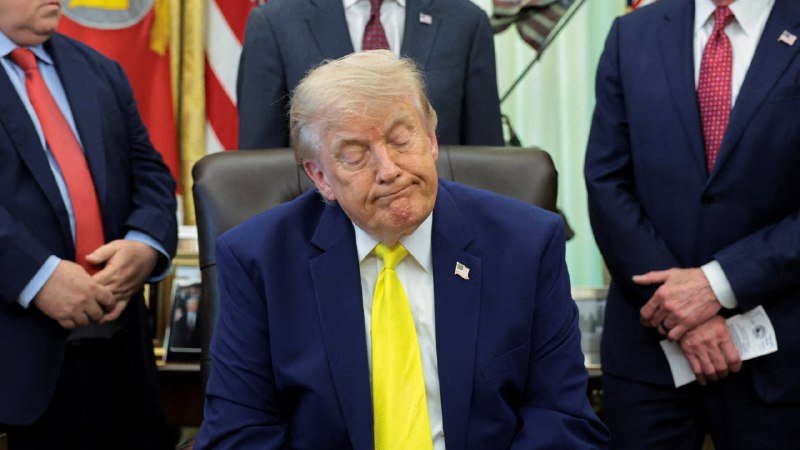
The US-Iran confrontation entered its sharpest phase of 2026 on Wednesday, 10 June, when President Donald Trump publicly warned that American forces would "attack Iran very hard," explicitly tying the threat to the reported downing of a US Army Apache helicopter and to what he described as a stalled negotiating track. The statement, carried by Reuters at 18:45 UTC, marks the first time Washington has so openly conditioned further military action on Tehran's behaviour at the table rather than on a discrete retaliation for a single incident.
What is unfolding is a two-track contest — combat operations and rhetorical escalation running in parallel, with neither side signalling an off-ramp. Iran's parliament fired the loudest volley in return. Ebrahim Azizi, the head of the Iranian parliament's national security commission, declared on 10 June that Iranian forces were "not afraid of fighting losers" and that the number of American casualties was already "far higher" than the US president had confirmed. The line, carried by Iranian-aligned channels, frames the conflict as one in which Washington is bleeding on a battlefield that Tehran insists it controls.
The trigger, and what triggered it
Trump's language leaves little room for ambiguity. According to the Reuters report, the president framed the downing of the Apache — a US attack helicopter — as the proximate cause of the planned escalation, while pointing to the failure of the diplomatic channel as the underlying grievance. Deutsche Welle's same-day bulletin, published at 17:53 UTC, recorded the statement in slightly softer form, with the US president saying forces would hit Iran "hard" and noting the broader pattern of "hostilities" between the two militaries. The two readouts are consistent: the diplomatic track is over in Washington's telling, and the military track is now the policy.
Azizi's response, distributed via Iranian state-adjacent Telegram channels, performs the inverse logic. The Iranian framing does not deny the clash; it relocates it, asserting that Iranian firepower has already produced results the US president is concealing. That is a propaganda reflex, but it is also a strategic message: any further US escalation will be met with force, and the cost, in Tehran's telling, will be borne on the American side.
The counter-narrative Tehran wants heard
The Iranian line is not a denial of war — it is a redefinition of who is winning it. Azizi's "fighting losers" formulation recasts the United States, the largest defence spender in the world, as the party on the back foot, and recasts Iranian ground-based air defence — a domain where Tehran has invested heavily for four decades — as the venue of choice. It is the messaging a sanctioned, asymmetric power reaches for when it cannot match the US dollar for dollar and chooses to fight on a terrain where cost ratios favour the defender.
That framing has structural appeal beyond Tehran. For audiences across the Middle East and the broader Global South, a narrative in which the US military is shown to be bleeding in a contained engagement fits a longer-running critique of American overreach. The Iranian messaging apparatus is, in effect, asking those audiences to read the Apache incident as evidence rather than exception — and to treat Washington's threat of "very hard" strikes as a confession that softer options have failed.
Why escalation, and why now
The most plausible read of Trump's statement is that the diplomatic track has been allowed to lapse on purpose, not by accident. The combination of a fresh military incident and an explicit threat of escalation is a familiar opening move: raise the cost of continued defiance, then leave a window for a face-saving climb-down. The fact that the threat was made on the record, to Reuters, rather than in a private channel suggests the administration is also speaking to domestic audiences — making clear that a diplomatic failure will not be answered with restraint.
The Iranian counter-messaging, distributed within hours of the Reuters report, forecloses that off-ramp. Once Tehran's parliament has publicly framed the next round of strikes as a stage on which American losses will mount, any pause by Washington can be marketed in Iran as a victory. That dynamic, more than the helicopter itself, is what makes the next seventy-two hours dangerous.
What remains genuinely uncertain
The sources do not specify the location of the helicopter shootdown, the operational status of the airframe, or the unit involved, and the Reuters report does not name which US formation the Apache belonged to. The Iranian claim of "far higher" American casualties has not been independently corroborated by any wire service in the thread. The status of the negotiating track — whether it is paused, suspended, or dead — is described only in the president's own characterisation. Until at least one of these facts is verified independently, the rhetorical posture of both governments should be read as positioning, not as ground truth.
Desk note: Monexus is leading on the Reuters wire for the US side and the Reuters/DW line for the diplomatic backdrop, while treating the Iranian parliamentary messaging as counter-claim material — quoted for what it reveals about Tehran's strategic framing, not as a stand-alone factual basis.
Wire provenance
This editorial synthesis draws on the following public wire/social posts:
- https://t.me/rnintel
- https://t.me/wfwitness
- https://t.me/GeoPWatch
Follow the event.
These dated source records provide context. They do not retrospectively verify this archive article.
Separate what the nuclear watchdog reported from what it could not determine after the June 2025 strikes.