Pressure tactics, public positions: parsing the new US–Iran escalation
New US sanctions, fresh strike threats and a pointed refusal from Tehran meet an unusually bullish prediction market. The gap between the two tells you where the real contest now sits.
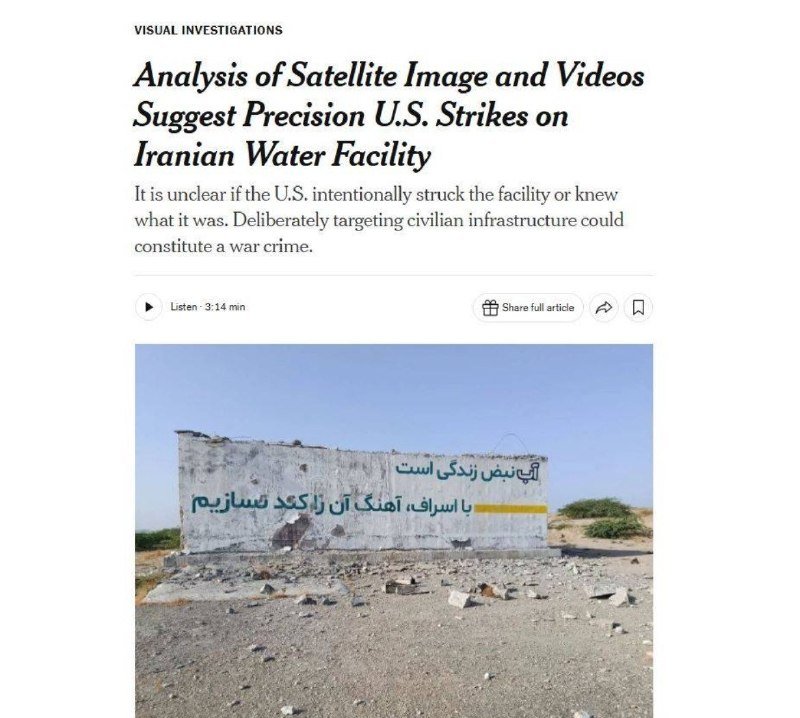
On 10 June 2026, the United States ratcheted the pressure campaign against Iran up a notch. South China Morning Post reported that Washington had unveiled a new tranche of sanctions on Iranian targets and was openly threatening further strikes, the latest move in an escalation that began earlier this month with direct US military action on Iranian infrastructure. By 20:03 UTC the same day, Iran's ambassador to the United Nations had published a flat refusal: Iran, the ambassador said, "has never negotiated under threats, and will never submit to pressure or coercion." Between those two postings sat a third piece of evidence — a Financial Times-sourced claim, circulated on X at 19:41 UTC, that US strikes on reservoir tanks in Iran had left roughly 20,000 people without running water.
The combination is not a negotiation. It is a test of which side moves first. The harder Washington leans on economic and military pain, the louder Tehran insists that pain is a precondition for talks rather than a substitute for them. And yet, even with the rhetoric at fever pitch, prediction markets are pricing something close to a deal into the year. Polymarket's US–Iran permanent peace market sat at 67% on 10 June, a remarkable number for a relationship that, on the same day, was producing fresh sanctions, fresh threats and fresh reports of civilian infrastructure damage.
What Washington actually did
The sanctions package detailed by SCMP is the kind of escalation that reads as routine in press releases and as a quiet tightening in practice. New designations usually mean additional Iranian entities — banks, shipping networks, oil brokers, sometimes officials — cut off from the dollar-based financial system. The dollar lever is the one that does the heavy lifting: a Treasury designation can shutter correspondent accounts overnight, and the cost of doing business with a blacklisted entity becomes prohibitive for any non-Iranian counterparty that wants access to US banks. "More strikes" is the other half of the message, and the explicit threat is what makes the sanctions land — sanctions work because the alternative is worse.
The civilian-infra dimension is harder to verify and easier to weaponise politically. The FT-sourced figure of 20,000 people without water after US hits on reservoir tanks, if confirmed, places the campaign inside a category of strike that governments usually insist is incidental rather than targeted. Water infrastructure is the kind of target that produces long-tail humanitarian costs without producing the obvious moral shock of a school or a hospital. That is precisely why such strikes tend to be reported, denied, partially confirmed and then quietly absorbed into the news cycle.
What Tehran is signalling back
The Iranian UN ambassador's statement is the diplomatic equivalent of bracing. The line — never negotiate under threats, never submit to coercion — is a long-standing pillar of Iranian negotiating doctrine, recited in Persian and English by every Iranian foreign minister for two decades. It is not a negotiating position so much as a precondition for one: the public script says that talks can happen, but only once the threats recede. That framing tells Washington that escalation produces resistance, not concessions, and that any deal will need to be sold domestically in Tehran as a return to parity rather than a climbdown.
There is also a domestic audience problem. Iran's negotiating team will eventually have to defend whatever emerges to a political class that has watched reservoir tanks struck and civilian infrastructure damaged. The harder the US campaign bites, the more politically expensive any deal becomes inside Iran. This is the standard coercion trap: pressure that is severe enough to force the adversary to the table is often severe enough to make the table politically toxic when the adversary gets there.
The prediction market tells a different story
Polymarket at 67% is the most counter-intuitive data point of the day. It implies that traders — putting real money behind their beliefs — think a permanent US–Iran deal is more likely than not this year, despite the public escalation. That gap between the news feed and the market is the article.
Two readings are possible. The optimistic read is that the threats and sanctions are bargaining, not policy — that the Trump administration (and whatever configuration of the Iranian system emerges as the counterpart) is using public pressure to set a floor for negotiations that both sides know are coming. The cynical read is that the market is mispricing, that prediction markets can be thin and manipulable, and that 67% reflects the recency bias of traders watching a few weeks of deal optimism rather than the underlying probability of a durable agreement.
This publication's read is closer to the first, with a heavy caveat. The pattern of US–Iran interactions for a generation has been a public posture of maximal pressure and a private posture of incremental talks, usually through intermediaries, usually in a third capital, usually with months of denials. The current cycle does not look structurally different — it is just louder, with more visible strikes and more visible refusals. Loudness is not a proxy for proximity to war or to peace. It is a proxy for the salience of the file in domestic politics on both sides.
What the structural frame looks like
Strip away the day-to-day drama and the contest is the same one the US and Iran have been running since 1979, with the same two currencies: oil flows and the dollar-based financial system. Washington's preferred instrument is exclusion from that financial system; Tehran's preferred counter-instrument is the leverage that comes from controlling chokepoints and from a sanctions-evasion architecture refined over two decades. Strikes on infrastructure add a third instrument — direct physical cost — but the underlying arithmetic is unchanged. Sanctions hurt; they do not collapse. Strikes damage; they do not break. Negotiations, when they happen, happen because both sides run out of asymmetric moves to make and arrive at the only remaining equilibrium: an exchange of constraints for constraints.
The pluralisation of the global financial system — the slow growth of non-dollar trade settlement, the willingness of some Gulf and Asian counterparts to work around US secondary sanctions — has changed the ceiling of what US pressure can do, but not the floor. Iran can sell oil, but it sells it at a discount and through intermediaries. It can access goods, but at a premium. Strikes can slow programmes; they cannot, on the public evidence, dismantle them.
What remains contested
Three things are genuinely unclear on this evidence. First, the FT-sourced reservoir strike has not been independently verified in the source material here, and the 20,000-people figure may move as ground reporting firms up. Second, the precise content of the new sanctions — which entities, which sectors — is not in the source items available to this piece, and the practical bite of designations is often narrower than the press release suggests. Third, the Polymarket number is a trader's price, not a poll, and prediction markets have been wrong on this file before — most notably in the run-up to the 2015 JCPOA framework, when similar instruments gave way to a deal that had seemed improbable a year earlier.
What can be said is that the two strongest signals of the day point in opposite directions. The diplomatic signals from both governments are maximalist. The market signal is conciliatory. The next few weeks will tell which signal is closer to where the actual negotiation, when and if it happens, will land.
This publication read the day's three signals — Washington's sanctions escalation, Tehran's diplomatic refusal, and the prediction market's 67% — and refused to treat any one of them as the headline. The honest read is that all three are real, and that the gap between them is the story.
Wire provenance
This editorial synthesis draws on the following public wire/social posts:
- https://t.me/FotrosResistancee
- https://x.com/unusual_whales/status/2062935260791263232
Follow the event.
These dated source records provide context. They do not retrospectively verify this archive article.
Separate what the nuclear watchdog reported from what it could not determine after the June 2025 strikes.