Tehran, Washington, and the $92 Barrel: A War That Stopped When the Cameras Stopped
US strikes on southern Iran ended within hours on 10 June 2026, oil jumped above $92, and Polymarket traders still price a year-end peace deal at 67% — a market that believes the bombs were a negotiation, not a war.
At 22:44 UTC on 10 June 2026, two Telegram channels that track military activity in real time — AMK Mapping and RN Intel — used almost identical language to declare the round of US strikes on southern Iran over. No new reports of explosions had come in for twenty-five minutes. The prior hour had been loud: the Middle East Spectator channel logged a fresh strike roughly an hour before that, and market data cited by The Kobeissi Letter put US oil above $92 a barrel on the news. The whole episode — the bombs, the panic, the price spike — fit inside a single evening.
What makes the sequence worth dissecting is not the ordnance. It is the price. By 21:41 UTC, the Polymarket contract on a US–Iran ceasefire this month had drifted to a 33% implied probability, while the parallel market on a permanent peace deal by year-end was pricing 67%. A market that watches the order book tick by tick was simultaneously telling its users that an immediate ceasefire was a coin-flip and that the year-end deal was the more likely outcome. That is not what a population watching missile footage on a loop would price. It is what a market that has watched this cycle repeat for decades would price: a coercive gesture inside an ongoing negotiation, not the opening shot of a wider war.
The shape of a "strike"
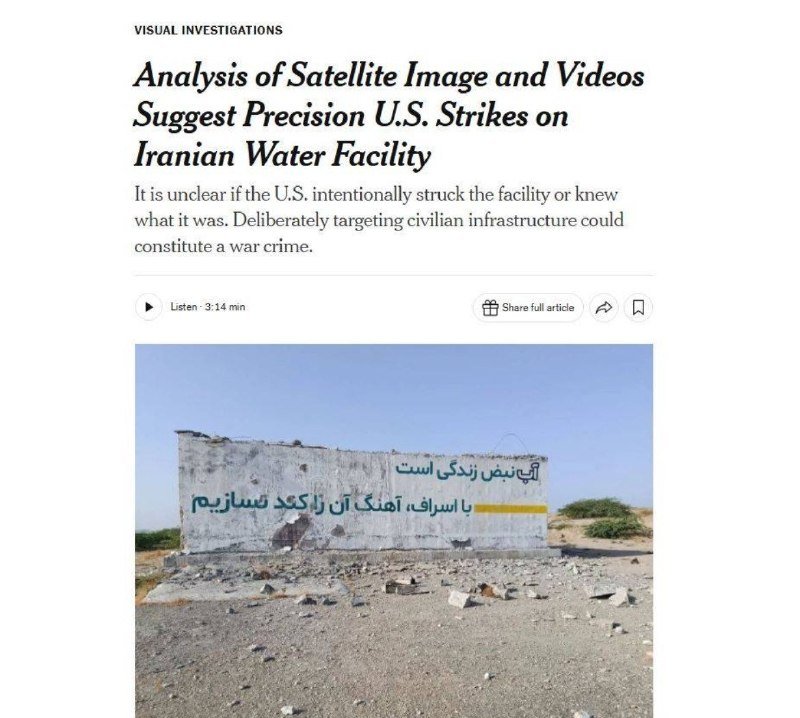
Reports of the operation arrived in clusters, not as a single event. Middle East Spectator's 23:08 UTC update placed a strike on Iran roughly an hour before — consistent with the AMK Mapping "operations appear over" timestamp and the WFWitness relay of The Kobeissi Letter on oil. Iran, via reporting cited by Unusual Whales at 19:41 UTC, said 20,000 people had been left without water after US strikes hit reservoir tanks, an attribution that traces back to the Financial Times' reporting on Iranian government claims. The FT is the primary source; the X post is a relay.
What the public record so far establishes is bounded: US military action struck targets in southern Iran on 10 June 2026, hitting infrastructure that Iran says included civilian water supply, and the operation paused within hours. Reuters, via its own account at 22:00 UTC, quoted the US energy chief as saying he was not aware of the US taking oil out of Iran — a denial that, if accurate, narrows the operational intent to damage and signalling rather than seizure.
The counter-read: this is exactly what negotiation looks like
The dominant Washington framing treats strikes of this size and brevity as either the prelude to escalation or the punctuation mark on a deal. Both readings struggle with the same evidence. If the US were preparing to escalate, the operation would not have ended before midnight UTC with the energy chief disclaiming knowledge of a seizure. If the strikes were meant to close a deal, the damage to a reservoir serving 20,000 people is an odd closing gesture. The shape that fits is the one Polymarket's year-end contract is pricing: a calibrated infliction of cost, designed to be visible enough to move Tehran's risk calculus and brief enough to leave the diplomatic channel open.
That reading is uncomfortable. It treats strikes on a sovereign state's infrastructure as a tool in a bargaining process, with the civilian cost — 20,000 people without water, in this case — as collateral rather than the point. The Iranian framing, in turn, treats the same operation as a violation of sovereignty requiring a security response. Neither side is being dishonest. They are operating on different theories of what military force is for.
The structural picture, in plain language
When a single evening of strikes moves a global benchmark above $92 a barrel, the question is not who is right. It is who absorbs the cost. US domestic gasoline prices respond to a $92 barrel within weeks; European and Asian importers, who price on the same benchmark, absorb the shock faster. Iran's own oil exports — already constrained by sanctions — are sensitive to enforcement decisions the energy chief's denial gestures at. A coercive strike is, among other things, a stress test of a sanctions architecture: it tells Tehran what the US is willing to do without actually taking Iranian oil off the market, and it tells the market what a bad night costs.
This is the larger pattern worth naming plainly. Coercive force between a superpower and a sanctioned regional power is no longer episodic; it is continuous, and the financial plumbing has been rewired to price it. Polymarket's two contracts on Iran — one for a ceasefire this month, one for a permanent deal by year-end — are a public, real-time ledger of how that pricing is being negotiated by participants who have no diplomatic access but plenty of money to lose.
What remains genuinely uncertain
The sources do not agree on what was actually hit, and the Iranian claim of water-system damage comes through an Iranian government channel via the FT, not from independent inspection. Polymarket's 33% ceasefire figure for June is consistent with a market that expects more strikes before the month is out; the 67% year-end deal figure is consistent with a market that expects those strikes to resolve into an agreement. Both can be true at once. The energy chief's denial of seizure is an absence rather than a presence — it tells us what the US is not doing, not what it is doing next.
What this publication can say with confidence is narrower than the cable-news frame. On 10 June 2026, US military strikes hit southern Iran, the operation paused within hours, oil moved above $92, and the prediction markets that price US–Iran relations did not reprice toward war. The rest is still in motion.
Desk note: Monexus treated Polymarket and FT-relayed Iranian government claims as primary sources for market and casualty figures, and the Telegram OSINT channels (AMK Mapping, RN Intel, Middle East Spectator) as timing corroboration rather than as independent confirmation of what was struck. The Reuters denial is the only US-side official on the record in the thread.
Wire provenance
This editorial synthesis draws on the following public wire/social posts:
- https://t.me/middleeastspectator
- http://reut.rs/4vebaDy
- https://t.me/wfwitness
- https://t.me/amkmapping
- https://t.me/rnintel
Follow the event.
These dated source records provide context. They do not retrospectively verify this archive article.
Separate what the nuclear watchdog reported from what it could not determine after the June 2025 strikes.