Healey's exit puts Labour's defence reckoning on the table
John Healey's resignation over Treasury parsimony hands Keir Starmer a political wound at exactly the moment the UK can least afford one.
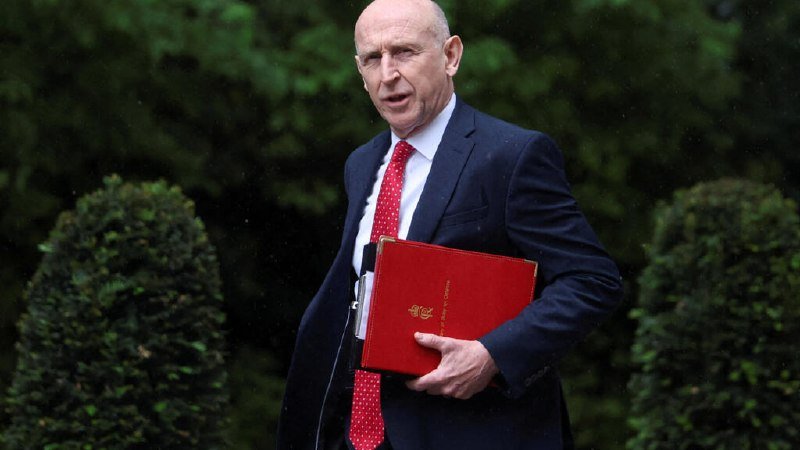
At 11:40 UTC on 11 June 2026, Reuters broke the story: John Healey, the United Kingdom's Secretary of State for Defence, had submitted his resignation to Prime Minister Sir Keir Starmer. By 11:44 UTC, the open-source intelligence channel GeoPWatch had posted the substance of the letter, and by 11:46 UTC the Telegram outlet BellumActaNews was circulating the framing that the resignation was a direct rebuke from the Defence Secretary to the Prime Minister and the Treasury. Within an hour, the political question had migrated from Westminster to NATO's eastern flank: when a sitting defence secretary walks out citing under-funding, what does it tell allies who have been asked to raise their own defence budgets to three percent of GDP and beyond?
The resignation is not, on the evidence so far, the product of a personal scandal or a routine reshuffle. It is a ministerial declaration that the British state is not putting its money where its security rhetoric sits. That distinction matters. Healey's letter, as paraphrased across the three Telegram threads that surfaced the news on 11 June, accuses Starmer and the Treasury of failing to commit the resources needed for defence amid what the same reports describe as "rising threats." The phrase is carefully chosen. It does not name Russia, Iran, or China, but it covers all three — and any British official writing in 2026 has those theatres in mind when they put pen to paper on defence.
What the resignation actually says
The core of the letter, as relayed by GeoPWatch and BellumActaNews, is administrative rather than ideological. Healey does not appear to have split with Starmer over NATO strategy, over Trident, over the war in Ukraine, or over the AUKUS compact. He has split over pounds and pence. The Treasury, in this telling, has refused to release the funding the Ministry of Defence says it needs to meet existing commitments and to plug the readiness gaps that the post-2022 strategic environment has exposed.
That framing is consequential because it is the framing ministers of defence are not supposed to use in public, and rarely use at all. The convention in British government is that departmental grievances stay behind closed doors and are resolved, when they are resolved, in a spending review. When a defence secretary concludes that the dispute cannot be resolved internally, the resignation letter becomes the document of record. The Prime Minister's reply — the courteous acknowledgement, the thanks for service — does not undo the political fact. The fact is that the Secretary of State for Defence has told the country, in writing, that the United Kingdom is not spending enough to defend itself.
The pressure Healey was sitting under
Theary environment, and the political arithmetic inside it. Britain's armed forces have spent most of the 2020s working through a backlog of unfunded commitments. Defence inflation has consistently outpaced general inflation, in part because the systems that anchor modern deterrence — submarine construction, combat air, long-range strike — are exceptionally capital-intensive and cannot be procured the way a supermarket re-stocks shelves. The Strategic Defence Review concluded before this government took office that the funding gap was material. What Healey's letter signals, if the reporting holds, is that the gap has not closed on the Treasury's watch.
The external pressure has tightened in parallel. The United States has been pushing European NATO allies to lift defence spending toward and beyond three percent of GDP, with rising impatience that has become harder to ignore under both the Biden and the early-Trump-era policy statements. On the eastern flank, frontline states are consuming vast amounts of ammunition, air defence, and artillery in real-time support of Ukraine, and the industrial base is straining to keep up. The UK is not a frontline state, but it is a framework state: it underwrites the Baltic air-policing mission, hosts the joint expeditionary force, and supplies a significant share of intelligence, training, and equipment. If Britain's defence secretary tells the Prime Minister the bill is not being paid, NATO's arithmetic changes.
The plausible alternative reading
The opposition reading — and the reading that Labour figures will reach for inside the next 48 hours — is that Healey has put his personal position above the collective one, and that the spending envelope he was offered is the maximum the British economy can sustain without breaking other public-services commitments. That reading is not without merit. The Chancellor has a fiscal rule, gilt markets have a memory, and any defence uplift that is not matched by cuts elsewhere or by higher borrowing is, in plain terms, a political choice with costs attached.
The structural counter-argument is straightforward. Defence is a public good whose value is realised only when the threat materialises, which is precisely when it is too late to procure. The post-2022 experience of European NATO members is that the time to spend was three years ago, and that the time to spend more is now. A defence secretary who believes this is not being recognised by the Treasury has a duty, on his own account, to make the case — and, if the case fails, to record the failure in a way that the next government cannot quietly bury.
What Starmer now has to manage
The Prime Minister's room for manoeuvre is narrower than it looks. He can replace Healey with a minister who will not write a similar letter, and there are several plausible candidates in the Parliamentary Labour Party. He can announce a modest uplift in the defence settlement and hope the headlines move on. Or he can use the resignation as the political cover for a more serious fiscal re-prioritisation, accepting that the Treasury-Red Book settlement was the wrong settlement in a year in which a long war in Ukraine has become a generational commitment and the Indo-Pacific posture is being reshaped by AUKUS and its successors.
The European South will note the episode with interest. NATO members running hot on the defence question have argued for years that the United Kingdom, with its nuclear deterrent, its permanent UN Security Council seat, and its global force-projection posture, ought to be a net contributor to the European defence effort, not a recipient of pressure from the United States to do more. A British defence secretary resigning over money, while frontline allies spend and train, is an awkward data point for that argument.
Stakes and what remains uncertain
The hard policy stakes sit in three places. First, the size of the next defence settlement, which is now a political question rather than a bureaucratic one. Second, the question of who replaces Healey, and what that person's first public statements say about the relationship between the Ministry of Defence and the Treasury. Third, the signal sent to NATO and to AUKUS partners about whether the UK is willing to back its strategic posture with the revenue base that posture requires.
What the open reporting of 11 June 2026 does not yet establish, with confidence, is the precise funding shortfall Healey had in mind when he wrote the letter, the specific capability areas the Ministry of Defence had identified as under-funded, and whether the Treasury had tabled a counter-offer that the Defence Secretary rejected. The Telegram-sourced reporting is consistent across three channels, but it is paraphrased rather than verbatim, and the full text of the letter had not, as of 11:46 UTC, been made public. The political meaning of the resignation is already fixed; its fiscal specifics are not.
That distinction is the one to watch in the days ahead. A minister who resigns over a principle leaves a document. A minister who resigns over a number leaves a negotiation. Healey's letter, on the evidence so far, looks like both.
This publication framed the resignation as a fiscal-political event inside a NATO context, rather than as a personal drama; the European wire's instinct to read it as a Starmer-versus-Healey personality story underplays the structural defence-spending question that the letter actually puts on the table.
Wire provenance
This editorial synthesis draws on the following public wire/social posts:
- https://t.me/BellumActaNews
- https://t.me/GeoPWatch
- https://t.me/wfwitness
- https://en.wikipedia.org/wiki/John_Healey
- https://en.wikipedia.org/wiki/Strategic_Defence_Review_(2025)