Britain's defence secretary just walked out. The plan he refused to sign tells you more than the resignation does.
John Healey's resignation letter is a rare public act of cabinet dissent — and a window onto a government that wants to talk like a wartime administration without paying like one.
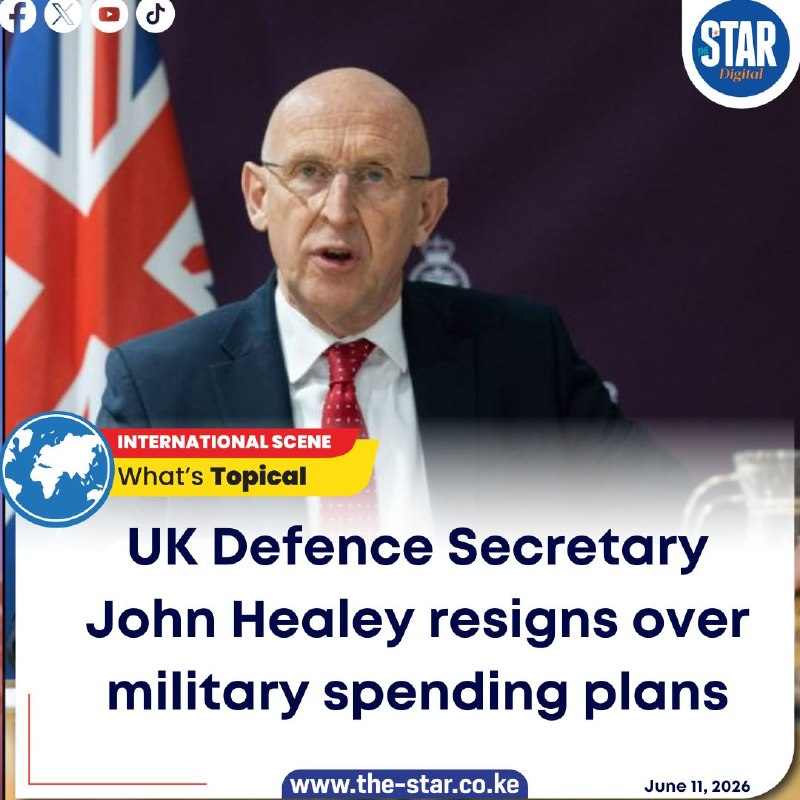
John Healey walked out of the Ministry of Defence on 11 June 2026 with a letter rather than a press release. In it, the Secretary of State for Defence told Prime Minister Keir Starmer that the government's defence investment plan "falls well short of what is required for defence and the country at this d[angerous moment]" — a phrase that, once it leaked, did most of the political work on its own.
A defence secretary resigning over the size of his own budget is not, on its face, a small event. Cabinet ministers are the ones who carry the flag for collective responsibility; they are not, in the normal British run of things, the people who publish the case for their own department's under-funding. Healey has done exactly that, and in doing so he has turned a procurement argument into a strategic one.
The letter, and what is not in it
The text, summarised by the Indian Express and circulated by way of the Telegram channel TheStarKenya, runs to a few sharp sentences: a verdict on the plan ("well short"), a verdict on the moment ("this dangerous moment"), and a verdict on the choice he says the government has ducked. The phrasing is careful. Healey does not accuse Starmer of being soft on Russia, or of undermining NATO, or of breaching the government's own pledge to lift defence spending to 2.5% of GDP. He makes a narrower, harder-to-deny claim: the numbers do not match the rhetoric.
The OSINTdefender channel, which is read closely by analysts tracking the war in Ukraine and by the Western commentariat that orbits it, has framed the resignation in the same register — a defence secretary pointing at a gap between commitments and cash. That framing matters. The Telegram-to-cable pipeline is now how most foreign-policy professionals in London, Washington and the wider European belt first encounter these stories. By the time a British Sunday paper has run a leader, the open-source accounts have already done the framing work.
What the letter does not contain is a resignation from NATO, a call for rearmament on the continental model, or a threat to bring down the government. Healey has not joined a backbench rebellion; he has staged a quiet, almost administrative, act of refusal.
The numbers behind the row
The investment plan Starmer's government inherited — and is now being accused of trimming — was built around a familiar set of moving parts: the 2.5%-of-GDP target, the long-promised modernisation of the British Army, the Dreadnought-class submarine programme, the AUKUS commitments, and the costs of training and equipping Ukrainian forces, which Britain has been doing on a scale disproportionate to its size.
The government's problem is not that it does not know the size of the bill. It is that the bill is being read in a wider context: a flatlining economy, a strained public-finance position, and a domestic political calendar that does not reward tax rises flagged as defence spending. The Ministry of Defence, in the British system, is uniquely exposed to this trade-off, because almost everything it spends on — submarines, combat aircraft, naval yards, the atomic stockpile — is politically invisible until the moment it is not.
Healey's argument, stripped to its bones, is that the plan on the table is what the Treasury could stomach, not what the strategic environment demands. That is the case his former colleagues in the armed forces, in the Commons defence committee, and in NATO headquarters have been making for months in private. He has now made it in public, with his signature attached.
Why a Starmer government cannot simply ignore this
There are two readings of the resignation, and the difference between them is the political story for the rest of the year.
The first is the reassuring one. Healey was always an awkward fit at Defence — a long-serving shadow minister, a Labour loyalist, a man more comfortable interrogating figures in select committee than waving through procurement schedules. He objected, did not get his way, and left. The plan stands. The trajectory holds. Starmer appoints a successor, the Commons moves on, and the budget cycle does what budget cycles do.
The second reading is the one Starmer's opponents, including much of the Labour left and a swathe of the Conservative press, will spend the rest of the month writing. On this view, a serving defence secretary has just told the country, on the record, that its first ministry is under-resourced for the world it actually lives in. If the strategic environment is as dangerous as the government's own language says — and ministers have used exactly that word — then the gap between rhetoric and pounds is not a procurement question, it is a credibility question. You cannot run a foreign policy that promises a continuous at-sea nuclear deterrent, an AUKUS-class submarine programme, a serious contribution to Ukraine, and a leading role in NATO, on a budget that the man in charge of spending it has publicly described as falling short.
What this is really about
The resignation is not, in the end, about Healey. It is about a British state that has been telling itself for two decades that it can be a tier-one power on a tier-two budget, and a Labour government that has come to office at the moment that fiction is hardest to sustain. The war in Ukraine, the AUKUS obligation, the Indo-Pacific tilt, the nuclear modernisation cycle, the hollowed-out British Army, the Royal Navy running on the goodwill of its senior ratings — all of these are debts that come due at once.
The instinctive British response is to muddle: to extend programmes, to defer decisions, to let inflation quietly shrink the real value of the budget and hope nobody notices. Healey's letter is, in effect, a refusal to muddle. The political question is whether Starmer treats it as a personal inconvenience, a problem to be managed with a careful reshuffle, or as a verdict on the plan itself.
That question will not be settled this week. It will be settled in the autumn statement, when the Treasury has to choose between the books it wants to balance and the commitments it has already made. Healey has not changed the numbers. He has changed the room the numbers will be discussed in. That is what a resignation, used carefully, is for.
This publication framed Healey's departure as a strategic-credibility story rather than a Westminster soap-opera one; the wire cycle will spend the day on the personality, but the policy fight runs on well past the reshuffle.
Wire provenance
This editorial synthesis draws on the following public wire/social posts:
- https://t.me/TheStarKenya
- https://t.me/osintlive