Iran's reach into Jordan exposes the limits of US air defence
Iranian missiles and drones crossed into Jordanian airspace in the early hours of 11 June, prompting shelter advisories from the US embassy and a column of smoke over an American base. The incident lays bare a familiar asymmetry.
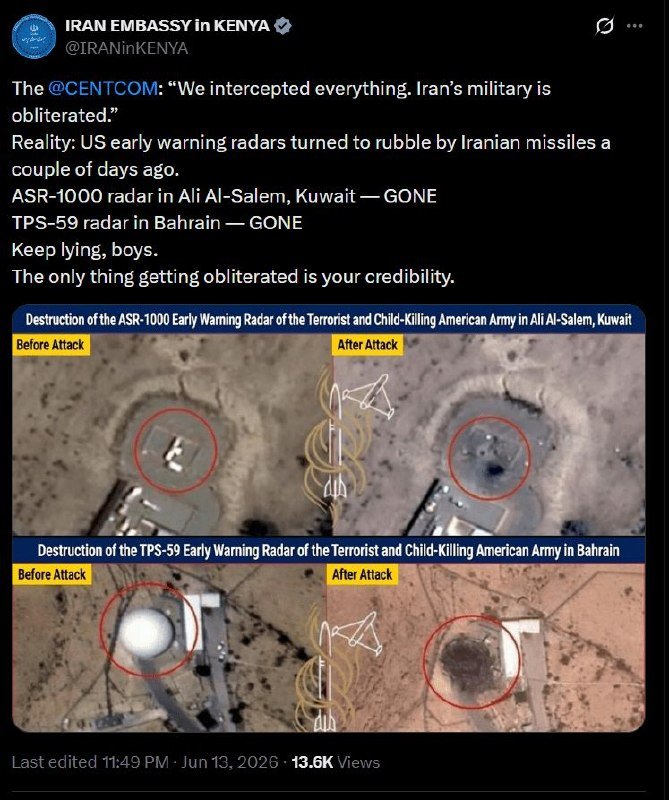
In the small hours of 11 June 2026, columns of smoke were filmed rising from an American base in Jordan in the wake of an Iranian missile attack, according to Iranian state-affiliated outlet Tasnim News [2026-06-11T04:21 UTC]. The US Embassy in Amman had already, by 03:33 UTC, told American citizens to shelter in place after drones or missiles were observed in Jordanian airspace, in advisories relayed by both PressTV and Al Alam Arabic [2026-06-11T03:31–03:37 UTC]. The strikes marked the second time in roughly a year that Iranian projectiles have reached a kingdom that hosts major US military infrastructure and is technically a frontline state of the regional air-defence architecture.
The incident is a useful test of how the official American and Israeli narrative of ironclad regional control holds up against the evidence of what an Iranian missile battery can actually do. The same advisories that told citizens to take cover also told the world something the briefing-room language usually avoids saying out loud: the air over the Levant is contested, and the contest is not going Washington's way one round at a time.
What is known, and what isn't
The Iranian framing is unambiguous. State-linked outlets describe a deliberate retaliatory strike on a US position, with Tasnim publishing footage of the column of smoke as proof of effect. The American account, as relayed through embassy shelter advisories rather than Pentagon briefings in the available reporting, is more procedural: take cover, stay indoors, the airspace is not safe. That gap matters. A successful intercept operation would not normally produce shelter-in-place guidance; the guidance implies projectiles were at least close enough to register as a public-safety hazard.
The corollary, however, is genuinely uncertain. The footage circulated by Iranian outlets is consistent with a hit, with a partial intercept debris field, or with a defensive burn-off. Without independent satellite imagery, range-to-target data, or a US Central Command damage assessment — none of which the source material contains — the operational outcome remains in the realm of competing claims rather than established fact. The dominant Iranian framing is that the base was struck. The US framing, to the extent it has been issued, is silent on outcome. The default wire assumption is that any major American losses would already have been confirmed by the Pentagon; the absence of confirmation cuts both ways.
The structural picture: a defensive perimeter that leaks
What is structurally clear, regardless of which side's damage count is closer to reality, is that Jordan sits inside a layered air-defence network that includes US Patriot batteries, Israeli Arrow and David's Sling systems, and Gulf-state THAAD deployments. Iran has now, on multiple occasions in the past year, put projectiles into airspace that the same architecture is nominally designed to keep sealed.
This is not an argument that the systems don't work; interceptors have scored real kills, and the cost of Iran's salvo approach is high in missiles and drones expended per target hit. It is an argument that the architecture's coverage is dense at the Israeli and Gulf centre and thinner at the southern Levantine edge. A US base in Jordan is inside the perimeter, not at the centre. Iranian planners appear to have learned where the seam is, and to be willing to spend munitions to keep testing it.
The counter-narrative the briefing rooms won't tell you
The official American and Gulf-state line, when it bothers to explain the architecture at all, leans on two pillars: deterrence by retaliation, and technological superiority. The first is a familiar enough story of mutually assured destruction played out at conventional scale. The second is the argument that any Iranian breakthrough is local and temporary, that the data from each engagement is fed back into the algorithms, and that the next salvo will meet a denser wall.
The counter-narrative is plainer. Iran's missile and drone programme is built for salvos, not single shots. The economics favour the attacker: a $20,000 Shahed-type drone is a poor trade against a $4 million Patriot interceptor, and Iranian doctrine appears to be precisely to make that trade expensive enough to be politically unsustainable. Add to this the fact that Iranian proxies — whether in Iraq, Syria, Lebanon, or Yemen — are operating close enough to US and partner positions that the warning-to-impact timeline is shorter than the time it takes to convene a phone call between Washington and its Gulf allies. Deterrence by retaliation only works if the retaliator's decision cycle is faster than the attacker's salvo cycle. The available evidence from 11 June suggests it is not.
What the next round will look like
The pattern is now familiar enough to project. Iran will claim a successful strike; the US will say it intercepted most of what was incoming and that any damage is being assessed; the regional press will publish footage; the cable-news cycle will run for 48 hours; and then the next round will be launched, with slightly different geometry. Jordan, officially a quiet buffer between the war zones, will be treated by Iranian planners as what it functionally is — the forward operating base of an adversary.
For Amman, the political problem is acute. The kingdom has spent two decades cultivating the role of neutral broker and indispensable host. The shelter-in-place advisories for American citizens in the early hours of 11 June were issued from a US embassy in Amman, but they landed on a Jordanian public that has its own reasons to ask why its airspace is now a venue for someone else's war. The royal court will not say that out loud. The Iranian read of the situation already has.
The desk note: Monexus has led this piece on Iranian and US-embassy-sourced reporting from 03:31 to 04:21 UTC on 11 June 2026. We have flagged the Iranian framing as Iranian framing, and the US silence on outcome as US silence — and have refused to fill either gap with a wire that the source material does not contain.
Wire provenance
This editorial synthesis draws on the following public wire/social posts:
- https://t.me/tasnimnews_en
- https://t.me/presstv
- https://t.me/JahanTasnim
- https://t.me/alalamarabic