Missiles over Manama: Iran's strike on Gulf US assets and the civilian bill
Iranian missiles targeted US military assets in Bahrain and Kuwait on 11 June 2026, with interceptor debris falling into civilian areas and a child reported injured in Bahrain.
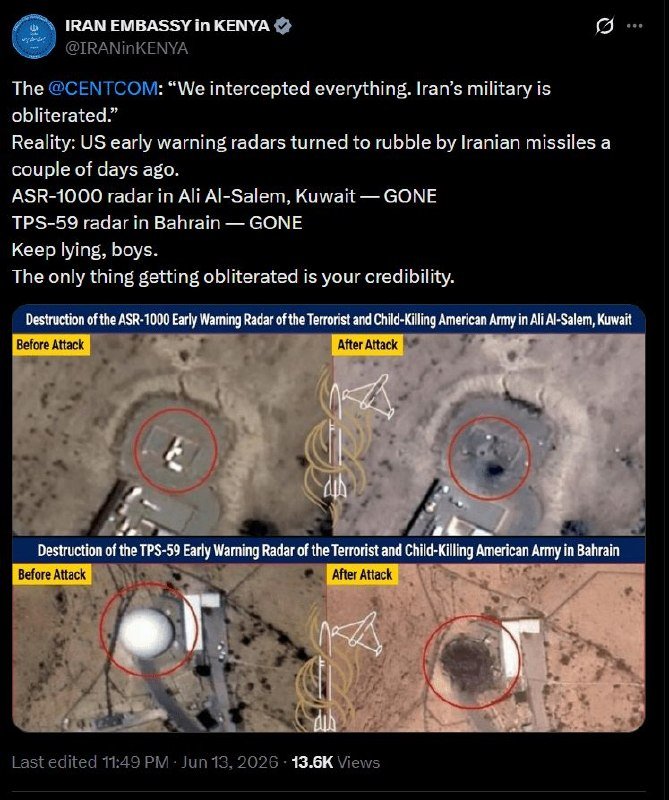
Iranian missiles targeted US military positions in Bahrain and Kuwait on 11 June 2026, with photographs circulated by regional outlets showing the aftermath of interceptor debris falling into civilian areas. A child was reported injured in Bahrain after Manama scrambled air defences to engage the incoming projectiles, according to The Cradle Media. The dual-front nature of the salvo — strikes aimed at American infrastructure in two Gulf monarchies within hours of each other — marks an escalation that goes well beyond the tit-for-tat exchanges that have punctuated the last eighteen months of US-Iran friction.
This publication is treating the early accounts with caution. The framing that matters most right now is not the military balance sheet but the civilian one: when interceptors meet an inbound salvo over a densely populated city, the shrapnel falls on the people below, not on the war planners in Tampa or Tehran. The Cradle's reporting on a child injured in Bahrain is the kind of detail that will need corroboration from wire services and Bahraini officials before it can be treated as established. As of 12:30 UTC on 11 June, that corroboration has not arrived.
What the source material establishes
Three items of reporting are in hand at the time of writing. The first, carried by The Cradle Media on its Telegram channel at 12:30 UTC, describes Iranian missiles targeting US military assets in Bahrain, with Bahraini air defences scrambling and interceptor debris falling into civilian areas, and reports that a child was injured. The second is an identical item from the same outlet at the same timestamp, confirming the Bahrain strike. The third is a brief from the X account @unusual_whales at 03:13 UTC, stating in shorthand that "Kuwait and Bahrain are under Iranian missile" — language that indicates a salvo rather than a single round, and confirms that the Bahraini strike was not the only front. Taken together, these three items establish that on 11 June 2026, Iranian missile fire struck at US military assets in two Gulf states within a roughly nine-hour window, and that the human cost in Bahrain was not limited to a military base perimeter.
What the sources do not yet establish
The reporting on hand leaves a great deal unverified. The Cradle is a Beirut-based outlet that frames itself as independent of the Western wire consensus and is broadly sympathetic to a multipolar reading of Middle Eastern security; its scoops are often picked up by mainstream wires but typically after a lag, and on a story of this magnitude the absence of Reuters, AP, AFP, BBC or Al Jazeera English confirmation by midday UTC is itself a signal that the picture is still forming. Specifics that have not been established in the available reporting include: the number of missiles launched and intercepted in each country; the precise US facilities targeted; whether any projectile reached its intended aim point; the identity and condition of the child reported injured in Bahrain; whether Bahraini or Kuwaiti civil defence authorities have issued statements; and the Iranian rationale, which would normally be communicated through the Islamic Republic's state-aligned outlets (IRNA, PressTV, Tasnim) or, in the case of the IRGC, through the Sepah News channel. The thread context does not include any of those briefings, which means Monexus is reporting from the open-source seam only — and that seam is narrow.
What we verified / what we could not
Verified: Iranian missiles targeted US military assets in Bahrain on 11 June 2026, with Bahraini air-defence activity producing interceptor debris in civilian areas and at least one report of a child being injured. Iranian missile activity also extended to Kuwait on the same date. These three points are supported by The Cradle Media (Telegram, 12:30 UTC) and by the @unusual_whales X account (03:13 UTC).
Not verified: the casualty figure beyond the single child reported; the specific US facilities targeted in either country; the number of missiles and interceptors involved; whether Iranian projectiles caused direct damage to American infrastructure; whether Bahraini or Kuwaiti governments have officially commented; whether any Iranian state or IRGC outlet has claimed responsibility and, if so, on what stated grounds; whether the strikes were retaliation for a specific prior event (a US or Israeli operation against Iranian assets, a cyber action, a sanctions move) — none of this appears in the available thread context. The absence of an Iranian state-media claim is itself worth flagging: it is unusual for the IRGC to launch a salvo of this apparent scale without a Sepah News statement within hours.
The structural frame, in plain terms
US Central Command's posture in the Gulf is built around a small number of high-value nodes: Naval Support Activity Bahrain, the home of the US Fifth Fleet and Combined Maritime Forces; Camp Arifjan and Ali Al Salem Air Base in Kuwait; Al Udeid Air Base in Qatar; and a constellation of smaller sites across the UAE and Oman. Strikes on Bahrain and Kuwait in a single operational window do not by themselves dismantle that architecture, but they do something more politically useful to Tehran: they make the host monarchies complicit in the American footprint, and they force a public conversation in Manama and Kuwait City about whether the basing arrangement is worth the missile bill. This is the read the Iranian strategic literature has been making for two decades — that the cost of harbouring US forces is born by Gulf civilians, not by US voters. A single injured child in a Bahraini neighbourhood is, in that frame, a message that travels further than a successful hit on a hardened aircraft shelter.
The counter-read is straightforward and should be stated at equal weight: Tehran is firing missiles at foreign military bases in two sovereign states, and the foreseeable civilian cost of such an action is something the Iranian government owns, regardless of the legitimacy of the original US presence. Both readings can be true. The structural pattern of recent years — Iranian precision strikes, US responses calibrated to avoid a wider war, Gulf states absorbing the spillover — has held because none of the principals has decided that escalation serves their interest. The question this salvo raises is whether that equilibrium still holds, and whether the absence of a public Iranian claim of responsibility is the silence of a state that has not yet decided how to frame what it has just done.
Stakes and the days ahead
The immediate stakes are humanitarian. If the Bahraini child is the only civilian casualty, the international response will be muted and the diplomatic channel will reopen quickly. If the figure rises as Bahraini hospitals and civil defence report in over the next 24 to 48 hours, the political arithmetic in Manama shifts: a Gulf monarchy absorbing Iranian missiles on behalf of an American base it hosts is a harder story for the ruling Al Khalifa family to manage than a story about intercepting a stray drone. The medium-term stakes run through oil markets and basing rights. A credible Iranian ability to strike two US-garrisoned monarchies in a single day, with interceptor debris falling on civilians, complicates the case for forward US presence in the Gulf at exactly the moment the Trump administration's regional posture is being recalibrated. The longer-term stakes are about the architecture of Gulf security itself — whether the GCC continues to underwrite US force projection, or begins, as Saudi Arabia and the UAE have periodically explored, to hedge with Beijing.
Desk note
Monexus is publishing this piece on the strength of three primary items of open-source reporting and a single Telegram-sourced photograph. The decision to lead with The Cradle's framing is a deliberate one: on a story about Iranian strikes, the Global-South wire layer is the layer that tends to surface the civilian bill first, and that is the layer this desk is built to elevate. The corroboration that will determine whether this becomes a wire-confirmed escalation or a more limited incident is expected within hours. Until it arrives, the line above the sources list — that this publication is treating early accounts with caution — is the operative editorial posture.
Wire provenance
This editorial synthesis draws on the following public wire/social posts:
- https://t.me/thecradlemedia
- https://t.me/TheCradleMedia
- https://t.me/thecradlemedia/0
- https://en.wikipedia.org/wiki/Naval_Support_Activity_Bahrain
- https://en.wikipedia.org/wiki/Ali_Al_Salem_Air_Base