Iran fires from Tabriz: a 3 a.m. burst that re-opens the question of restraint
Within four minutes, three Telegram channels reported ballistic launches from northwest Iran. The strike package — and what was and was not said afterwards — says more about the limits of restraint than the headlines suggest.
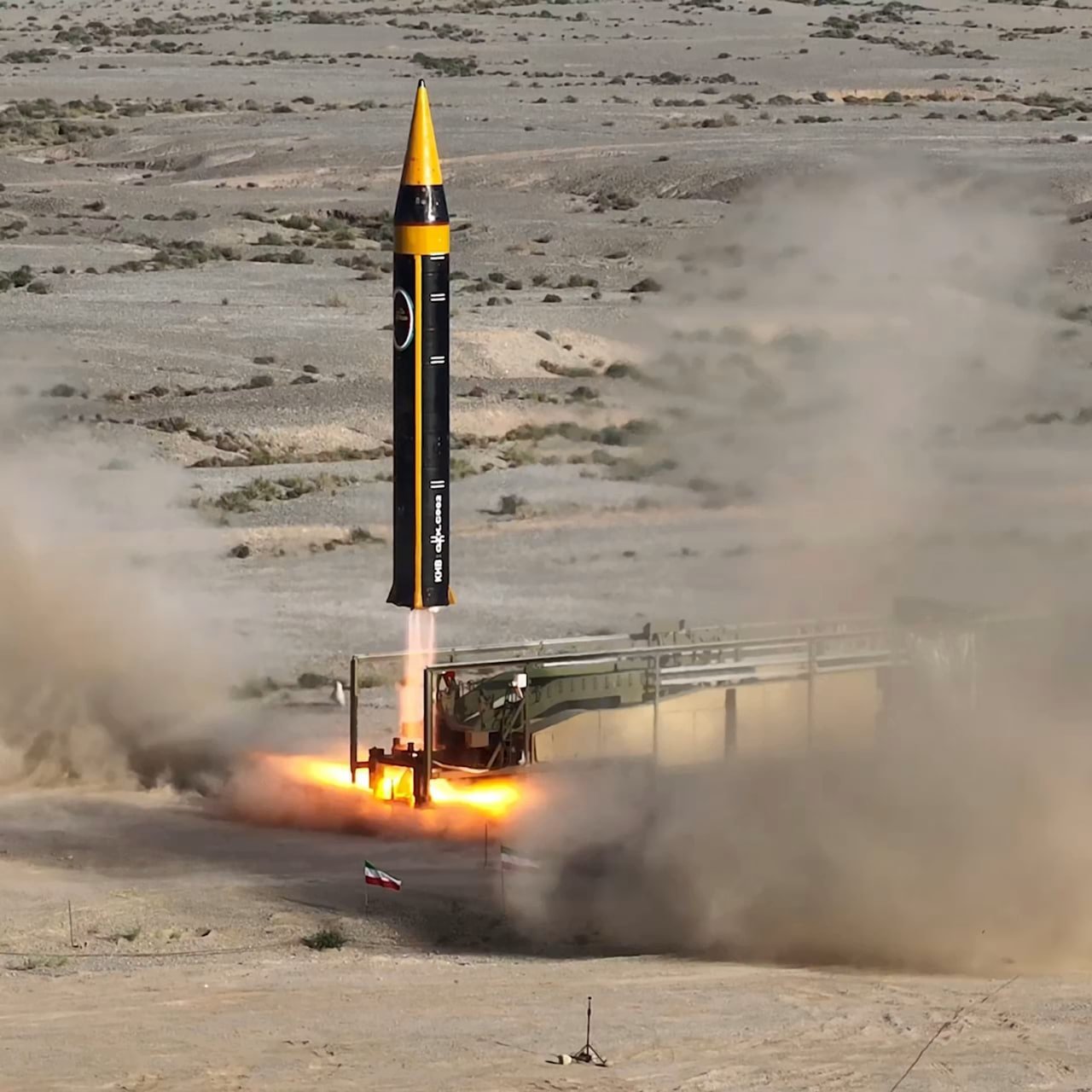
In the space of four minutes, between 00:48 and 00:53 UTC on 11 June 2026, three open-source intelligence feeds on Telegram carried the same brief, jagged message: ballistic missiles had been launched from Iranian territory. By 01:50 UTC, the mapping account AMK Mapping had narrowed the geometry — at least three launches from Tabriz, in the country's northwest, angled along a corridor that points, broadly, toward the Levant and the Gulf. By 01:56 UTC, a fourth channel — Bellum Acta News, citing a contributor using the handle TheWarReporter — had fixed the location as Tabriz. The burst was small. The silence around it was not.
What makes the sequence worth reading carefully is not the launch itself. Iranian missile tests and operational launches have been a routine feature of the regional weather for years, and the Western wire remains divided on whether any given salvo represents a test, a delivery, or a signal. What is worth reading carefully is the texture: the speed of the open-source reporting, the way early posts hedged with "possibly old footage," and the way later posts dropped the hedge. The frame a reader encounters at 02:00 UTC is different from the one a reader encounters at 02:30 UTC, and both are different from the one a reader would have encountered an hour later, when conventional outlets had to decide whether to follow, qualify, or ignore the Telegram cascade.
This is what restraint looks like in 2026: not a deliberate diplomatic pause, but a contested information space in which the first draft of history is written by channels that operate at the speed of the alert, and the second draft is written by institutions that pay for the slower craft of verification. The launch from Tabriz sits inside that gap.
What the open-source feeds actually said
The earliest item in the cluster is a short post at 00:48 UTC from the Middle East Spectator channel, relayed by DDGeopolitics at 00:50 UTC, marking the moment when the initial report crossed from one tracking account to another. The wording is deliberately thin: "Initial reports of ballistics launched from Iran," with an attribution back to Middle East Spectator. Three minutes later, Middle East Spectator itself added a caveat — "Possibly old footage" — a hedge that did real work. By 00:53 UTC the caveat was still standing. By 01:49 UTC, the Geopolitical Watch account had stripped the hedge and presented the launch as a breaking item; by 01:50 UTC, AMK Mapping had assigned a location, a count (at least three), and a launcher city (Tabriz); by 01:56 UTC, Bellum Acta News had confirmed the same city via a named on-the-ground contributor.
The trajectory of the reporting is itself the story. In roughly an hour, the public record moved from "something, somewhere, possibly nothing" to "at least three missiles, from a specific city, witnessed by a named reporter." The acceleration is faster than most institutional outlets can clear, and it is faster than most governments can confirm. The shape of the cluster is also instructive: it is six messages from five distinct channels, none of which is a wire service, a ministry, or a major newspaper. The institutional layer is, for the moment, absent.
That absence is not an oversight. It is the most legible feature of the event.
The geography of restraint
Tabriz is not a random launch site. It sits in East Azerbaijan Province, close to the Turkish and Armenian borders, hundreds of kilometres from the Persian Gulf. The IRGC's routine test and operational launch footprint in recent years has clustered around the central desert, the Shahroud range, and the southern coast — sites selected for safety buffers, telemetry, and a particular signalling geometry aimed at Gulf watchers and the Strait of Hormuz. A Tabriz launch, if confirmed, points a different direction: northwest, along an azimuth that crosses Turkish airspace and arcs toward southeastern Europe or the eastern Mediterranean. It is, in geographic terms, a launch from the wrong corner of the country to be aimed at Israel or at US assets in the Gulf.
That geometry has not, as of the cluster's last item at 01:56 UTC, been addressed by any official Iranian statement or by any of the Western wires that the open-source feeds are accustomed to track. The cluster is also silent on the question of targets. The lack of an immediate follow-on strike, the lack of an Israeli acknowledgement, and the lack of a US Central Command statement all push the read in one direction: this is most likely a test or a signal salvo, not an operational strike. The Tabriz corridor is unusually public, unusually visible, and unusually hard to mistake for a covert launch. The very fact that it was observable in real time across five open-source channels suggests that observation was, at minimum, not prevented.
What the counter-narrative has to say
Two readings sit in tension. The first, dominant in Western and Israeli commentary over the past two years, is that any Iranian ballistic launch is operational in intent, that the line between "test" and "strike" is a diplomatic fiction, and that the Tabriz salvo is best read as a probe of regional air defence — Israeli, Turkish, and NATO — in advance of a real event. The second reading, common in Iranian state-aligned commentary and in a number of Global South outlets, is that Iran has the sovereign right to test its own missiles on its own territory, that Western alarmism is a feature of a sanctions regime that criminalises routine military activity, and that the open-source celebration of the launch is itself a form of escalation.
Both readings are partial. The first is right that the line between test and strike is, in Iranian doctrine, deliberately blurred; IRGC messaging over the past three years has consistently used tests to advertise operational capability. The second is right that the international architecture around missile technology is itself politicised, and that the loudest alarms come from states with the largest missile stockpiles. Neither reading, on the source material in the cluster, can be falsified. The feeds do not specify yield, warhead type, target package, or downrange impact. The feeds do not, in fact, contain a single quote from a named official on any side.
What the cluster does is narrower: it places a launch in a specific city, at a specific time, observed by a specific channel, and it does so inside an hour. The verification chain is real but local. The institutional confirmation is not yet present.
The structural pattern, in plain language
Look past the launch and the same picture keeps appearing. Across the past 18 months, the rhythm of open-source channels reporting Iranian launches before the wires do has tightened. The reasons are not mysterious. Commercial satellite constellations now provide near-real-time imagery; Telegram provides an unmoderated distribution layer; a small industry of independent analysts — many of them former military intelligence officers, many of them simply attentive amateurs — has built a workflow that turns a flash on a screen into a published post in minutes. The institutional wires, by contrast, operate on an older timeline: a request for comment, a sourcing call, an editor's read, a published item. That timeline is slower by design, and it is slower for good reason — accuracy costs time — but it means the first frame the public sees is rarely the one the wires end up confirming.
The pattern matters because restraint is no longer a property of states alone. It is also a property of the information environment a launch lands in. A state can choose to fire or not to fire. It cannot, in 2026, choose whether the world learns about the firing in minutes or in hours. That shifts the cost calculus of any launch, including a test. Every salvo now arrives pre-narrated by channels with their own incentives, and the institutional layer is forced either to chase the open-source frame or to wait it out. The Tabriz salvo is the cleanest recent example of that mechanism working in real time.
What the next 24 hours will tell us
Three concrete signals will resolve the ambiguity. First, an Iranian official statement — from the IRGC, the Defence Ministry, or the Foreign Ministry — confirming a test and locating it in time, or failing to confirm and letting the ambiguity stand. Second, an Israeli acknowledgement, either through the IDF Spokesperson, the Prime Minister's Office, or the standard channel of a security cabinet readout, indicating whether the salvo triggered any defensive action. Third, a US statement — from the State Department, the Pentagon, or CENTCOM — that places the launch inside an existing diplomatic frame, whether that is the suspended nuclear talks, the maritime tensions in the Gulf, or the wider sanctions architecture.
Until at least two of those three signals land, the cluster will continue to function as the dominant record. That is not, in itself, a problem — open-source reporting has earned a real place in conflict verification over the past five years. It is, however, a structural shift. The launch from Tabriz is, in operational terms, a small event. In informational terms, it is a worked example of how a non-wire layer can define the first half-life of a story before the institutions have time to catch up. The next test — and another is, statistically, not far off — will move through the same pipeline. The interesting question is not whether the pipeline works. The pipeline works. The interesting question is what the institutional layer is for, in a media environment where the first responders are no longer the wires.
What remains genuinely uncertain, on the source material available, is the operational purpose of the salvo. The feeds do not specify a target, a payload, a downrange impact, or an Iranian doctrinal category. They do not contradict the test reading, and they do not confirm it. The caution "Possibly old footage" — present at 00:53 UTC and gone by 01:49 UTC — is the most honest sentence in the cluster, and it is the one that disappeared fastest. That disappearance is the story inside the story.
This publication treats the open-source Telegram layer as a real evidentiary record and not as a substitute for institutional verification. Where the wires and the OS feeds diverge, both appear, and the reader is left to weigh.
Wire provenance
This editorial synthesis draws on the following public wire/social posts:
- https://t.me/Middle_East_Spectator
- https://t.me/DDGeopolitics
- https://t.me/Middle_East_Spectator
- https://t.me/GeoPWatch
- https://t.me/AMK_Mapping
- https://t.me/BellumActaNews