Iran's missile salvo at US bases in the Gulf: what Tehran says happened, and what we don't yet know
State-linked outlets in Tehran circulated footage on 11 June 2026 of overnight IRGC missile strikes on US positions in the Gulf. The reporting is unverified; the implications are not.
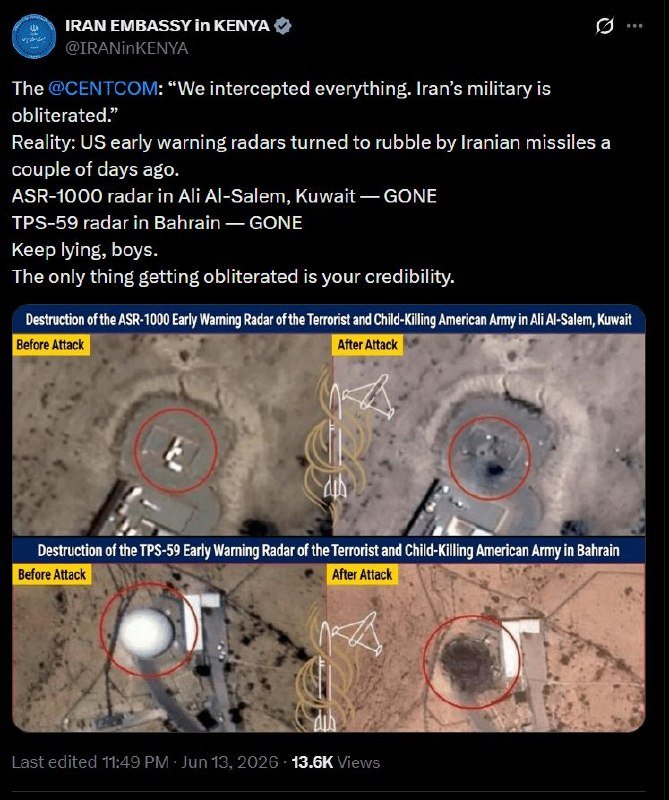
Two Iranian state-linked news agencies began publishing still images and short video clips on the morning of 11 June 2026 claiming that the Islamic Revolutionary Guard Corps' Aerospace Force had launched a missile attack on US military bases across the Gulf. Fars News posted a thread on its Telegram channel at 10:58 UTC carrying what it described as footage of "early morning IRGC aerospace missile attacks on American bases in the region," followed at 10:57 UTC by an identically worded release on the Tasnim News English Telegram channel. A third Fars post, timestamped 10:56 UTC, quoted the IRGC as saying the location of "the American fighters was destroyed" in what it framed as a retaliation for an earlier US strike on a recreational site, a production complex, and a residential area. The outlets named no specific base, no casualty figures, and no independent on-the-ground confirmation.
The framing matters more than the footage. Tehran is, in effect, broadcasting its own escalation through its own channels before the international wire has had time to verify a thing. That sequence — claim first, evidence later, narrative already cemented on Persian-language and Arabic-language social media — is the playbook the IRGC has refined across months of tit-for-tat exchanges with US forces deployed across the Gulf. The substance of what actually happened on the ground, however, is genuinely unclear.
What Tehran is claiming
The IRGC statement carried by Fars and Tasnim frames the salvo as direct retaliation for a prior US action the IRGC describes as an attack on a "recreational place," a "production complex," and a residential area. Fars uses the loaded phrase "American child-killing army" to characterise US Central Command. The post asserts that the location of "the American fighters was destroyed," implying a forward operating base, airfield, or radar-and-billet site rather than a purely logistical node. Neither agency names a country hosting the target, gives coordinates, or identifies the munition used; both refer to "the region," the standard Iranian formulation for the wider Persian Gulf theatre that includes Qatar (Al Udeid), Bahrain (the US Naval Forces Central Command hub), Kuwait, the UAE, and Iraq's Kurdish-administered areas where US forces remain.
The clips themselves, at the time of writing, consist of launch tubes firing from an undisclosed position and a handful of blurred horizon shots. No blast damage is visible in the material distributed through Telegram. The IRGC routinely releases imagery from the launch phase of an operation well ahead of impact footage, partly because the strike itself is often too far from Iranian correspondents to be filmed, and partly because the political utility of the image is in the moment of launch, not in the crater.
What is unverified — and what is not, yet, in the public record
Three things are missing from the thread context that any serious read of the event requires. First, there is no named US base. US Central Command has not, in the materials available to Monexus, issued a statement confirming or denying impact at any of its Gulf installations, and no Gulf state has acknowledged a strike on its territory. Second, there is no casualty figure from either side — Iranian, American, or civilian — and no damage assessment. Third, there is no third-party visual confirmation: no Planet Labs imagery, no commercial satellite repost, no Reuters or Associated Press correspondent on the ground has yet been cited. The story, as of 11 June 2026 around 11:00 UTC, is functionally a Tehran-only claim with corroborating framing from Tehran-aligned outlets.
That does not mean it didn't happen. Iranian ballistic and cruise missile strikes on US positions in Syria and Iraq in 2023 and 2024 were initially circulated in the same way — Tasnim and Fars first, international wires hours later. But in those episodes, US Central Command eventually acknowledged impact, even when it downplayed damage. The current gap between the Iranian claim and any US acknowledgement is the single most important variable in the story, and it is the variable most likely to move in the next 12 to 24 hours.
Why the framing is also a weapon
The IRGC's choice of language is the giveaway. "Child-killing army" is not a translation artefact — it is a calculated phrase designed to consolidate a domestic Iranian audience around the legitimacy of the strike and to pre-empt criticism that the operation was a reckless provocation. The reference to a "recreational place" and a "production complex" puts civilian infrastructure in the foreground as the alleged casus belli, sharpening the moral asymmetry Tehran wants the regional conversation to accept. The two-line assertion that "the location of the American fighters was destroyed" is meant to close the loop: harm done, harm returned, ledger balanced.
None of that is neutral reporting. It is the construction of a narrative aimed at three audiences simultaneously — an Iranian public that the regime needs to keep behind a widening confrontation, a Gulf Arab public that Iran is trying to peel away from the US security umbrella, and a Global-South audience that is, by long historical habit, more receptive to a sovereignty-and-civilians frame than to a forward-defence frame. The footage is the receipt. The Telegram broadcast is the press conference. The substance on the ground is the thing no one outside the relevant air defence zones has yet been able to see.
What the next 24 hours will tell us
Three confirmations would move this from Tehran's claim to a verifiable event. A statement from US Central Command acknowledging impact, or denying it, would be the first. A Gulf host-government statement — from Doha, Manama, Abu Dhabi, or Kuwait City — would be the second, because no IRGC salvo into the Gulf crosses foreign airspace without political consequence for the host. Independent satellite imagery of a base perimeter in the hours after impact would be the third. None has yet appeared. The corridor between Fars and Tasnim, both of which are state-adjacent by any honest reading, is the only public source for the claim at the moment.
The structural reality underneath the news cycle is that a strike of this character, even one that is partly or wholly Iranian propaganda, lands in an already brittle environment. The US-Iran back-channel that the Trump administration has, by Axios's reporting, intermittently kept alive is the kind of arrangement that survives one unverified night and tends not to survive a second. The piece to watch, in other words, is not the first IRGC statement. It is whether the second, third, and fourth — if they come — are addressed to a Washington that still has an interlocutor, or to one that has decided the channel is no longer worth the cost.
Desk note: Monexus is publishing the Iranian claim in the form Tehran released it, with explicit sourcing caveats, and is not treating the strike as an established fact until US Central Command, a Gulf host government, or independent satellite imagery confirms impact at a named installation.
Wire provenance
This editorial synthesis draws on the following public wire/social posts:
- https://t.me/farsna
- https://t.me/tasnimnews_en
- https://t.me/farsna
Follow the event.
These dated source records provide context. They do not retrospectively verify this archive article.
Separate what the nuclear watchdog reported from what it could not determine after the June 2025 strikes.