Maximum pressure, maximum confusion: reading the Trump-Iran week
Six contradictory statements in 24 hours, missiles in the air, oil allegedly being 'taken out,' and a deal that may or may not exist. The signal is in the contradictions.
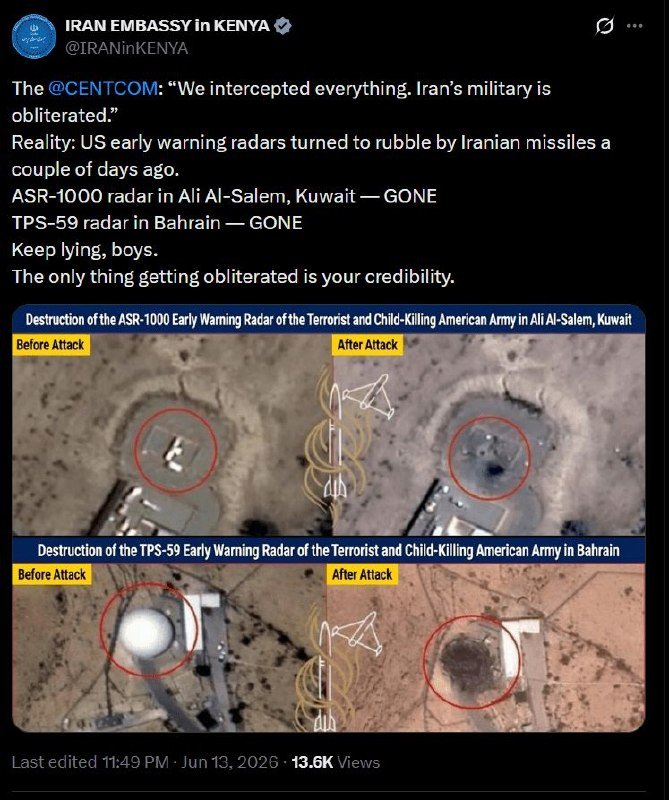
Between 13:43 UTC on 10 June and 01:53 UTC on 11 June 2026, six messages about Iran crossed the wires in roughly twelve hours. The President of the United States said Tehran had "taken too long to negotiate a deal that would have been great for them" and would now "have to pay the price." Within hours, he insisted the deal was "fully negotiated" and that Iran had "agreed not to have a nuclear weapon, all they have to do is sign the paper." He described Iran's military as "a complete and total mess," much of which "doesn't even exist anymore." He claimed the US was "taking out" millions of barrels of Iranian oil that Tehran "didn't know… until right now." In the small hours, missiles were launched from Urmia, in northwestern Iran. Six messages, no agreed-upon read.
This is not analysis of whether the United States will strike Iran, whether Tehran will sign, or whether the missile launches are kinetic, theatrical, or staged. It is analysis of what it means when the principal parties to a potential war cannot keep their own messaging coherent across a single news cycle — and when the financial press, in the meantime, must price oil, currency, and risk on the basis of that incoherence.
The deal that is "fully negotiated" and the deal that has not been signed
At 18:29 UTC on 10 June, Trump told reporters the agreement was "fully negotiated" and that Iran had agreed to forgo a nuclear weapon pending signature. At 13:57 UTC the same day, his own White House was reported, via Fox, to be "exerting maximum pressure to get a deal done." Those two statements are not the same statement. A deal under maximum pressure is a deal whose terms are being extracted; a deal that is "fully negotiated" is a deal that has been agreed. One implies a closing phase; the other, an unresolved one. Iran's diplomatic channel has not, as of the available reporting, confirmed signature or even confirmed that the substance under discussion matches what Trump described in his remarks.
The pattern — and it is now a pattern, because this is roughly the fourth cycle of the kind since the spring — is that the US side moves the goalposts in real time, in front of cameras, while demanding the other party treat the goalposts as fixed. Each round resets what "the deal" is. Each round also gives the financial press a fresh headline to chase.
"Taking out" oil, and the price of theatre
At 17:05 UTC on 10 June, Trump told reporters the US was "taking out" millions of barrels of Iranian oil and that Tehran had not known "until right now." The comment was delivered with a flourish — "I love the inflation" — that is at best economically illiterate and at worst deliberately so. Crude markets did not, on the available reporting, move in a way consistent with a credible, sustained multi-million-barrel supply disruption. Sanctions enforcement against Iranian crude exports is not a new instrument, and the marginal effect of a presidential boast about it, on a Wednesday afternoon, is hard to distinguish from the baseline.
The risk is not that the boast is false. It may be true that interdictions, secondary-sanctions actions, or shadow-fleet seizures have stepped up. The risk is that the boast becomes a substitute for a policy: a way of signalling resolve to a domestic audience and an Iranian one without committing to a specific, verifiable action. A sanctions regime whose enforcement is announced in superlatives is a sanctions regime that has stopped functioning as enforcement and started functioning as performance.
The military that "doesn't exist anymore" and the missiles over Urmia
At 15:17 UTC, Trump described Iran's military as a "complete and total mess," with much of its navy and air force "not even exist[ing] anymore." At 01:53 UTC on 11 June, monitoring channels reported additional missile launches from Urmia, in northwestern Iran, following earlier activity. Iran's missile and drone forces are not the same as its air force or its navy, and degrading the latter does not, on the available evidence, degrade the former. Anyone who has watched the war in Ukraine — where a country with a small pre-war navy and a stripped air force has continued to launch one-way attack drones, cruise missiles, and ballistic missiles at industrial depth for four years — already knows that an adversary does not need a navy or an air force to put a missile in the air.
The Urmia launches may be signalling, may be operational, may be a missile test, or may be a third thing. The sources do not specify. What the sources do establish is that the launches occurred, that they occurred from Iranian territory, and that they occurred on the same day the US President described Iran's military as functionally destroyed. Both can be true. The reading of which one matters more is the reading the markets, and the Pentagon, will have to do in the next 72 hours.
What the contradictions actually settle
Strip out the rhetoric and the picture is narrower than it looks. Iran is being asked to sign a document whose contents, on the public record, keep changing. The United States is signalling, simultaneously, that Iran is militarily finished and that Iran must be pressured into a deal. The oil market is being told to expect a supply shock and is not, so far, pricing one. The missile launches from Urmia continue in the background. None of this resolves in the direction the White House wants, and none of it collapses into the war scenario the commentariat is rehearsing.
The honest read of the week is that the US has not yet decided what it wants, and is negotiating with itself in public. That is dangerous. It is dangerous because Iran's decision-makers must price their own moves against a counterpart whose stated position is a moving average, and because every other capital in the Gulf, in Tel Aviv, in Ankara, and in Beijing is being asked to read the same contradictory signals and respond. The next data point will not be a quote. It will be a signature, a strike, or a missile that hits something.
Until one of those three things happens, the only defensible posture is to assume the contradictions are the message, and to price accordingly.
Desk note: This article reads the available wire and channel reporting as a single contradiction set rather than as a series of discrete stories, on the view that the contradiction itself is the newsworthy unit. The missile launches from Urmia are reported by a single monitoring channel and have not been independently corroborated in this piece; readers should weight them accordingly.
Wire provenance
This editorial synthesis draws on the following public wire/social posts:
- https://t.me/s/AMK_Mapping
- https://x.com/unusual_whales/status/
- https://x.com/unusual_whales/status/
- https://x.com/unusual_whales/status/
- https://x.com/unusual_whales/status/
Follow the event.
These dated source records provide context. They do not retrospectively verify this archive article.
Separate what the nuclear watchdog reported from what it could not determine after the June 2025 strikes.