The northern front reopens at 3 a.m.: what two rockets over the Galilee actually say
Two rockets out of southern Lebanon on 11 June 2026 are a small tactical event. The silence around them is a much larger strategic one.
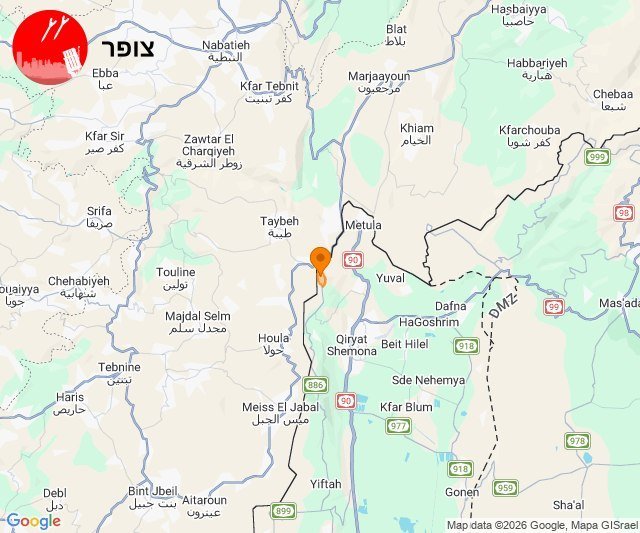
At 02:32 UTC on 11 June 2026, air-raid sirens sounded in northeastern Israel. Within a minute, open-source intelligence channels tracking the border were flagging rocket launches from southern Lebanon toward Israeli territory. By 02:53 UTC the IDF had confirmed what residents along the Galilee had already heard: two projectiles had impacted near an area where Israeli ground forces were operating inside southern Lebanon, in a strike the army described in clipped, procedural language — and conspicuously without the usual qualifier about launches that miss populated areas. The episode lasted minutes. Its silence is what makes it matter.
Two rockets are not a war. They are, however, the texture of one — a reminder that the Israel-Lebanon front never fully closed, only thinned. The reporting is sparse because the event was small. But the absence of follow-on launches, the absence of a Hezbollah claim of responsibility in the same window, and the absence of an Israeli retaliatory strike in the hours immediately after, all suggest a careful choreography: a shot across the bow, calibrated, deniable, watched closely by both sides. The Israeli framing on the day was that the projectiles impacted in a militarised zone, not a civilian one. That distinction does the diplomatic work. It allows Jerusalem to log the event without forcing a response that would re-escalate a front it has spent two years trying to demobilise.
What the wire actually shows
The public record on the morning of 11 June is unusually thin, and that thinness is itself the news. Telegram channels running open-source intelligence from both sides of the border — AMK_Mapping and rnintel, among others — concur on the sequence: launches detected, sirens activated, two impacts, IDF operating in the area. The Israeli press has not, as of writing, been given a confirmed casualty count. There is no public statement from the UN Interim Force in Lebanon. The Lebanese Armed Forces have not been quoted. Hezbollah's own media arm has not, in this window, claimed the launches. Each of those silences is informative. A claim of responsibility would invite a response; a denial would relieve pressure; a death toll would force a political reaction. None of those levers has been pulled.
The frame the framing hides
Western coverage of Hezbollah rocket fire has a default register: alarm, then attribution, then demands for the group to be "deterred". This case fits awkwardly into that template. The two rockets struck near Israeli forces, not Israeli towns. The IDF's own statement, as relayed by open-source channels, pointedly did not include the language Israeli spokespeople usually reserve for attacks on civilian areas — language that functions as a domestic-political signal that retaliation is politically required. The omission is the quiet tell. Israel is choosing, for the moment, not to let the incident do the work of escalation.
The counter-reading is also serious: that any rocket at all from Lebanese territory is a violation of the understandings — formal or otherwise — that have kept the border quieter than it was in 2024, and that a permissive response now sets the floor for what comes next. Iranian-aligned outlets, when they cover these episodes, frame them as proof that the "resistance" retains capability; Israeli hawks frame the same launches as evidence that deterrence is leaking. Both are doing politics with two small projectiles. The empirical content is what the open-source channels show: two rockets, two impacts, no claim, no counter-strike, and a long day of waiting to see whether the silence holds.
Stakes, plain
If the episode is read as the new equilibrium — occasional probing fire from southern Lebanon, calibrated Israeli restraint, no political cost on either side — then the northern front has effectively become a managed attritional border rather than a hot one. That outcome suits a Lebanese state that cannot afford another war, an Israeli government under domestic pressure not to open a third front, and a US administration that has made border quiet a deliverable. If the episode is read as the seam beginning to tear — the first of a series, with a Hezbollah claim and a harder Israeli response following within days — then the regional arithmetic changes: the Iran-Israel shadow war loses another layer of indirection, and the diplomatic cover that has held since the November 2024 ceasefire starts to fray. The public evidence, as of the morning of 11 June 2026, does not let a careful reader choose between those readings with confidence.
What the sources do not specify is what would falsify either story — how many rockets, from which launchers, hitting which targets, would tip the line from "calibrated" to "collapse". That uncertainty is the operational reality for the people living under the sirens at 02:33 UTC. The rest of us get to argue about framing.
Desk note: Monexus has reported this episode from open-source channels and the IDF's own procedural statement, not from wire service reconstruction. Where the Western wire frame treats any Hezbollah launch as a discrete escalation event and the Iranian-aligned frame treats it as proof of continued capability, this publication has tried to surface the silence between the launches and the response — the diplomacy that happens in the absence of a retaliatory strike.
Wire provenance
This editorial synthesis draws on the following public wire/social posts:
- https://t.me/AMK_Mapping
- https://t.me/rnintel
- https://t.me/AMK_Mapping