Strikes, Counter-Strikes, and the Geometry of Restraint
Tehran's IRGC says it struck a US-aligned air base in Jordan. Washington says it hit Iranian missile sites hours earlier. The exchange reads less like escalation than as a managed signalling contest — and the read-throughs are starker than the ordnance.
Within roughly seventeen minutes on the morning of 11 June 2026, the geometry of the US–Iran confrontation shifted twice. At 04:12 UTC, Telegram channel OSINTdefender logged that the United States had conducted new strikes on Iran, hitting missile sites and military infrastructure as part of a broader campaign. At 04:29 UTC, the same channel reported the Islamic Revolutionary Guard Corps announcing retaliatory missile strikes against the Al-Azraq air base in Jordan. Two kinetic actions, announced within the same operational news-cycle, on opposite ends of a contested arc that runs from the Iranian plateau to the Jordanian desert.
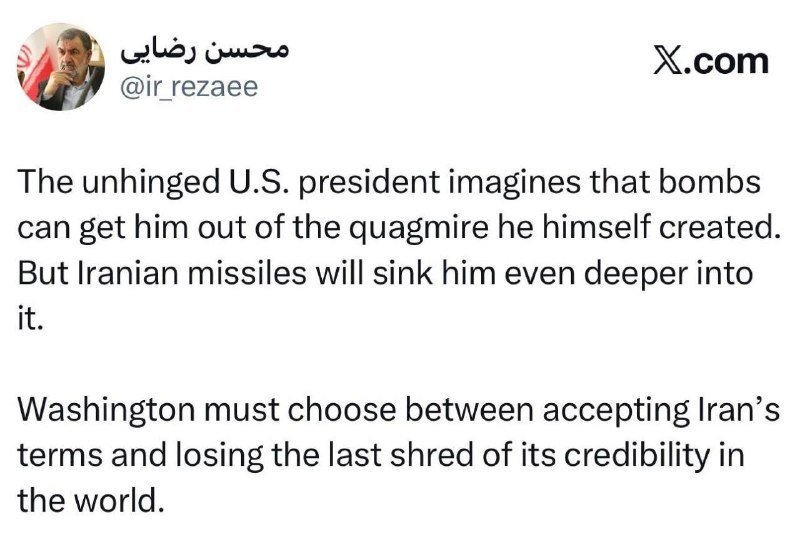
What is striking — and what the early wire traffic already under-reports — is how tightly the exchange is bracketed. The US action is described as targeted at missile infrastructure; the Iranian counter is described as striking a base used by US forces, on Jordanian soil. The framing on both sides, even in the first hours, has been calibrated: each side names the other's military hardware as the target, not its cities, not its civilian infrastructure. That is not the language of a campaign. It is the language of a signalling contest being conducted through ordnance.
What the first hours actually establish
The verifiable kernel of the morning is narrow. The United States struck Iranian missile sites and supporting military infrastructure, per the OSINTdefender summary of US operational messaging, in what the channel describes as a continuation of a broader campaign. Iran's IRGC, in turn, claimed strikes against Al-Azraq, a Royal Jordanian Air Force installation long used as a hub for US Air Force operations in the Levant. Both claims were issued by parties to the conflict, via official channels and state-aligned media. The OSINTdefender items are themselves downstream summaries of those primary releases, not independent battle-damage assessments.
Three things follow. First, the strike on Al-Azraq is the first publicly claimed Iranian missile attack on Jordanian territory in this cycle. The political cost to Amman is real: a partner state absorbs fire for the second-power status of a third. Second, the US targeting list — missile sites, not command-and-control, not the oil economy — keeps the door open to de-escalation. Third, neither announcement specifies numbers of launchers, warhead classes, intercept rates, or casualties. The information environment is being run by the shooters.
The counter-narrative, taken seriously
In Western wire framing, the default read is that Iran is escalating into a regional war it cannot win. There is a real argument underneath that read: Tehran's missile force is finite, its air defence is degraded, and the political bandwidth for a sustained exchange is thinner than the rhetoric suggests. But the counter-position, voiced from Tehran and from much of the regional commentary around it, deserves the same structural weight. In that framing, the IRGC's strike is a deliberate, limited, symbolic retaliation: it lands on a US-operating base, not a Jordanian city; it is announced, not denied; and it is calibrated to demonstrate reach without triggering the kind of response that ends regimes. The base was chosen because it is legible — to Washington, to Gulf partners, to Israeli planners — as US infrastructure. That is the point.
A second counter-read holds that the US action, framed in domestic messaging as a continuation of pressure, is itself a signal: targets are military-industrial, not political. The shape of the strike package reads as escalation-management rather than escalation itself. Both sides, on this view, are bidding inside an unwritten ceiling, and the morning's news is the bids being made public.
The structural frame, in plain prose
What this exchange sits inside is a long-running contest over the architecture of the Middle East security order — the credibility of US forward presence, the deterrence value of Iran's missile force, and the willingness of host states (Jordan, the Gulf monarchies, Iraq) to absorb political exposure for an American umbrella they did not choose this crisis over. The Al-Azraq strike is a test of that architecture more than a test of air defence. Jordan's position is the binding constraint: Amman has signed onto normalisation with Israel, hosts US Central Command infrastructure, and depends on Washington for budget support and security guarantees. A strike on Al-Azraq forces Jordan to choose between two patrons whose interests it cannot fully reconcile.
There is a deeper pattern, too. Each round of US–Iranian fire since the early 2020s has been followed by a diplomatic off-ramp negotiated through intermediaries — Oman, Qatar, Switzerland, Iraq. The expectation in regional chancelleries, even in the hours after the strikes, is that the off-ramp machinery is already moving. The strikes are, in this sense, the cost of admission to the talks that follow.
Stakes, on a clear horizon
If the trajectory continues, three outcomes become more likely. Iran's missile force, finite in reload capacity, degrades faster than it can be reconstituted under sanctions, narrowing its bargaining leverage within months. Jordan's risk premium rises, with knock-on effects on its IMF programme, its water and energy financing, and its standing inside the Arab League. And the diplomatic off-ramp narrows: each round of fire raises the political cost for any Gulf or Levantine capital seen as brokering with Tehran. The losers, on this trajectory, are the host states and the civilian populations inside Iran absorbing the next round of targeting. The winners are the harder-line constituencies on both sides that have argued for years that the other side only respects capability, not negotiation.
What remains genuinely uncertain
The morning's reporting comes from official channels and from open-source intelligence accounts aggregating those channels. Independent battle-damage assessment on both sides is not yet available; casualty figures have not been disclosed by either government; the launch parameters, warhead types, and interception rates are not in the public record. Whether Jordan was given advance warning — and through which channel — is the single most consequential unknown for the next forty-eight hours, because the answer tells you whether Amman is being treated as a partner, a stage, or a target. Until those details are verified, the strikes are best read as a posture statement from two governments that have learned, painfully, that posture is the only language the other side reliably hears.
Wire provenance
This editorial synthesis draws on the following public wire/social posts:
- https://t.me/osintdefender/
- https://t.me/osintdefender/
Follow the event.
These dated source records provide context. They do not retrospectively verify this archive article.
Separate what the nuclear watchdog reported from what it could not determine after the June 2025 strikes.