Trump's Iran deal has the air of a handshake the other side hasn't shown up for
The president says the deal is 'fully negotiated.' Tehran hasn't signed. The gap between those two facts is where the next crisis will be written.
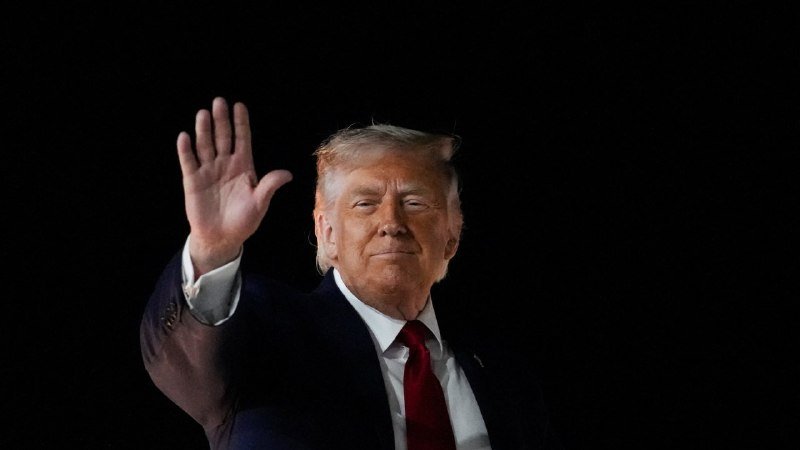
On the afternoon of 10 June 2026, aboard Air Force One, Donald Trump told reporters that Iran had agreed to forgo a nuclear weapon and that all that remained was for Tehran to sign the paper. "They have agreed not to have a nuclear weapon, all they have to do is sign the paper," the president said, adding that the arrangement was "fully negotiated" (Unusual Whales wire, 2026-06-10T18:29 UTC). Four hours later, in a separate exchange reported by the same wire, Trump described Iran's military as "a complete and total mess," claiming that much of the country's navy and air force "doesn't even exist anymore" (Unusual Whales, 2026-06-10T15:17 UTC; re-aired in his BBC interview at 2026-06-10T17:05 UTC). Strip away the theatre, and two things are true at once: a diplomatic text may genuinely be on the table, and the United States is publicly preparing the case that it has the means to enforce whatever Tehran does next.
This publication reads those two statements not as contradiction but as choreography. The first sets the price of compliance. The second sets the price of non-compliance. Between them sits a deal that, on the evidence available at publication, exists in the mouth of one negotiator only.
What the public record actually shows
The only documentary artefact on the public record, as of 18:30 UTC on 10 June, is the president's description of one. No joint communique, no agreed text, and no signature ceremony has been confirmed by Tehran, by the International Atomic Energy Agency, or by any of the governments that have historically served as intermediaries in the US-Iran file — Oman, Qatar, or Switzerland. The thread context contains no Iranian Foreign Ministry readout corroborating the American claim, and no wire has independently verified the existence of a signed or initialed draft.
The president's own framing concedes the central uncertainty. A deal that requires Iran to "sign the paper" is, by his own description, not yet a deal. It is a proposal that one side believes it has finalised and the other side has, at most, conceded in principle. The history of the file — from the 2015 Joint Comprehensive Plan of Action through its 2018 American withdrawal, the maximum-pressure campaign, the 2025 strikes, and the indirect talks that followed — is a record of exactly this kind of near-agreement collapsing over verification timelines, sanctions sequencing, and the fate of enriched uranium stockpiles already on Iranian soil.
The economic lever, named out loud
In the same BBC interview, Trump disclosed that the United States is "taking out" millions of barrels of oil from Iran and said Tehran only learned of it "until right now" (BBC News, 2026-06-10T17:05 UTC). The phrase is loose — Iranian crude continues to move, particularly to Chinese refiners, and a multibillion-dollar shadow trade has rebuilt itself under sanctions — but the political signal is precise. The United States is asserting the capacity to interdict Iranian exports at will, and is doing so publicly, in the middle of a negotiation it is simultaneously describing as concluded.
This is the lever every previous US administration has refused to brandish on camera. The signal to Tehran is that sanctions enforcement is operational, not rhetorical, and that the cost of walking away from the unsigned paper is being deducted in real time from the country's principal source of foreign exchange. The signal to oil markets, including to the Chinese and Indian buyers absorbing most of Iran's sanctioned barrels, is that the floor under the regime's revenue is being deliberately thinned.
The second front: equity in the AI stack
The Iran file is not the only administration headline on 10 June. Earlier in the day, Trump told reporters the federal government would seek equity stakes in top artificial-intelligence companies, per CNBC reporting carried in the wire (Unusual Whales, 2026-06-10T18:12 UTC). The two announcements, read together, sketch a coherent theory of state power. In Tehran, the US is trading relief from coercion for a signed commitment. In the AI sector, it is trading federal contracts and regulatory cover for an ownership share. The connective tissue is the same: a state that can disrupt a foreign economy with a sanctions regime, and a state that can pick winners in a strategic industry, is in both cases converting sovereign leverage into equity — whether the equity is uranium non-enrichment or shares in a frontier technology firm.
That the two stories sit a hundred minutes apart in the same news cycle is the structural point. Foreign policy and industrial policy are no longer separate desks.
What remains contested
The single most important unverified claim is the simplest: that there exists a text, agreed by both sides, awaiting only a signature. The American side says so. The Iranian side has not, on the public record available at publication, said so. Tehran's pattern in this file is to confirm deals through its Foreign Ministry spokesperson, not to leave the confirmation to a counterparty's press conference. Until that confirmation arrives, the deal is a press statement, and the gap between a press statement and a treaty is exactly the gap in which wars start.
There is also a fair counter-read worth taking seriously. The administration may genuinely have an agreed text, may be timing the announcement to shape Tehran's negotiating posture, and may be using the military-language remarks and the oil-interdiction disclosure to harden the Iranian public's expectation of the cost of refusal. If so, the public boasting is not bluff but pre-commitment — a way of raising the political cost of walking away, for both sides, in the window before signature. A reader who holds this view should note that it rests on the existence of a document the world has not yet seen.
The stakes, plainly
If a signed text is announced in the days ahead, the immediate winners are the Gulf states that have absorbed the regional spillover of the maximum-pressure years, the global oil market, and the US negotiating position across every other file in the Middle East. The losers are the IAEA inspectors whose access will be the test of compliance, and the Iranian civilian economy, which will still pay a price even in a settlement. If no text is announced, or if Iran signs a different document than the one the White House has described, the administration has a ready-made escalation ladder: the same interdictions, the same military framing, and a public record in which the United States warned, in plain words, that it knows what Iran's navy and air force look like in 2026.
This publication will update this analysis when the Iranian Foreign Ministry, the IAEA, or a named intermediary publishes a text or a denial. Until then, the deal is what the president says it is, which is, by his own description, a piece of paper Tehran has not yet touched.
Desk note: Monexus treats the Iran file with the scepticism the record warrants. The same wire that carried the "fully negotiated" line also carried the "complete and total mess" line four hours later; we have read them as one event, not two, and have flagged the absence of Iranian corroboration as the central evidentiary gap rather than a footnote.
Wire provenance
This editorial synthesis draws on the following public wire/social posts:
- https://t.me/unusual_whales/
- https://t.me/unusual_whales/
- https://t.me/unusual_whales/
Follow the event.
These dated source records provide context. They do not retrospectively verify this archive article.
Separate what the nuclear watchdog reported from what it could not determine after the June 2025 strikes.