Trump's "powerful blow" against Iran: a deal, a threat, and a deportation question mark in the same 24 hours
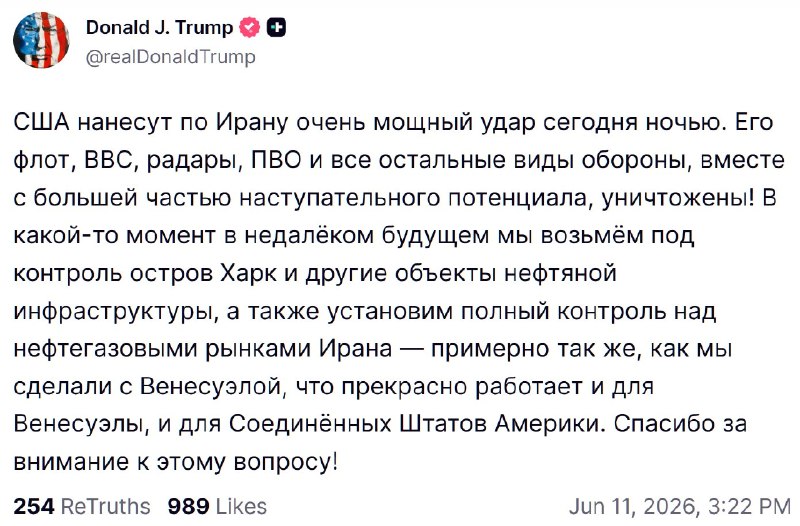
At 12:30 UTC on 11 June 2026, Euronews relayed a single sentence from US President Donald Trump that did the work of a press conference: "The US will deal a very powerful blow to Iran tonight." Within minutes, the same day's wire carried a different Trump line, in which he claimed Tehran had "agreed not to have a nuclear weapon, all they have to do is sign the paper," and insisted the arrangement was "fully negotiated." And before either statement landed with analysts, Middle East Eye reported that US officials and documents reviewed by a pro-Trump outlet were already being used to examine the immigration status of Trita Parsi, one of America's most prominent critics of a US war with Iran.
The three messages belong to a single tactical pattern. Pressure and the offer of relief are being delivered in the same breath, aimed at a negotiating partner that has spent four decades learning to read Washington by tone rather than by text. The deportation inquiry sits awkwardly beside the diplomacy: it suggests that the administration's domestic political perimeter around an Iran confrontation is being drawn as tightly as its external one.
A "blow" and a "signing" in the same news cycle
The contradiction in the two Trump statements is partly an artefact of the platform. The 12:30 UTC Euronews flash carried the threat; the 10 June evening statement, relayed via Unusual Whales, carried the deal. They are separated by hours, not weeks, and a reader is entitled to hold them together. A "very powerful blow" delivered the same evening a deal is supposedly "fully negotiated" is not a description of a sequence; it is leverage. The threat sets the ceiling for what Iran will accept on paper, the deal describes the floor of what the White House is willing to settle for in practice, and the gap between the two is the actual negotiation.
That is the conventional reading, and it is the one most Washington desks will adopt on Thursday. There is a second, less comfortable reading worth airing. The threat may not be aimed at Tehran at all. It may be aimed at a domestic audience for whom a kinetic operation is a more legible outcome than a diplomatic one, and at allies who would prefer a deal but need to be seen to have exhausted the coercive options first. Either way, the practical effect on Iranian negotiators is identical: every public statement from the US side raises the political cost of saying no and the political cost of saying yes.
The Parsi case: the cost of dissent is being clarified
The Trita Parsi story breaks the spell of pure geopolitics and drags the picture back inside the United States. According to Middle East Eye, US officials and documents reviewed by a pro-Trump outlet are being used to examine the possibility of deporting Parsi, a Swedish-American academic and foreign-policy analyst who has been a leading public opponent of a US war with Iran. The reporting did not, in the items available, name the outlet or specify the immigration mechanism at issue; the framing of the inquiry — a deportation possibility, not a charging document — is itself the news.
The substantive question is not whether one analyst can be removed from the country. It is whether a sitting administration, while publicly claiming that a nuclear deal is within reach, is simultaneously building an apparatus that makes public criticism of a war with Iran more expensive. Deportation of a legal permanent resident or naturalised citizen is not a casual step; it is the kind of move that requires an underlying legal hook and political will. The reporting suggests both are now being assembled.
The fact that the documents were reviewed by a pro-Trump outlet, rather than surfacing through a leak to a wire service, is also worth flagging. It indicates that the political usefulness of the inquiry is at least as important as its legal substance. A deportation proceeding that nobody knows about deters nobody; one that is read by the administration's base is doing deterrent work in real time.
What the two threads share: a single theory of pressure
Read together, the threat to Iran and the inquiry into Parsi share a theory of how leverage operates. The Iran track assumes that a population watching a credible military threat on the evening news will eventually compel its government to accept terms it would otherwise refuse. The domestic track assumes that analysts, journalists, and activists who can be made to fear consequences will stop providing the rhetorical cover under which a war is contested. The two are mirror images: maximum external coercion paired with minimum internal dissent.
This is not novel. Coercive diplomacy, by definition, marries threats to negotiating positions. What is novel is the openness with which the two are now being telegraphed, and the speed at which the contradiction between them is being normalised. A White House that promises a "powerful blow" the same evening it claims a deal is "fully negotiated" is, in effect, telling its counterpart that any signed document will be read against the background of the threat that produced it. That is a workable negotiating posture only if the counterpart believes the threat is real and the deal is binding. On present evidence, Iranian negotiators have reasons to doubt both.
Stakes and the next seventy-two hours
The narrow question for the next seventy-two hours is whether the "paper" Trump referenced is presented to Iran, signed, or quietly shelved. The wider question is what happens to the diplomatic space around the file if it is shelved. A threat that is not followed through is a spent asset; a threat that is followed through closes the diplomatic channel for the duration of the operation and for some time after. A deportation proceeding against a high-profile Iran-war critic that is not pursued tells its own audience that the administration blinked; one that is pursued tells every other potential critic that they should find a quieter venue.
For Iran, the calculus is asymmetric. Accepting a deal signed under explicit US threat binds Tehran to a document whose terms can be reinterpreted by a future administration, as the 2015 framework's trajectory has already shown. Refusing the deal and absorbing a "powerful blow" is the cost of preserving the option to revisit the file on different terms later. The Iranian leadership has historically preferred the second path when the first offered no durable protection; the question for the coming days is whether the gap between the two paths has narrowed enough to change that preference.
What we verified / what we could not
Verified from the source items. On 11 June 2026 at 12:30 UTC, Euronews carried Trump's statement that "the US will deal a very powerful blow to Iran tonight." On 10 June 2026 at 18:29 UTC, Trump said Iran had "agreed not to have a nuclear weapon, all they have to do is sign the paper" and described the arrangement as "fully negotiated." On 11 June 2026 at 12:29 UTC, Middle East Eye reported that US officials and documents reviewed by a pro-Trump outlet were examining the possibility of deporting Trita Parsi, identified in the reporting as an Iran war critic.
Could not verify from the source items. The specific mechanism by which Parsi could be deported (visa status, naturalisation record, any underlying legal proceeding), the identity of the pro-Trump outlet that reviewed the documents, the content of any Iranian counter-statement to the 12:30 UTC threat, and the operational meaning of "tonight" in the original Trump quote (whether it referred to a kinetic action, a sanctions action, or a rhetorical deadline) are not specified in the items available. The sources do not state that any strike, sanctions package, or deportation order has actually been carried out; the items describe statements and an inquiry, not completed actions. Any inference beyond that is editorial and should be read as such.
Desk note: Monexus ran the two threads together because they share a single day, a single file, and a single theory of pressure. The wire framing on 11 June was split between a diplomacy-led read (a deal is close) and a security-led read (a strike is imminent); both are accurate to a slice of the available reporting, and neither is complete without the domestic dimension the Parsi inquiry introduces.
Wire provenance
This editorial synthesis draws on the following public wire/social posts:
- https://t.me/euronews
- https://t.me/s/euronews