Strikes, reservoirs and a 33% line: a US-Iran ceasefire comes apart in real time
Washington releases warship footage of fresh strikes on Iran while Tehran says 20,000 people are without water after a reservoir hit. Markets now price a one-in-three shot at a deal this month.
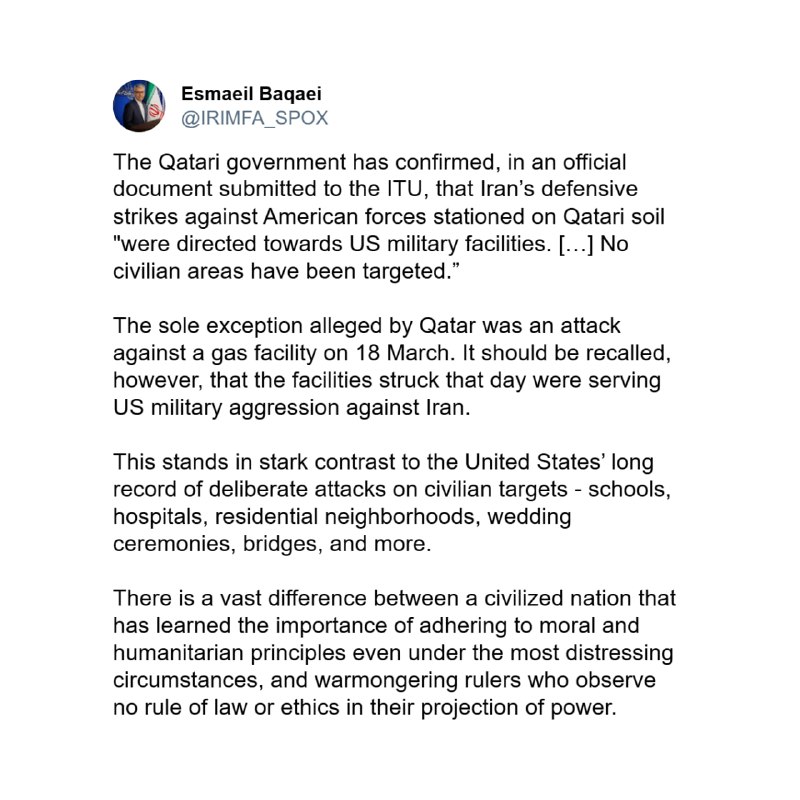
By 12:24 UTC on 11 June 2026, the diplomatic scaffolding around the US-Iran ceasefire was visibly buckling. Middle East Eye reported that the two sides were trading strikes, with the arrangement that had held since late spring now under "renewed strain". Ten minutes earlier, Al Jazeera English's global channel had circulated US Navy footage of a warship firing missiles in what it described as strikes on Iran — a public release, not a leak, and therefore a deliberate signal from the Pentagon about both capability and intent. On Polymarket, the implied probability that a US-Iran ceasefire would actually be agreed this month had drifted down to 33%, a figure the prediction market had posted on X at 21:41 UTC the previous evening. And by 19:41 UTC on 10 June, Iran's authorities had told the Financial Times that roughly 20,000 people were without water after US strikes hit reservoir tanks — a civilian-utility claim that, if substantiated, changes the political arithmetic on every side.
The picture is no longer one of two governments edging towards a deal and a handful of spoilers trying to wreck it. It is a picture of an active, kinetic phase that has resumed inside a nominally live ceasefire, with both sides now competing to define the optics — and with the market pricing in a non-trivial chance that the diplomatic track collapses entirely. The structural question is no longer whether the US and Iran can land an agreement; it is whether the agreement that exists on paper can survive the violence that is happening in its name.
What the footage, and the numbers, actually show
The most concrete piece of evidence on 11 June is visual. Al Jazeera English's channel posted video of a US warship firing missiles, framed as strikes on Iran. The release is unusually direct: navies do not typically circulate combat footage in the middle of a declared ceasefire unless they want the adversary, and the wider audience, to see the cost of escalation. Read alongside the Middle East Eye report of renewed strikes, the footage is best understood as a public confirmation of an action that the other side is already complaining about, rather than as a reveal of something new.
The civilian-utility dimension is harder, and more politically consequential. Iran's account — that US strikes hit reservoir tanks and left around 20,000 people without water — was carried by the Financial Times on 10 June and amplified via X. Two things follow. First, if the reservoirs were dual-use infrastructure feeding both military and civilian demand, the strike is defensible under the looser reading of the law of armed conflict and politically toxic in the Gulf and beyond. Second, if the reservoirs were purely civilian, the framing collapses quickly: striking water storage in a country already under severe water stress is the kind of incident that even sympathetic governments find difficult to defend. The source items do not resolve that distinction. They record the Iranian claim and the FT's reporting of it; they do not record an independent US acknowledgement of what was hit or why.
The Polymarket line — 33% for a ceasefire this month — is the single cleanest piece of evidence about how the diplomatic track is being priced by people putting money on the outcome. It is not a poll. It is a continuously updated implied probability drawn from order flow on a regulated US prediction market. A reading in the low-thirties after several weeks of public negotiations is a meaningful downgrade: it implies the market believes the path to an agreement is still real, but is no longer the base case.
The counter-narrative: a managed escalation, not a collapse
The dominant reading in much of the Western press, and in much of the cable-news cycle that follows it, is that the ceasefire is "under strain" — language that implies a process that is wobbling but still moving. There is a plausible alternative read. A ceasefire under which both sides keep striking, both sides keep signalling, and both sides keep talking is not necessarily a ceasefire in trouble. It can be a managed escalation: a posture in which each side preserves the option of returning to a negotiation that has not actually produced a deal, while continuing to shape the battlefield and the information environment in ways that strengthen its hand when — or if — talks resume.
This reading fits the pattern. The US releases warship footage, which costs nothing diplomatically and signals resolve. Iran leaks the water-story through a Western paper, which costs the US soft power and reminds Gulf audiences that the strike campaign has a civilian tail. Neither side has walked away from the table. Neither side has declared the ceasefire formally dead. Polymarket, for its part, is pricing in continued uncertainty, not collapse: a 33% line is the market's view that the deal is roughly twice as likely to fail as to land this month, with the remainder sitting in a wide range of "delayed, partial, or redefined" outcomes that the contract does not cleanly separate.
The reason the dominant framing still holds, despite the appeal of the managed-escalation read, is that managed escalation has a half-life. The longer kinetic action continues inside a declared ceasefire, the more each strike generates a domestic constituency on the other side that wants retaliation, and the less either government can credibly claim it is in control of its own operations. The footage, the water claim, and the falling market line are all consistent with a process that is, at best, still moving — but moving on a slope that is steeper than it was a week ago.
The structural frame: why optics now matter more than the deal
Strip the diplomatic theatre away and what is happening is a contest over the frame in which a US-Iran settlement, if it comes, will be received. A deal struck from a position of continued US kinetic pressure looks different — domestically in Iran, in the Gulf, in Washington — than a deal struck from a position in which the strikes are held in reserve. Each leaked story, each piece of released footage, is a small down-payment on the story the relevant side wants to be the one that is told when the agreement is announced or, more likely, when it is not.
This is the dynamic the prediction market is, in its blunt way, capturing. Polymarket does not read the FT or watch Al Jazeera; it reads order flow. The fact that the implied probability has settled in the low-thirties suggests that the people willing to risk money believe the framing war is now the main event, and that the actual text of a deal — if one emerges — will be a downstream consequence of who wins it. That is a different mental model from the one most cable-news panels are operating with, which still tends to treat the strike-and-talks sequence as a series of tactical moves around a fixed diplomatic table.
It is also a model in which the Global South reads the optics differently from the Western wire consensus. Iranian state-aligned messaging, where it has been visible, frames the reservoir strike as a deliberate act of economic warfare against a population already under water stress — a story that lands hard in audiences that have lived through sanctions architectures and infrastructure attacks of their own. The Western framing, where it has been visible, tends to treat the reservoir hit as an operational question about target legitimacy, to be resolved by lawyers and spokespeople. Both frames are doing real political work. Neither has yet won.
What is actually contested
The evidentiary record on 11 June is thinner than the rhetorical record. The Middle East Eye report records the existence of "renewed strain" and a trade of strikes; it does not specify targets, timing within the day, or which side initiated the latest round. The Al Jazeera English footage shows a warship firing missiles, presented as strikes on Iran; it does not show the impact, the target set, or the operational context. The FT report on the reservoir hit, relayed via X, carries the Iranian government's account and not a US acknowledgement; the location of the reservoir and its dual-use status are not in the source items. Polymarket's 33% line is precise but blunt — it is a single probability, not a decomposition into scenarios.
The honest summary is that something kinetic is happening, that both sides are claiming the other is responsible for breaking the spirit of the arrangement, and that the prediction market is roughly twice as bearish on a deal this month as it is bullish. What the sources do not yet support is a confident read on whether the ceasefire will hold in some degraded form for weeks, collapse in days, or be quietly replaced by a new framework in which the strikes are described differently. The next 72 hours of reporting from Western wires, Iranian state media, and the prediction-market order book will narrow that uncertainty. They have not narrowed it yet.
Stakes
If the ceasefire holds in some form, the most likely outcome is a deal that both sides can describe as a win — narrower in scope than the maximalist positions each side started with, and priced in advance by markets as roughly a coin-flip rather than a base case. The US gets a managed nuclear-and-missile file; Iran gets sanctions relief that the Gulf and the Global South read as vindication of patient negotiation; the prediction market re-prices upwards.
If the ceasefire collapses, the trajectory is more familiar. Strikes on reservoir infrastructure harden Iranian domestic opinion against any deal that includes normalisation with Washington. The Gulf and the wider Global South, already sceptical of US-led frameworks after years of Gaza and Lebanon coverage, read the reservoir strike as confirmation that the US will use humanitarian pressure as a tool even inside a declared truce. The diplomatic track freezes, possibly for the remainder of 2026, and the next round of talks is delayed into a US electoral cycle in which the costs of military action and the costs of negotiation are being re-priced simultaneously.
The Polymarket line, in that sense, is not just a number. It is a leading indicator of which of those two futures the people with money on the outcome currently consider more likely. On the evidence available at 12:24 UTC on 11 June 2026, neither future is the base case — but the trajectory is, for the moment, tilting against the diplomatic one.
This article tracks the optics war as much as the strike count, on the working assumption that a US-Iran deal in 2026 will be made or broken in the framing before it is made or broken at the table.
Wire provenance
This editorial synthesis draws on the following public wire/social posts:
- https://t.me/aljazeeraglobal
- https://x.com/unusual_whales/status/example
- https://en.wikipedia.org/wiki/Joint_Comprehensive_Plan_of_Action
- https://en.wikipedia.org/wiki/2025%E2%80%932026_US%E2%80%93Iran_crisis
Follow the event.
These dated source records provide context. They do not retrospectively verify this archive article.
Separate what the nuclear watchdog reported from what it could not determine after the June 2025 strikes.