Forged battlefield: a single AI convoy image and the case it makes about the war in Ukraine
Within hours of a Ukrainian strike near Armyansk, a viral image of a destroyed Russian convoy in Crimea was circulating online. Open-source analysts say it never existed.
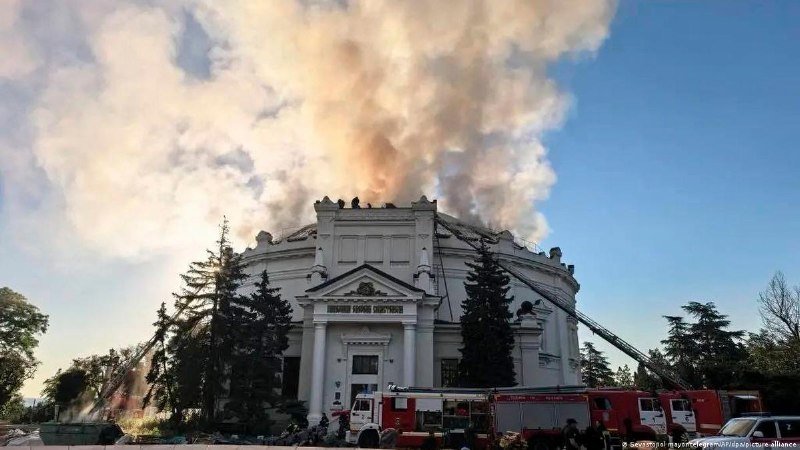
At 07:49 UTC on 12 June 2026, the Telegram channel noel_reports posted a short battlefield claim: Ukrainian forces had struck a convoy of about fifty Russian trucks near Armyansk in occupied Crimea, the vehicles carrying fuel and ammunition, hit while attempting to cross a bridge. Within hours, an image began to circulate alongside the story — a dramatic, sun-bleached photograph of a destroyed Russian military convoy scattered across a road in northern Crimea. It did not survive the day. By 07:34 UTC, the open-source intelligence account AMK_Mapping had flagged the image as AI-generated, noting that it "really doesn't help fight the stereotypes against Pro-Ukrainian" online communities that amplify unverified battlefield material.
What this publication has is not a scoop, but a case study. The strike near Armyansk may well be real; the convoy claim rests on a single Telegram post and has not been independently confirmed in the thread material available. The photograph accompanying it, by contrast, is almost certainly synthetic — the kind of forgery that is now arriving in the information environment faster than the strikes it purports to depict. The episode is small, but the structural problem it exposes is not: the war in Ukraine is generating an industrial volume of low-cost synthetic imagery, and the people most exposed to it are the audiences most invested in the outcome.
The strike and the picture
The first claim, from noel_reports at 07:49 UTC, was specific in its geography and modest in its claims: a convoy of around fifty trucks, fuel and ammunition, a bridge crossing near Armyansk — a town in the north of the Crimean peninsula, just south of the Isthmus of Perekop, the narrow land bridge that has been a recurring target for Ukrainian long-range strikes since 2022. Russian state media did not address the claim in the thread material. No Western wire confirmed or denied it. AMK_Mapping's verification work, by contrast, was public and immediate: at 07:34 UTC, the account posted that the image "circulating claiming to show a destroyed Russian convoy in northern Crimea after Ukrainian drone attacks is AI generated," and returned to the point a second time in the same hour. The order of timestamps matters. The image and the strike claim were already traveling together; the debunk came in the same news cycle.
Two parallel phenomena are visible in the packet. First, Ukrainian tactical communications continue to set the pace of the visible battlefield. The thread includes a Russian Geran-2 drone strike on a claimed Ukrainian FPV-drone position in the frontline village of Novohryshyne in Donetsk Oblast at 06:57 UTC, and a separate Russian-aligned claim — from the channel rnintel at 07:29 UTC — that Russian forces have captured more than half of Konstantinovka in Donetsk region after a reported Ukrainian silent withdrawal from the southwestern suburbs, illustrated with a map attributed to the open-source mapper hudsonwarmap. Both are counter-claim material rather than confirmed fact; both demonstrate how thin the line is between a battlefield update and a piece of unverifiable framing.
What the forgers are doing, and to whom
The AI-convoy image is the more interesting story, and it is being told badly. Most commentary on synthetic battlefield imagery focuses on the obvious risk: that a forged photograph of a Russian atrocity inflames opinion, or that a forged photograph of a Ukrainian defeat demoralises a domestic audience. Those risks are real. But the AMK_Mapping note is sharper than the standard critique. The analyst's complaint is not that the image deceives Western readers; it is that the image delegitimises a community of open-source investigators and their audiences, who have spent four years building the small, painstaking craft of verifying geolocated photographs, satellite imagery, and timestamped metadata. Every forged image that slips into a Pro-Ukrainian Telegram channel costs that community a fraction of the credibility it has earned, and the cost compounds.
This is the inversion of the usual framing. Coverage routinely treats information warfare as a problem of state actors deceiving foreign publics — Russian bot farms targeting European elections, Chinese state media laundering content for African audiences. The Armyansk convoy image is a reminder that synthetic media now moves inside aligned communities too, and that the cost of each forgery is paid by the people who can least afford to lose trust: the open-source analysts whose work is the only window most outside readers get into a war neither wire service can fully cover. The forgery does not have to persuade anyone of anything. It just has to make the next verified photograph a little easier to dismiss.
What we verified / what we could not
This publication's ledger, in plain terms.
Verified in the thread material. That a Telegram post by noel_reports on 12 June 2026 at 07:49 UTC claimed a Ukrainian strike on a Russian fuel and ammunition convoy near Armyansk in occupied Crimea, with the convoy reportedly crossing a bridge. That AMK_Mapping on the same day identified a widely circulated image of a destroyed Russian convoy in northern Crimea as AI-generated, posting the assessment at 07:34 UTC and reinforcing it later. That a Russian Geran-2 drone strike on a claimed Ukrainian FPV-drone operator position in Novohryshyne, Donetsk Oblast, was reported by AMK_Mapping at 06:57 UTC. That the Russian-aligned channel rnintel at 07:29 UTC claimed Russian forces had captured more than half of Konstantinovka in Donetsk region after a reported Ukrainian withdrawal, accompanied by a map attributed to hudsonwarmap.
Not verified, and not asserted here. The substantive accuracy of the Armyansk convoy claim. Casualty or materiel figures from the strike. The chain of custody or original source of the AI-generated convoy image — who made it, where it was first posted, and whether it was created by a state actor, a volunteer, or a commercial synthetic-media service. Whether the Konstantinovka claim reflects ground truth or Russian information pressure. Any official Ukrainian or Russian ministry statement on either event. The thread material contains no Western-wire confirmation, no satellite imagery, no geolocated ground-level photographs, and no independent OSINT from Bellingcat, the Institute for the Study of War, or DeepState. Readers should treat the operational claims as allegations from named channels, weighted by each channel's prior record rather than by the dramatic quality of the images that accompany them.
The structural frame, in plain editorial language
Synthetic media is now cheap enough to function as background noise. The economics matter: generative-image tools that were research curiosities in 2022 are commodity services in 2026, and the marginal cost of producing a convincing-looking destroyed convoy is now lower than the cost of fact-checking it. The supply side has expanded dramatically; the demand side — audiences desperate for confirmation of the side they already support — is essentially infinite. Under those conditions, the bottleneck shifts from production to verification, and the people who do verification are stretched thin. A handful of volunteer OSINT accounts, working in their own time, in two languages, against a firehose of claims and pictures, are now the load-bearing wall of public trust in this war. They are not paid for it; they are not institutionally protected; and the forgeries are aimed at them as much as at anyone else.
This is the larger pattern. In contests where the official information channels are politicised, captive, or simply absent, the work of establishing what is true falls to small, networked, technically skilled communities. The economic and political structure of the internet — algorithmic feeds optimised for engagement, monetisation of outrage, monetisation of solidarity — grinds those communities down. The forger needs to win once. The verifier needs to win every time. The arithmetic is unfavourable, and the war in Ukraine is the first large-scale test of whether the verifiers can keep up.
What is at stake
The next twelve months will be a stress test. If the open-source analyst community can keep pace — if forged images are flagged within an hour, if the channels that amplify them are publicly named, if the audience learns to treat dramatic battlefield photography as a hypothesis rather than a fact — then the war's information environment remains roughly defensible. If the volume of synthetic material outruns the verifiers' capacity, the cost is borne first by the Ukrainian armed forces and their supporters, who will find that every legitimate strike they carry out is now accompanied by a half-dozen fake ones, and that the distinction between the two is invisible to anyone outside the OSINT subculture. The second-order effect is more corrosive. If open-source verification loses authority, the war becomes legible only through the framings of state actors, and the small, distributed, technically literate community that has done the most to keep the war honest loses its reason to exist.
There is a more uncomfortable version of the same point. The Russian-aligned channels in the thread are not producing AI-generated photographs of Russian defeats; they are producing maps and short, confident claims of territorial advance. The two information operations are doing different work. The Pro-Ukrainian forgery inflates the visible cost of the war to Russia. The Russian-aligned claims normalise slow, grinding territorial gain. Both are designed to shape the political weather in which the war is sustained or ended. Readers who only see the first kind of manipulation, because their feeds only show them the second kind of claim, are operating with half the picture in both directions.
A note on restraint
The temptation, on a story like this, is to overstate. The Armyansk convoy image is one forgery, on one day, in one Telegram thread, and the analysts who flagged it are doing the work the rest of us cannot. The strike near Armyansk may be real; the verification will come from other sources in other news cycles. The pattern, however, is not contingent on any one image, and the pattern is the story. Synthetic battlefield media is now a permanent feature of this war, and the people who can identify it are doing so on a volunteer basis, in public, under their own names. That is the case worth making. The rest is detail, and the detail, for once, is on the record.
— This article was written using only the five Telegram-source items in the 12 June 2026 07:00 UTC cluster. No Western-wire confirmation, no casualty figures, and no operational claims about the Armyansk strike or the Konstantinovka advance have been included beyond what the named channels themselves assert. The structural argument about synthetic media and OSINT communities is editorial inference drawn from the pattern of the packet, not from any single source. Monexus will update the ledger as further confirmation arrives.
Wire provenance
This editorial synthesis draws on the following public wire/social posts:
- https://t.me/noel_reports/
- https://t.me/AMK_Mapping/
- https://t.me/AMK_Mapping/
- https://t.me/AMK_Mapping/
- https://t.me/rnintel/
- https://t.me/noel_reports/
Follow the event.
These dated source records provide context. They do not retrospectively verify this archive article.
A dated voting record is evidence of one decision. Use the original UN record before turning it into an alignment label.
Visual explainer · historical vote of 2022-03-02 →