Gasly's Monaco podium restored after FIA admits pit-lane timing error — and the appeal fight is just starting
Formula One's governing body has reversed the two penalties that demoted Pierre Gasly from third to seventh in Monaco, conceding its timekeeping equipment was wrong. McLaren and Red Bull say they will appeal the reinstatement anyway.
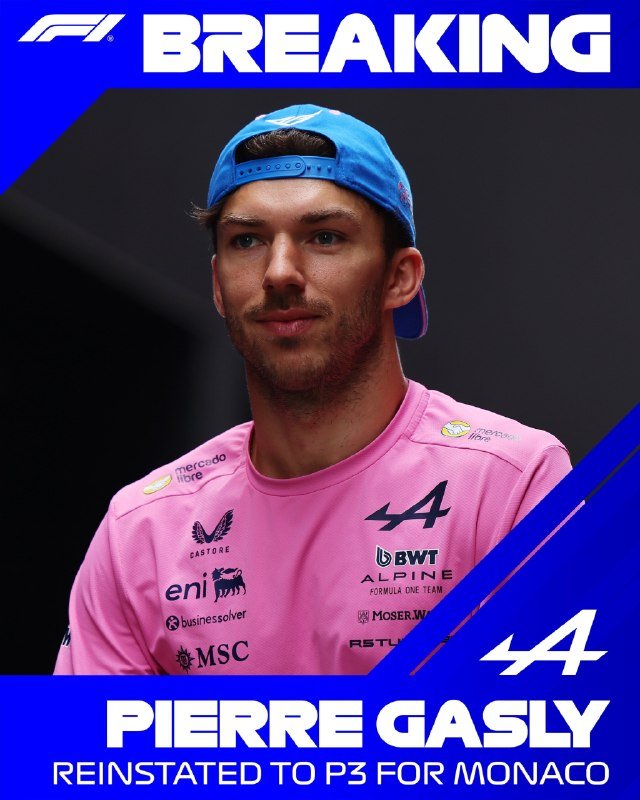
Formula One's governing body conceded on 12 June 2026 that it had measured Pierre Gasly's car incorrectly at the Monaco Grand Prix, reversing the two pit-lane speeding penalties that had demoted the Alpine driver from third place to seventh and reopening a result that the sport's smallest principality had briefly declared settled. The admission lands with weight because Monaco does not produce close finishes — overtaking is essentially impossible on the 3.337-kilometre street circuit — so the steward's verdict, more than at almost any other round, defines who leaves with silverware.
The reversal, confirmed by the FIA stewards in the hours after Alpine's appeal, is not the end of the affair. According to Sky Sports, McLaren and Red Bull have lodged their intention to appeal the reinstatement itself, arguing that a procedural error on the regulator's part should not retroactively alter a race result that competitors and the public had already absorbed. Mercedes, per the same report, is still weighing its options. A second procedural fight is now sitting on top of the first.
What the FIA actually admitted
The original penalties, issued in the immediate aftermath of Sunday's race, were triggered by the FIA's loop-based pit-lane speed detection system, which registered Gasly's Alpine as exceeding the 80 km/h limit during his sole pit stop. Two infractions, two separate time penalties, and the loss of four championship points and one podium position. The driver, the team, and a large slice of the paddock said the data did not match the on-board telemetry.
According to the BBC's 12 June 2026 report, the stewards rescinded both penalties after reviewing evidence that the FIA's own timing loop had malfunctioned. The Guardian's motorsport outlet was first to confirm the framing used by the governing body in its short statement: the system was at fault, not the driver. That distinction is procedural rather than sporting — the rules require the stewards to rule on what the loop measured, and the loop's inaccuracy is treated as a fact about the world, not as a discretionary judgment call. Reversal followed automatically once the unreliability was conceded.
Why the rivals are still angry
If the rules produced this outcome, the rules also produced the original one. That is the core of McLaren and Red Bull's grievance, and it is not a frivolous one. A race result in Monaco does not get re-run; it gets re-written. Every team that finished behind Gasly's original seventh place — including, by the reckoning of the constructors' standings, McLaren and Red Bull cars that would have inherited the podium positions — had already begun their post-race media and engineering cycles working from the published classification. Television graphics, FIA documents distributed to teams, and the official championship sheet all reflected a demoted Gasly for the better part of a week.
Monaco's results, in practice, often outlast the race weekend itself. The street circuit is rare in producing what the paddock calls a "procession" — the narrow track, the absence of meaningful straights, and the modern generation of ground-effect cars all conspire to make position changes at the front exceptionally hard. That structural feature gives the steward's room unusually high leverage: a single time penalty in Monaco moves a car three, four, sometimes five positions, where at Barcelona or Silverstone it might cost a single place. The rivals' appeal, in that sense, is not just about this result — it is about who bears the cost when the regulator's own equipment fails.
The structural question underneath
The episode has put a working spotlight on how the FIA's officiating layer interfaces with the digital systems that have come to define modern race control. Loop-based speed detection, marshalled flag signals, and the timing screens that the television feed consumes are not neutral infrastructure — they are the rules, in operational form. When the equipment malfunctions, there is no neutral ground to fall back to. The stewards can only choose between two imperfect options: accept the loop's reading and penalise a driver the telemetry suggests was compliant, or accept the team's telemetry and unsettle the entire result that competitors raced on.
The FIA chose the second option. That is the right call on the specific facts, given that the regulator itself has acknowledged the error. But the choice also illustrates a quieter problem: there is no clean doctrine in the regulations for whose evidence prevails when the official system is the one in dispute. Alpine's appeal succeeded partly because the FIA was willing to say it had been wrong, not because there is a tidy rule saying what happens next. The same evidence package, before a different stewards' panel, might have produced a different outcome.
What is unresolved
The appeal from McLaren and Red Bull is the immediate open question. The two teams' argument — that a procedural correction should not be applied retroactively to a result that has already been acted on — is consistent with how sporting bodies elsewhere treat such cases, where competitions are typically settled by what was written down at the time, and corrections to the record are kept administrative rather than competitive. Whether the FIA's International Court of Appeal takes that view, or treats the regulator's concession as binding, will not be known for several weeks.
Two further things are worth keeping in mind. First, the sources do not specify the exact margin by which Gasly allegedly exceeded the 80 km/h limit — a number that, if the malfunctioning loop had been producing a small over-read, would be materially different from one where the loop was registering a non-existent offence. Second, the wider championship consequences are not yet clear. The point swing from Gasly's restored third place is small; the precedent the appeal sets could be considerably larger than its arithmetic.
For now, the trophy cabinet has been reopened. Whether it stays that way depends on a procedural fight that has, in effect, just begun.
— How Monexus framed this: the wire outlets led on the FIA's admission and the sporting consequences; we have placed equal weight on the rival teams' procedural challenge, which several reports noted in passing but did not treat as the live issue. The structural question — whose evidence prevails when the regulator's own equipment is the disputed instrument — is the one that will outlast the podium itself.