Haiti's World Cup jersey, FIFA's political-symbol rule, and the limits of a pink-booth spectacle
Two days from the World Cup's opening match, FIFA has forced Haiti to redesign a jersey that depicted a 19th-century anti-colonial battle. The dispute exposes the federational politics of symbolic space, and comes wrapped in a tournament whose soft-power choreography is already visible in a different colour: pink.
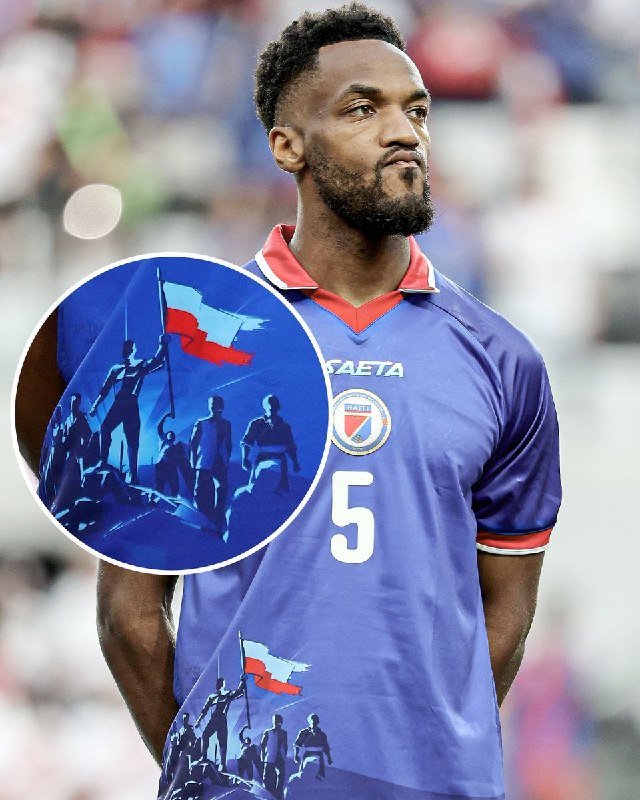
Haiti's men's national team will take the field at the 2026 World Cup in a kit that is not the one its federation originally wanted. On 11 June 2026, FIFA confirmed it had blocked the original jersey because it contained imagery of the 1803 Battle of Vertières, the final engagement of the Haitian War of Independence — the only successful large-scale slave revolt in modern history, and the founding act of the first independent Black republic. The design, FIFA judged, breached its rules on political symbols. Haiti must produce an alternative by the time its first group game kicks off at the tournament in the United States, Canada and Mexico.
The ruling, reported simultaneously by The Athletic and FIFA's own communications channels, lands at an awkward moment for the federation. The World Cup is sold to the world as a parade of national identity, yet the federation's statutes reserve the right to police which parts of that identity are allowed on the shirt. Haiti is being asked, in effect, to celebrate itself less.
What the design said, and what FIFA's statutes say it cannot
The 1803 Battle of Vertières is the symbolic terminus of the Haitian Revolution. The defeat of French forces at Vertières, near Cap-Haïtien, cleared the way for the Declaration of Independence at Gonaïves on 1 January 1804. Any depiction of that moment is, in Haitian public memory, a civic emblem on the order of a flag, not a political slogan in the sense FIFA's regulations target.
FIFA's kit regulations bar symbols or statements of a "political, religious or personal nature." The rule is broad on paper; its application has historically been inconsistent. The federation has previously allowed the Iranian national team to display symbols tied to the country's official state identity, and has tolerated the Palestinian keffiyeh motif on certain North African federation releases. The variance suggests the rule is enforced less as a neutral standard than as a discretionary screen, with the federation reserving for itself the final read on what counts as political in any given fixture.
For Haiti, the timing is consequential. The squad's presence in the World Cup is itself a qualification success worth marking, and the men's senior team is the only Caribbean representative at this edition. The federation had treated the kit as part of that statement. FIFA has now forced a redesign inside a narrow window, on a lead-in in which national teams are already finalising apparel deals, manufacturing runs, and the merchandising inventory that funds the federation's grass-roots programmes.
The counter-read: rules are rules, and the symbol is a weapon
The standard institutional defence of FIFA's decision is procedural, not thematic. Kit regulations must apply uniformly; if a federation wishes to commemorate a historical event, the federation's design window is the in-stadium ceremony, the press conference backdrop, and the social media apparatus, not the playing strip that the federation's own commercial partners have an interest in keeping clean of contestable iconography.
The harder read sits underneath that one. National symbols are also a state-relations problem. A federation hosting games under the political oversight of governments that have withheld or restored recognition of the Haitian state over the past two decades has an interest in not placing any one federation's most charged iconography in front of cameras broadcasting across 211 member associations. That calculation is structural, not editorial; it does not require FIFA to be hostile to Haiti. It does require FIFA to prefer the path of least friction.
The plausible counter-narrative is that the federation should have known better than to submit a design that would be flagged, and that a less provocative composition could have honoured the same historical moment without the disputed element. Haitian football supporters, on the available record, do not accept that framing. The federation had, in their telling, designed a kit around the only national origin story available to it.
A tournament whose soft-power choreography is already visible — in pink
The kit dispute is unfolding inside a tournament whose visual order has already been set by an entirely different kind of design decision. As BBC Sport reported on 11 June 2026, the opening match was dominated by players wearing pink boots, a colour that has become a near-default for elite-level forwards over the past two seasons. The reason is commercial: boot manufacturers can produce small runs of a high-visibility colour that does not have to match a team's primary kit, and the resulting photos are the most circulated inventory of the match.
The contrast is not a digression. One design decision — the colour of the boot — is left to the market, to the player, to the manufacturer, and to the photo desk. The other — the emblem on the chest — is regulated by the federation. The boot gets a free field. The flag does not.
Stakes, and what remains unclear
For Haiti, the near-term stakes are concrete: a redesigned kit must be produced, photographed, shipped to the United States, and worn in time for a group-stage game. A federation with constrained resources is now absorbing the cost of a process it believed it had already completed. For FIFA, the stakes are precedential. A federation that publicly overrides a member association's chosen national-symbol reading invites the question of where the line sits, and which associations get the benefit of doubt. The federation's own statutes allow political symbols in specific cases; the Haitian case will now sit in the precedents folder for the next federation that tries to commemorate a contested history on the front of its shirt.
The reporting on 11 June 2026 does not yet record FIFA's full reasoning letter, the identity of the panel that reviewed the Haitian submission, or the specific clause under which the design was rejected. The sources do not specify whether the Haitian Football Federation intends to appeal, nor whether the redesign will retain any reference to Vertières in a less explicit form. Those are the questions that will define whether this episode is closed by the opening whistle, or whether it carries into the rest of the tournament.
Desk note: Monexus frames the Haitian kit dispute inside the federation's own governance record rather than as a stand-alone cultural grievance. The pink-boot story sits beside it as a useful control case: a design decision the federation chose not to police.
Wire provenance
This editorial synthesis draws on the following public wire/social posts:
- https://t.me/Olympics
- https://t.me/FIFAcom
- https://t.me/TheAthletic