Hockney at 88, still finding new surfaces: the artist's half-century flirtation with consumer technology
From photocopiers in the 1960s to a 2025 Royal Academy retrospective, David Hockney has spent fifty years treating everyday machines as collaborators rather than threats. The lesson is bigger than one artist.
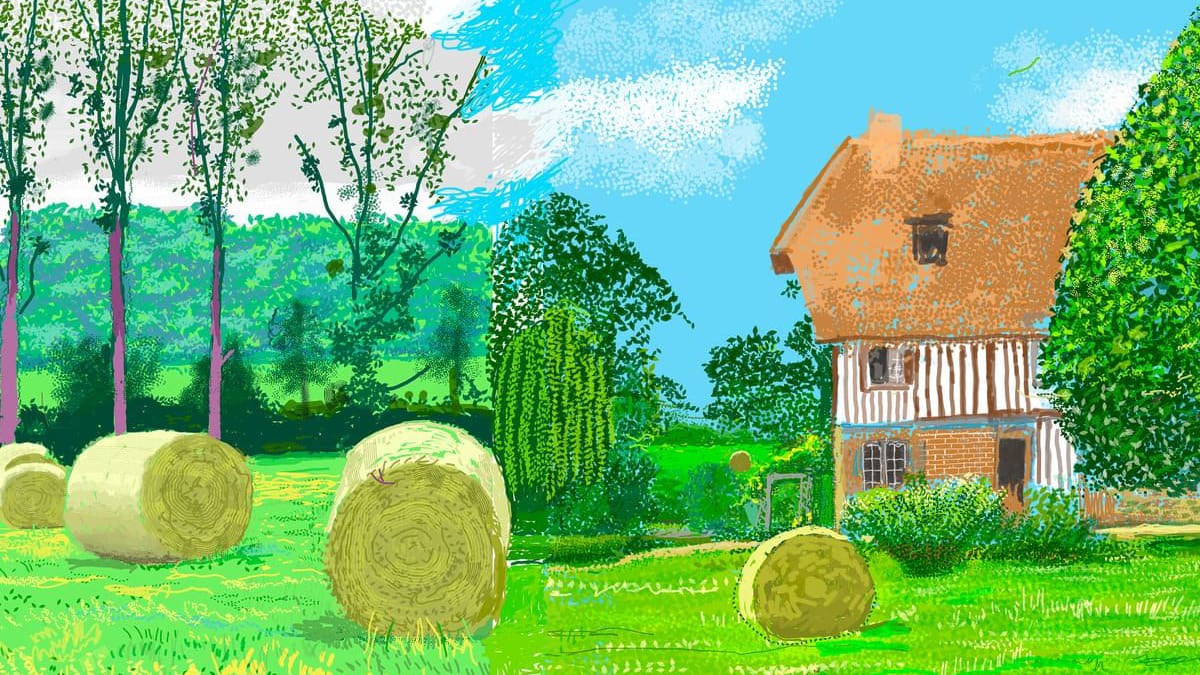
At the Fondation Louis Vuitton in Paris and the Royal Academy of Arts in London, the curators who organised David Hockney's 2025 retrospective faced an unusual curatorial problem: how do you hang paintings next to faxes, photocopiers and iPhone drawings without making the gallery feel like an Apple Store? Their solution, in effect, was to admit that Hockney has been treating the question itself as the subject of his work for at least five decades. The 88-year-old Bradford-born artist arrived in Los Angeles in 1964 and has never quite stopped picking up new machines.
The thread running through the recent coverage is not novelty for its own sake. Hockney's early photocopier experiments, his fax drawings of the 1980s, his Polaroid joiners and his iPad and iPhone blooms are best read as a sustained argument about what a picture can be — and who gets to decide. The argument is more pointed now than it was in 1966, when the painter first walked into a print shop and asked whether the office Xerox could be a creative tool.
A working method, not a gimmick
The New York Times's 12 June 2026 account of Hockney's technology habit emphasises continuity. The Polaroid joiners of the early 1980s — composite images built from dozens of instant-camera prints — grew directly out of his dissatisfaction with the single, frozen viewpoint of Renaissance perspective. The photocopier, taken up in 1966, allowed him to push a drawing through a machine and watch it distort. The fax, used through the late 1980s, let him send pictures across the Atlantic as quickly as he could phone.
Each device entered the studio not as a replacement for paint but as a way of asking whether paint was the only honest medium for a given problem. The joiner asked whether a single vanishing point was truthful. The fax asked whether drawing had to be a solitary act. The iPhone, in his hands since the late 2000s, asks whether a finished work has to be a finished object — most of the iPhone drawings are sent, shared, sometimes revised in transit, then allowed to drift across the gallery wall as inkjet prints.
The Royal Academy's autumn 2025 hang, which travelled to Paris, made the point structurally. Paintings from the 1960s — the splash canvases, the pool pictures — shared walls with sheets of paper that had been put through a Canon office copier. Visitors who arrived knowing Hockney only as a painter left recognising him as something more like a one-man research lab into the materials of looking.
The counter-narrative: technique as content?
The obvious objection from the academic wing of the art world is that Hockney's technology pieces are precisely that — pieces, in the sense of curiosities — and that the real work, the swimming pools and the double portraits, is on canvas. There is something to this. The 1971 Portrait of an Artist (Pool with Two Figures) sold at Christie's New York in 2018 for $90.3 million, then a record for a living artist. Nothing in the photocopier room has approached that gravity, and probably never will.
But Hockney's own framing pushes the other way. In interviews collected for the 2025 retrospective catalogue, he argues that the technology works are not warm-ups for the paintings but tests of the same hypothesis from a different instrument. If a photocopier can reveal something a brush cannot about how a hand moves, then the brush and the copier are colleagues rather than rivals. The point is not that machines replace painters. It is that painters who refuse to touch machines are working with one hand behind their back.
The most generous reading, which the Fondation Louis Vuitton wall texts lean toward, is that the technology works are also an argument about artistic labour in a digital age. Hockney did not, in 1980, buy a computer and call it a studio. He bought a Polaroid camera, used it the way he used a brush, and produced work that was unmistakably his. Half a century later, when every artist with a stylus and a subscription is producing algorithmically smoothed images, the discipline of working with a machine rather than through it looks more like a manifesto than a hobby.
What the work is actually saying
Strip the romance away and three propositions emerge from the recent surveys. First, that the camera — whether Polaroid, photocopier or iPhone — is not a neutral recording device but a tool with a point of view, and a serious artist can argue with that point of view rather than surrender to it. Second, that the distance between a sketch and a finished work is shorter than the art world has been willing to admit, and that sending a drawing by fax in 1985 or by iMessage in 2015 changes the drawing less than the academy thinks. Third, that the market's preference for oil on canvas, while economically rational, is a narrowing of the definition of art that Hockney has spent a working life quietly refusing.
None of these are particularly new ideas. What is new is that an artist of Hockney's standing has lived long enough, and worked hard enough, to demonstrate them across seven decades. The 2025 retrospective is, in that sense, less a victory lap than a proof of concept. The machines came and went — the photocopier has been replaced by the phone in his hand, the Polaroid by the iPad, the fax by every messaging app ever shipped — and the argument survived all of them.
Stakes for the rest of the field
For younger artists, the Hockney example is more useful as a method than as a style. The point is not to draw on an iPhone, but to interrogate the tool you happen to be holding and ask what it can reveal that your last tool could not. The market will continue to price large canvases more highly than iPhone blooms. The museums, increasingly, will not. The Royal Academy's decision to give the technology room equal wall space with the swimming pools is a quiet institutional endorsement of the idea that the question matters more than the medium.
What remains genuinely uncertain is whether the next generation of painters will treat consumer technology as Hockney has — as raw material to be argued with — or as he fears in private, as a route to mass-produced imagery that flatters the maker without troubling the viewer. The 2025 shows cannot answer that question for them. They can only leave the equipment on the table and wait to see who picks it up next.
This piece treats the 2025 Royal Academy and Fondation Louis Vuitton retrospective as a single curatorial event. Wire coverage of the shows ran in The New York Times's arts section throughout 2025; the article cited above is a representative summary rather than a news report of a single new acquisition.